[Music] Hi, I'm Dr Sheldon Harowitz here at the National Center for Learning Disabilities. Thank you for joining us today for the next of our Ask the Expert video series. Today I would like to present a very general overview of specific learning disabilities, what they are and how to think about them in the context of other kinds of disorders.
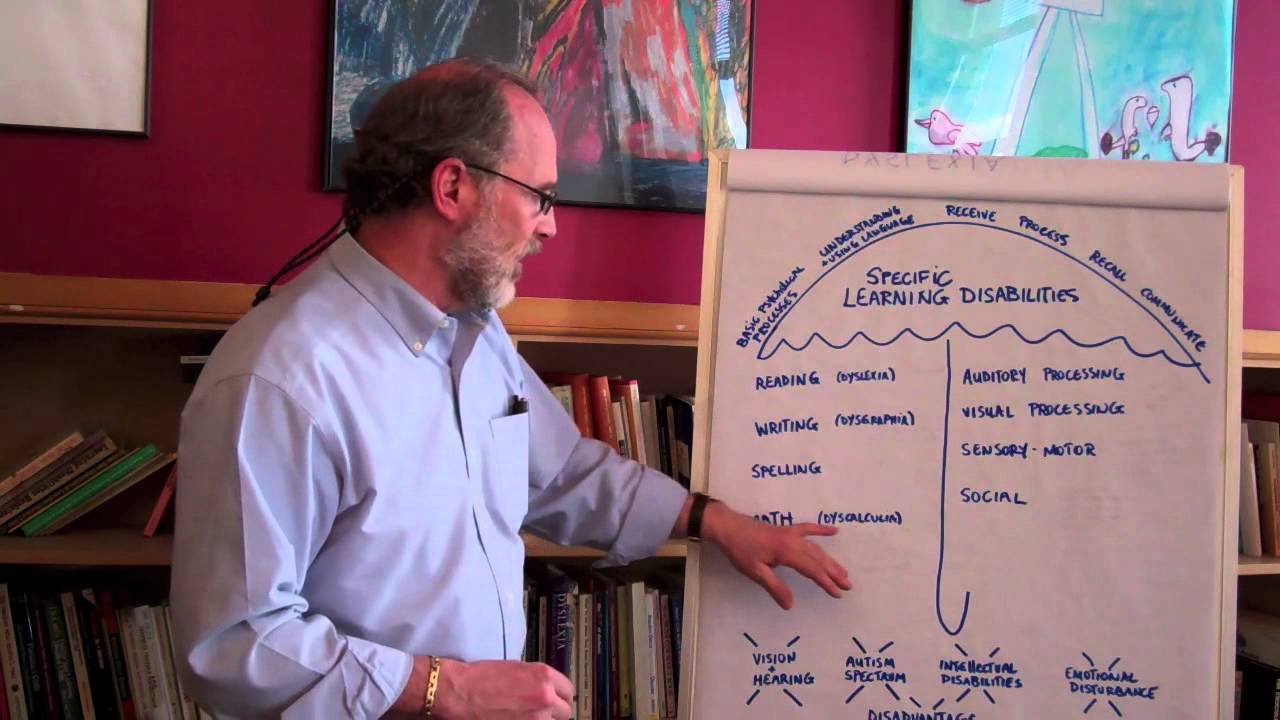
You'll see that I put specific learning disabilities inside an umbrella. And my reason for doing that is because the term specific learning disabilities, the phrase is in fact an umbrella term within which there are many different types of specific disorders. So let's unpack what we mean by specific learning disabilities in general and then talk a little bit about each of them.
Learning disabilities by definition are disorders in basic psychological processes that involve understanding and using language. And by that we mean the ability to receive, process, recall, and then communicate that information. And we do that not in a vacuum, but we do that in particular kinds of areas within the specific learning disability definition.
And under that umbrella, we're talking about certain disorders that impact reading. So, for example, a learning disability in reading is often referred to as dyslexia. And dyslexia isn't just reading words.
It's also the ability to understand what you're reading. It's also the speed and the accuracy with which you read. So, reading dyslexia, specific learning disability in reading.
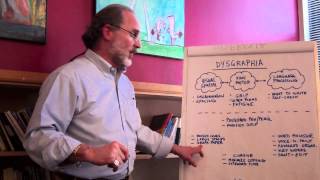
In the writing domain, a specific learning disability in writing is often referred to as disgraphia. Disgraphia could be any number of different kinds of things. It could mean different things to different people at different stages of their learning disability experience or during their lifetime.
But it's not just how they hold a pencil or how they write, but it's also how they organize themselves and plan and edit their writing. So it could be anything that falls within that writing domain, that expressive language, expressive written language domain. Spelling is also an area very much impacted by learning disabilities in reading and in writing and they're very much connected in some very important ways.
And math also a learning disabilities category is often called discalculia. and discalcua or learning disabilities in math um involves not just one thing again it's not just counting but it could involve the fluidity and flexibility of how it is that a person operates within the counting and numbers domain it could be measurement it could be estimating distances and it could be counting and making money could be understanding patterns and rules working with numbers so it could be any number of things but a learning disabilities a specific learning disability in math is referred to as discalculia. Learning disabilities are also impacted by the ways that we process information, the way we listen, the way we view things, the way we organize new information as it comes in to us in through our senses, through our ears, through our eyes, through our touch, through any number of sensory processes.
So in the auditory processing domain um there are children who have very strong preferences for example to have information presented them verbally the way I'm speaking but would have a terrible time if they were in a classroom when the teacher was just writing on the board and not talking out loud. So they would have challenges in the auditory or visual processing area depending upon how that information was presented. They would also have difficulty retrieving information that they heard, remembering and then processing and then getting that information back and then doing something with it if they were being taught in a way that wasn't consistent with the way that they preferred to process information.
Sensory motor information is important to consider in the learning disabilities domain and under that LD umbrella. Um what we mean by that is fine motor control, manual dexterity is involved as well. Eye hand coordination, children with dyspraxia often have those kinds of difficulties in sensory motor integration.
And then there's the whole area of social and emotional functioning. Um, students with specific learning disabilities are not necessarily those kinds of kids who have difficulties in the social domain, but because so many of them often miscue language, they often will say something and mean something else or they won't be able to find the right word for a situation, they could easily be ridiculed or not understood by their peers. Um, often there are some non-verbal cues that they don't pick up on.
So um they don't necessarily know when something is appropriate to say or to do. Um and those are the kinds of things that with maturity and practice can be taught to individuals with specific learning disabilities. Um self-confidence is something that's very important.
Um, if you go to school every day and you are fearful that you're going to be called on to read and reading is the one thing that you don't do really well, you're not going to really look forward to sitting in that class where the teacher may very well call on you and your sense of self, your sense of um, empowerment, your sense of confidence may very well be diminished as is the case with many children with learning disabilities. And some students with learning disabilities have difficulty with transitions, moving from one comfortable situation where they learn the rules, where they have those teacher student relationships, where they've practiced certain things and they know how to accomplish and achieve success moving to a new situation. Often those kinds of transitions are difficult for students with learning disabilities.
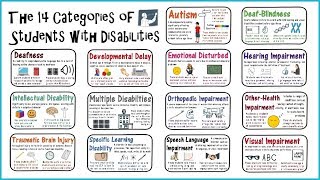
I need to also say that learning disabilities are not the result of poor vision or poor hearing. They're also not the same as children who have difficulties on the autistic spectrum. They're not the same as intellectual disabilities, the term we use formerly known as mental retardation.
they're not consistent with or the same as or interchangeable with emotional or mental health kinds of issues, emotional disturbance. Um, and very importantly, learning disabilities are not the result of disadvantage. So, for example, cultural, environmental or e economic disadvantage are not the causes of learning disabilities.
If you would like to comment on this video or if you have more information to share with us about specific learning disabilities or about anything on our website, please do so by visiting the website and by writing to us at nldn. org.