Do you want a garden that's stunning and also good for our planet? These six eco-friendly landscape ideas work in any yard, whether big or small, and they'll save you time on maintenance while making your plants healthier, too. Let's dig in.
Almost every type of landscape has some type of paving or walkway, but the typical kinds like brick, concrete, asphalt cause major problems with your storm water management. These two surface styles address the problem while looking very attractive. The issues of imperous paving in our landscape and environment is a major issue right now in design and everyone is looking for ways of putting in paving that's pvious.
There's a lot of demand for that. And the reason they want pvious paving is that it minimizes the need for big drainage basins and swailes and concrete curbs. Non-pervious or imperous paving is paving like concrete that where the water just runs off and goes into some kind of storm water system of collecting and treating water.
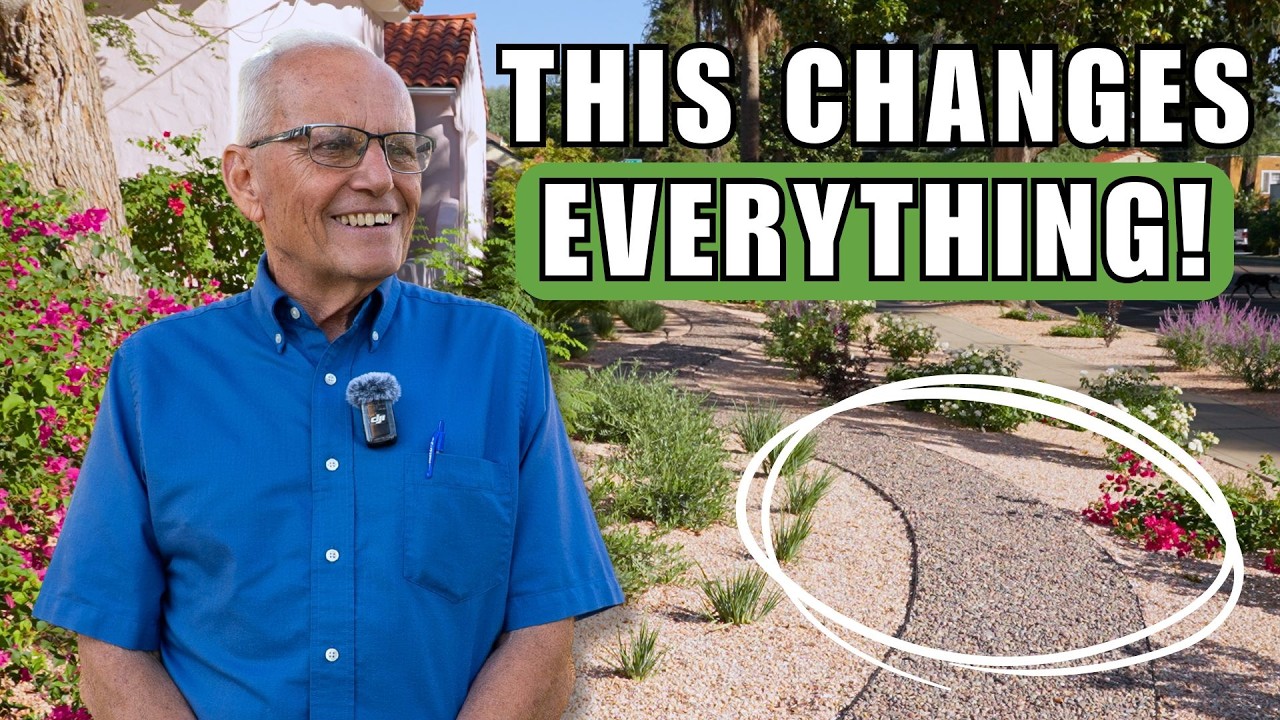
Pervious means that it'll filter right through the paving. As it's going through the paving, it mixes with microbes and these products that are pvious to actually filter the water and as it gets into the groundwater, it's clean water. One very common one that we've shown you in other videos is our simple garden paths idea where we use decomposed granite on top of base rock and then we cap it with a thin layer of like 3/8 inch rock use a vibratory compactor to press it into the DG and the result there is a pvious rock path that's very environmentally friendly.
Another way to approach that, we use this unique grout in between the flag stone called perk grout. I'm standing right now on the perk grout. Let's take a closer look.
So, it doesn't have sand in it. And because it doesn't have sand in it, it has a lot of pores in it. So, it's a rough finish, and that's necessary for it to be uh pvious.
And yet, as you can see, it's very firm and hard like concrete. Even Toby u appreciates it. If you don't believe me, let's test it with some water.
Let's see if it goes right through. Wow, look at that. This isn't even puddling.
Look at that. Just goes right through it. Another surface in landscapes and gardens are wood decks, and they actually are quite ecologically problematic.
Here's what we can use instead. Two brands of products that can be used on decks are TX and Timberline. Probably the two most popular.
95% of the product is made from recycled material. Lots of plastic bags go into the manufacturer of TX and Timberline, which is neat because you know how throwing away plastic bags is a problem. There's actually a good use for it.
And combined with wood scraps, a product is made that replaces wood. And wood obviously is a precious resource. And also wood rots.
Trex and timberline don't rot. And also wood requires refinishing or painting or sealing, which is also with a lot of products that aren't environmentally friendly. So TX is made from recycled products.
It's durable, it's strong, it lasts much longer than wood, and it doesn't require refinishing every couple of years. The next thing is a layer you can add to your garden which will completely change the way it grows in a positive way. I will tell you exactly where and how to use it.
Frequently overlooked is the importance of top dressing mulch. It's actually a mini miracle. What top dressing mulch does for your soil is protect it.
It also allows it to break down and enrich it. It also conserves moisture. And all of these things go into making it ecologically positive and an important part of growing an environmentally friendly landscape and garden.
This is not necessarily something that you can just do one time. You need to refresh it and renew it every few years. It's important in terms of the health of your soil and the health of everything you're growing in your garden.
Another big benefit of it is weed suppression. It's incredibly effective minimizing the need for any kinds of chemicals and such. And if you train your yard that way over time, you can end up with a well-trained yard that doesn't have weeds, that has healthy soil, that doesn't need a lot of water just because of the benefits of that top dress mulch.
If your plants are struggling and maybe sick, the problem might not be what you can see, but what's happening underneath. Here's what most soil is missing and how to sustainably fix it. Nothing is more important environmentally in a garden landscape than the health of your soil.
Healthy soil is determined by life in the soil. And you need beneficial bacteria, beneficial fungi, good prozzoa, good neatodes. All of those are what makes your soil not only properly feed your plants, but also make it so your plants don't get pests and diseases.
when they get pests and diseases, you usually respond with something that isn't environmentally friendly, pesticides and such, and those are at the very bottom of the list of what we want to be doing in our garden. From an environmental standpoint, another big advantage is healthy soil is a carbon sink. It doesn't work as a carbon sink if the soil isn't alive with all the beneficial microbes that we need in your landscape in order for your plants to do their best.
Also, the best way to make sure your soil has beneficial life is with products like compost and earthworm castings or are concentrated products which are formulated specifically for this purpose. We want soil that's environmentally friendly, ecologically positive, and that allows you to garden without having to use chemicals. Everyone mows their lawn, but almost nobody does it like this.
It's faster, greener, and it gives your soil and your lawn a big boost. And that's mulching mowing. Many, many mowers have that mechanism that you can do mulching mowing instead of mowing and collecting the grass and throwing it away.
This way, if you're using a mulching mower, you're fertilizing your lawn at the same time you're mowing it, you're fertilizing your soil at the same time you're mowing it. It's kind of like buying our products, except you don't have to buy anything. All you have to do is something you were going to do anyway, and that's mow your lawn, but with a mulching mower.
If you're unfamiliar with a mulching mower, what it does is it more finely cuts up the lawn so that it's like a mulch. You don't have a bag or anything. There's nothing you collect.
It cuts the uh grass up and in place as it's mowing it, it drops it right back down onto your lawn. What you're after is never cutting off more than onethird of the blade of the height of the blade. So, if you keep your lawn 3 in, you would never cut off more than 1 in.
And when you're cutting off less than 1/3 of the total length of the blade, that's much easier to mulch because this mulching mower kind of cuts it up into a product that decomposes quickly and goes back into the soil. And there's not a better way to begin on the process of building the soil in your lawn by doing mulching, mowing. Many people have irrigation systems to water their lawn and plants, but a lot of these systems are outdated, inefficient, and unreliable.
Here's how to make sure your system is environmentally and ecologically friendly. So the first thing that's a big part of an echofriendly irrigation system is to not waste water. And one of the most effective systems at doing that is a drip system that delivers water right to the plant and doesn't throw water everywhere and delivers it slowly so it can sink in and not evaporate, which is what happens when we apply a lot of water quickly.
it makes a puddle and doesn't even ever get into the soil. Secondly, we want that system to be very reliable and not break. When it breaks, it usually wastes water.
And there's ways to make sure it does that. We also want it to apply water evenly and be able to control the water so that you don't put more water than you need on the north side and at the same time you're applying it to the west side of your house. So you need to separate your valve so that you can apply it just what you need.
A mechanism to make sure that you apply water as needed. Many have come on the market recently. I like the ones connected to weather data.
So it analyzes your local weather and based on the kind of weather you're having. If it's raining, your system turns off automatically. And if it's 100°, you're watering more.
All the major manufacturers make products like that. Hunter, Rainbird, Toro. There's also products made to connect your system to soil sensors.
I'm less fond of soil sensors. To me, they're more complicated to install and to use, but it is a way to have a system that's based on need rather than you just guessing. And even if those are more than you want in your home system, just focusing on efficiently delivering the water and making a system that doesn't break and is reliable and making even watering and separating the zones that will allow you to have an environmentally friendly system.
If you would like to see one of these eco-friendly ideas in action, check out our construction of a gravel pathway. It's easier than you think and your garden will thank you.