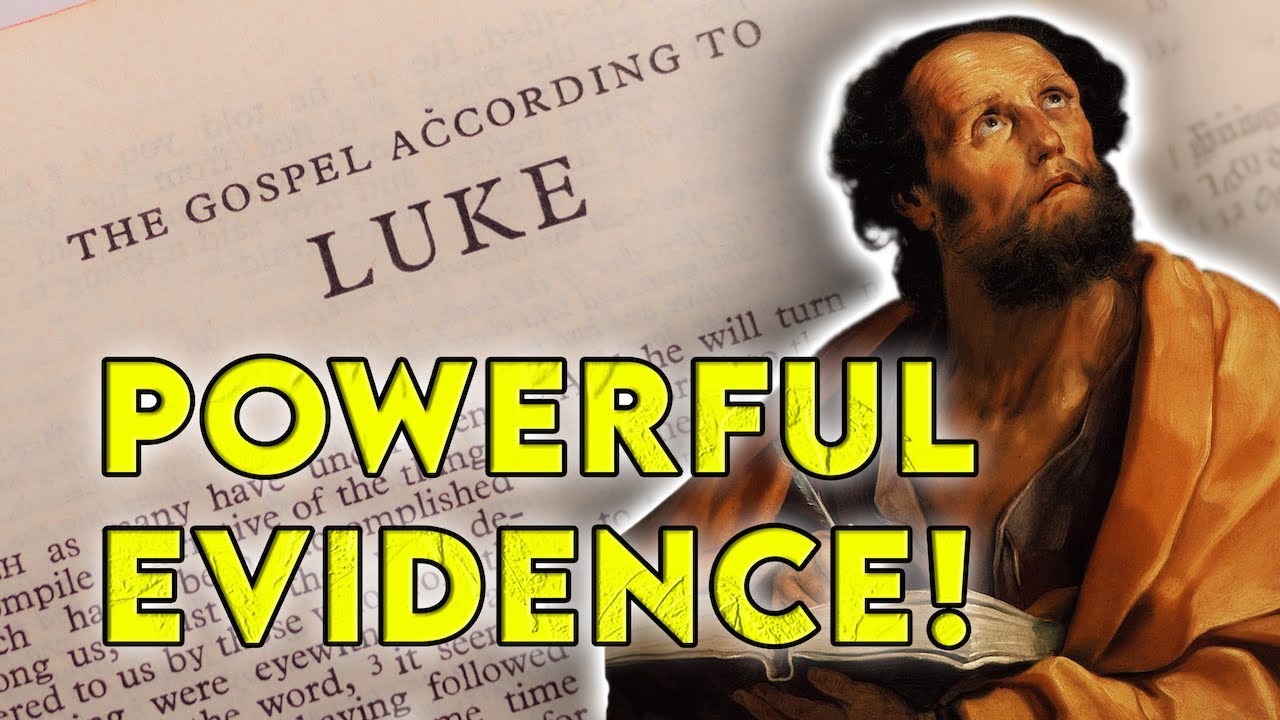
the Gospel of Luke is a peculiar work to even exist in the church Luke was known as a gentile convert a physician and a traveling companion of the Apostle Paul Paul obtained information on Jesus from Peter and James but he didn't follow Jesus during his Earthly Ministry and with only this fact to go on it would make Luke three steps removed from Jesus why would we include a gospel in the biblical Canon written by someone so far removed from Christ but the truth is more interesting than we realize when we dive into the Gospel of
Luke we find strong evidence the author obtained eyewitness testimony on what Jesus taught and did and we find indications that the gospel does go back to Luke The Physician thus Luke is in fact based on eyewitness accounts as we noted in the last video on Matthew and Mark this is one video in a series on the reliability of the gospels many objections that could be raised against the arguments we present here were addressed in earlier videos so we have good evidence the gospels are reliable accounts that go back to the historical Jesus but what evidence
is there to argue that Luke did write the Gospel attributed to him first the unanimous attestation of the early church is that Luke wrote the Gospel attributed to him and as well as the book of Acts no one has ever ascribed the gospel or acts to another author Clement of Alexandria said Luke was the author of his gospel araneus tertullian and origin agreed the muratorian fragment which dates to around 150 ad says the third gospel book that according to Luke this physician Luke after Christ's Ascension since Paul had taken him with him as an expert
in the way of the teaching composed it in his own name according to to his thinking yet neither did he himself see the Lord in the flesh and therefore as he was able to ascertain it so he begins to tell the story from the birth of John the anti- marcite prologue says indeed Luke was an antii and Syrian a Doctor by profession a disciple of the Apostles later however he followed Paul until his martyrdom serving the lord blamelessly he never had a wife he never fathered children and died at the age of 84 full of
of the holy spirit in biosa therefore although gospels had already been written indeed by Matthew and Judea but by Mark in Italy moveed by the Holy Spirit he wrote down this gospel in the parts of AA and indeed afterward the same Luke wrote The Acts of the Apostles so we see early texts confirming the tradition that the gospel author was Luke a traveling companion of Paul and when we look at three letters attributed to Paul we see he mentions someone named Luke was with him in Colossians it even says Luke is a physician so the
external evidence puts a physician named Luke in the company of Paul and also confirms that Luke is the author of The Gospel attributed to him given how far Luke was removed from Jesus it is unlikely the church made this tradition up Leon Morris said Luke was not as far as we know a person of such prominence in the early church as to have two such considerable volumes as these fathered on to him without reason if people were guessing would they not be much more likely to come up with an apostle given this luuk and authorship
is more likely to be an authentic tradition however as noted at the beginning how can we trust the testimony of someone so far removed from Jesus does the internal evidence confirm the church tradition of Luke and authorship in truth Luke was not three or more steps removed from the eyewitnesses of Jesus we have good reason to believe he spent consider consider able time in Judea and interviewed the eyewitnesses first the gospel opens with an interesting preface it says he's writing to someone named Theophilus given that Theophilus the dedicate is named he would have known who
was writing to him it's extremely unlikely Theophilus received an anonymous biography Simon gatheral notes the author's name would probably have been included outside of the main body like in a title the dedication to Theophilus in Luke's gospel means that the name of the author could hardly have been omitted from the title in Luke's prologue Demands a title with Luke's name or else the first person references in Luke 1 1:4 would be left hanging given that theophus would have known who the author was and that later Church fathers unanimously agreed the author is Luke the simplest
explanation is the author of The Gospel was always known to be luke which is why we see the same attribution among later Church fathers spread across a wide geographical range this is a more parsimonious explanation than the idea that Theophilus knew who the author was but that knowledge was lost then someone in the 2 Century attributed it to Luke and had the power to convince the rest of the church that this man who never met Jesus was the author if the tradition of Luke and authorship was made up at a later point we should see
a diverse debate about who the author was instead we see agreement the author was Luke in the idea at the beginning that the authorship of the Gospel was never known to be anonymous not only that but the preface is meant to indicate to Theophilus and others the historical nature of the whole work Greg Sterling notes it is one of the most polished sentences in the New Testament John moles noted the preface signals a conscious appropriation of the historical nature of works like that of Herodotus through cides and pus in other words Luke intended for refers
narrative to be read as any other Greek history and not as fiction as many observe not only is Luke or Luke act's narrative but it is some sort of historical narrative that is a series of past events in a narrative of past events especially one drawn up written up accurately and in order and with a beginning and an end it self- denotes historiography history itself consisting of things that happened or that were done after this immediate generic signal readers must read the rest of the preface historiographically as the narrative broadly confirms John J Peters notes
the preface follows a similar method thus cides employed and to a lesser extent the method employed by pus fuses indicated the importance of relying on eyewitnesses and being an eyewitness from the beginning he also taught one could not write accurately about non-contemporary events because one would rely on Old poets who were inclined to exaggerate Luke followed these ideas and says he was part of a group that received information not simply from eyewitnesses but eyewitnesses from the beginning along with this Luke follows this by stating that he has investigated everything that goes back to the beginning
this means Lucas claiming his information came from eyewitnesses who saw firsthand everything he is reporting he also mentions another group as a source the Servants of the word Luke used a Greek word that was often used for the Hebrew word hazan as seen in Luke 4:20 the Hans in Judea were responsible for keeping the sacred Scrolls in the synagogue saluke indicates some special individuals preserved and controlled the tradition of Jesus the use of the single definite article makes it likely that these were carefully selected eyewitnesses who were trusted with keeping the oral tradition in check
John J Peters says Luke may have distinguished these groups of eyewitnesses in order to highlight their respective roles as sources the narrow group of eyewitnesses Servants of the word functioning as sources for the reported speeches and dialogues and the larger group of eyewitnesses functioning as sources for the events narrated additionally Clare Rothchild analyzed the claims ancient historians made in their prefaces and found six claims were commonly made these were the claim to truth the claim to accuracy the claim to research or have a narrative from the beginning the claim to avoid Style the claim to
order and the claim to rely on autopsy or eyewitnesses Rothchild notes the terminology is flexible and not every claim was always utilized but even with that Luke utilized five of the six claims indicating his work was very much written in the fashion of a history that is meant to pass along accurate eyewitness testimony Luke also claimed his work as a narration which is the same word pus Josephus and diodorus used to refer to their histories and Shan Adams noted Luke's preface Falls comfortably within the proportional range of historical prefaces Eve Marie Becker noted he used
a word that refers to obtaining complete knowledge which was used in juridical or administrative contexts one would not use this term unless they were suggesting a high degree of confidence that they obtained accurate and complete knowledge when this term was observed in the writings of Josephus Steve Mason remarked it is difficult to believe that he employed the fbe theme historiographically with little thought of its implications thus Luke employed lexical and semantic features that one would expect if he necessarily relied on eyewitness testimony it is unlikely Luke would go through the trouble of carefully mimicking Greco
Roman historiographical work and used such powerful language if he was merely writing a fictional account or did not honestly believe he was passing on accurate eyewitness testimony has Lov day Alex and remarked it is simplest to conclude short of positive indications to the contrary that Luke meant what he said with this in mind it is unfounded to assume Luke's gospel was intended to be fictional some Skeptics have argued that if Luke did rely on eyewitnesses it is AI only mentions this in his preface and not throughout his gospel but Peter's notes through cities also appear
to only mention his sources and methods in his preface John Marca suggested this was likely done to achieve a smooth narrative flow which was probably also Luke's goal Peter says the critical point to highlight with fd's handling of sources is that as a general rule outside of the opening preface he does not interrupt the narrative in order to site name or discuss his sources equally important to note is that subsequent writers largely followed his Convention of concealing the sources within their narrative Luke pitcher says one of the biggest problems we face is the fact that
ancient historians concealed their sources within their narrative so Luke was following the same pattern employed by other historians of his time as Richard bacham said the gospels share broadly in the attitude to eyewitness testimony that was common among historians in the Greco Roman period some argue that Luke implied the written accounts that came before his were an error or inadequate since Mark was written for Luke this could mean Luke was asserting he rejected the reliability of Mark but Craig Keener says many think that Luke thus finds fault within the works of his predecessors but Luke's
language is far less harsh than that of writers who genuinely criticize their predecessors love day Alexander adds the real difficulty with this reading lies not in the parallels or in the verb itself but in its relation with the text as a whole for in succeeding verses Luke by imp a en list these same predecessors alongside himself as recipients of authentic tradition and ranges himself beside them not against them with words that seem good to me also furthermore since it is pretty clear luke did use Mark as a source he may not have rejected it outright
but merely thought it was missing important additional information that he obtained from other sources John Peters thinks Luke was claiming former accounts were inaccurate but suggests Luke is referring to the written accounts that he mentions later in The Narrative of Acts which were those of lus and fesus either way there is no good evidence that Luke thought Mark or even Matthew were inadequate or inaccurate the preface is not the only place Luke stresses the importance of eyewitness testimony in Acts we see he recounts the time the disciples picked a replacement for Judas a scariot to
meet the qualifications Peter said the replacement must have been an eyewitness from the baptism of John until the Ascension so Luke noted The Importance of Being an eyewitness to be an authority in the church acts 24 records that Felix had more accurate information on the Christian movement in the narrative we can see this is because he was able to consult eyewitnesses like Paul in Acts 18 Luke tells us of the preaching of apollis but points out he was only taught on the baptism of John so he needed to be corrected and updated because he obtain
limited eyewitness testimony the implication is Apollos was not an adequate deliverer of the word because of his lack of eyewitness testimony Peter says Luke's narrative repeatedly stresses examination of eyewitnesses in pursuit of the goal of secure knowledge and secure writing so also pus stresses at critical moments the importance of secure writing if the author reminds us multiple times throughout his work of the importance of eyewitness testimony and directly says he obtained eyewitness testimony if we're being reasonable and apply the principle of Charity the conclusion we should come to is the author likely did consult eyewitnesses
of Jesus in order to write his gospel Luke should be considered innocent until proven guilty additionally we have good reason to believe the author of Luke was a traveling companion of Paul in Acts 16:10 to17 something peculiar happens we see the author refers to the the apostles in third person before this point but then he suddenly switches and starts saying we Colin hemmer noted the use of we involves the claim to personal participation the pronouns return to third person after but when Paul returns to Macedonia the pronouns return to first person plural and remain the
same until the group arrives in Jerusalem and Paul is subsequently arrested when Paul is finally sent to Rome the pronouns again change from third person to first person and plural and remain the same until the end the only other place we see first person pronouns is in the prefaces where the author is clearly referring to himself given this it is likely the author reintroduced the first person pronouns only later in Acts because he was present for these events the charitable interpretation is the wi sections refer to when Luke was with Paul for his mission work
some have argued the author of Luke X has merely produced The Diary notes of someone else and didn't change the pronouns to third person but this explanation runs into the numerous problems Colin hemmer notes this doesn't fit with the professional style of Luke a which is a seamless narrative why should the writer have preserve mechanically the inappropriate pronouns from a narrative by a different unidentified person it is a phenomenon oddly out of step with the smooth luk in unity we have observed and it is hard to square with Arguments for redaction second why only include
the supposed firstperson pronouns from his Source at various times and acts why not insert this in the gospel and make it seem like you were an eyewitness of Jesus from the beginning it is also odd the we passages only show up in the prefaces in sections of Acts that would align with the church tradition that the author was a traveling companion of Paul a more parsimonious explanation is the author was noting when he was present and he has has already set a precedent in the opening verses of the Gospel that he'll use first-person pronouns when
it is relevant it is therefore reasonable to assume he does this later in Acts only because he was present with Paul at these times on top of this col and hemmer went through the last 16 chapters of Acts which are comprised mostly of Paul traveling around the Gentile world he notes there's at least 84 facts in these chapters that are confirmed by archaeology and external sources to give some examples Luke knows the proper names of ports local Industries for various regions the proper lines of borders slang terminology specific landmarks local variations in languages and the
proper titles for local officials he knows the governor of Cyprus was called a proconsul while in Philippi they were referred to as magistrates in thessalonica they were called pitars in Ephesus the chief magistrate was called the town clerk and the roller of Malta was referred to as a chief in the story of the Shipwreck Luke knows accurate sailing times of distan supports directions of sailing relevant meteorological factors the correct naming of villages accurate nautical jargon and the presence of superflous details concerning even significant nautical Maneuvers Richard Hansen noted that Luke's accuracy and vividness here exceeded
suties when writing about similar events Luke also has to cover the political landscape of Palestine from Herod the Great up until around 60 AD the problem is this period is incredibly complicated first Herod the Great rules the United Kingdom but then it's divided between his three sons Herod archelus is never certified as king but is allowed to Reign then archelus makes the mess of Judea and is deposed Judea is reduced to a Roman province run by prefects but the religious leaders are still allowed some rule in military power this lasted until Herod Agrippa was given
kingship of the region he reigned for a few years before dying and is replaced by procurators however later Herod a grippa II is given some power in Judea but it's limited the whole issue is very confusing and befuddles even some Roman historians but Luke easily navigated through this complicated mess where it would be easy to make a mistake in telling the story of Jesus in the early church he accurately depicts the complicated political changes even though that was not his main focus one does not obtain this kind of accuracy unless they were an eyewitness or
were close with the eyewitnesses this strongly suggests the author was present for the events of Acts and familiar with the eyewitnesses like Paul when he was absent and this would of course support the church tradition that the author was a traveling companion of Paul one of of the interesting facts about the second Wii section is it ends by noting the group had arrived in Jerusalem then the author implies he's separated from Paul for a few years while Paul was in Roman custody corresponding with the preface of Luke this would have been the perfect time for
Luke to interview many of the eyewitnesses in and around Jerusalem so the author indicates he was not several steps removed from Jesus but would have had access to eyewitnesses before venturing with Paul to Rome where he might have been able to find more ey Witnesses like Peter to support these claims an important feature of Luke act that indicates the interviewed eyewitnesses is the presence of onomastic congruence in his books as we noted in the video on Mark's gospel onomastic congruence refers to the creation of naming patterns by an ancient author that appropriately reflects the data
of relevant prosopography in other words an ancient work as onomastic congruence if the names within the body of the work align with the ratio of names we find from that period for example the most popular name in Judea in the first century is Simon if someone was writing a history of Judea from that time we would expect that one of the most popular names in their work would be Simon names like Matthew or Annis should appear much less throughout the work given they were not as popular as names like Simon or Joseph we would also
expect that because Simon was such a popular name an author would find a way to distinguish those that have that name like referring to one Simon as Simon son of Jonah and another as Simon the Tanner where is less popular names like zakus we have no need for distinguishing them and if an ancient work contains a naming pattern that aligns well with the distribution of names from that time and place that it purports to come from this supports its overall reliability Luke vanderway said a work with onomastic congruence has three factors a relatively significant number
of appropriate proper names a relatively increased level of detail in proper names patterns of proper names reflecting the situation on the ground seldom will a non-history graphical work surveyed in our study contain any one of these three features it never contains all three vandaway put this to the test and surveyed the naming patterns in various ancient works to see which ones would contain onomastic congruence the Apocrypha gospels various tra IES and novels were found to lack onomastic congruence surprisingly even some GRE Roman biographies failed to achieve onomastic congruence thus vanderway noted lacking onomastic congruence doesn't
mean a work is not historical or reliable but if a work does achieve it it strengthens its overall reliability the only biographies that obtained onomastic congruence were josephus's autobiography plutarch's lives and suetonius is 12 Caesar Craig Keener noted these biographies Mark the height of historical reliability and were written at a time when biographical expectations for historical reliability were at their highest the fact that vandaway finds onomastic congruence in all three supports this conclusion and as we noted vand way also found onomastic congruence in Mark's gospel which puts it in a category alongside the most reliable
biographies of the ancient world however when Luke ax was examined onomastic congruence was found to an even greater extent than Mark's gospel which supports Luke's overall reliability since the time vandaway published his research on autastic congruence he has continued to update and improve his argument when it comes to naming statistics with the help of the statistician Jason Wilson he has demonstrated in a statistically significant way that Luke for example could likely not have achieved his naming patterns through fabrication even he had access to the works of Josephus and a significant amount of appropriate Jewish names
in fact the gospels and acts contain a statistically closer naming pattern to the general population than Josephus does thus further confirming Luke's historical care and strengthening his claim that he relied on eyewitness testimony also supporting the claim that he relied on eyewitnesses is the presence of semitisms in his gospel a semitism is a characteristic feature of a Semitic language occurring in another language James Edwards found that the synoptic material independently found in Luke contained 400% more semitisms than the material shared with Matthew and Mark this material also contained 28 of the 44 named individuals in
Luke and would greatly contribute to his overall onomastic congruence and this suggest as independent material came from my Witnesses the names were also likely included for a similar reason that Mark had named random individuals during the death and burial of Jesus these were some of the iwitness sources that Luke relied on for his material that was independent of Mark for example Luke 8 lists three women Irrelevant for the story of Jesus along with Minor Details about them as we noted in the video on Mark's gospel this was likely an ancient practice of stating one's sources
within the narrative when names are listed that are irrelevant to the story the author is likely telling us the eyewitnesses they consulted Albert hurp and adelbert do know provided a comprehensive list of the available semitisms throughout Luke acts and concluded Luke intentionally varied the semitisms in his two books and infus them with the rhetorical aims of his prologue this strengthens Luke's overall reliability and authenticity to quote with details of Semitic language and traditional backgrounds Luke butus is the point of authenticity and reli ability of his gospel account about Jesus and his movement in early Jewish
millus of the first century CE an example as Luke typically writes Simon Peter in its heniz form but he switches to the Semitic form when he's quoting James Raymond Martin noted that Luke added to Mark's account of the Transfiguration but wherever Luke did this it is significantly more Semitic this would be unexpected if Luke was merely adding fictional aspects Luke vanderway says this would be unexpected if Luke used an independent written Source from Mark since it would be highly unusual for it to be consistently more citic than Mark only in places where it does not
overlap with Mark at the same time it would be strange if Luke supplemented Mark with another written sore sporadically smoothing out the semitisms only when taking over the mark in texts it seems more likely that Luke supplemented the mark in text with extra material he received from an informant possibly Peter adorning it with a narrative style that added weight and authenticity to this setting Luke's infancy narrative which recounts the Virgin birth is often assumed to be late fiction but it is replete with semitisms based on manuscript evidence Richard fellows noted that Luke typically refers to
Mary with a Semitic variant of her name but in Luke 2:19 in Acts 11:14 he uses the Greek form of the name these seem to be Luke's editorial notes and are distinct from the Semitic tradition he inherited the infancy narrative is also filled with Illusions and quotations to the Greek septu agent Steven Ferris notes this section of Luke's gospel including the hymns is very similar to the septu it and has an apparent Semitic nature however when we read the prefaces in the we sections of Acts we find something interesting we observe very few semitisms in
biblical Illusions if if it was merely the author's style of writing in a Semitic fashion why is it oddly lacking in his preface in the wi sections we see a distinction between material where the author claims to be present and material that would have come from eyewitnesses of Jesus and the early church this suggests Luke received his material on Jesus like the infancy narrative from a Semitic speaking source and combined it with his own notes on his travels with Paul the semitisms throughout his gospel combined with animasa congruence suggest Luke was getting his information from
eyewitnesses not only does Luke tell us he was a traveling companion of Paul and did consult eyewitnesses but the internal evidence of Luke acts confirms this as well finally another interesting aspect of Luke's gospel is it contains more medical language than the other three gospels the church tradition is the author was a physician if this is true we should expect that he would have written in a way that would have subtly revealed knowledge of medical phrases and ideas in the 19th century WK Hobart documented numerous instances of medical terms throughout both works and used this
to argue the author was a physician but in 1919 Henry Cadbury responded to Hobart and argued many of the terms that Luke used which Hobart classified as medical could be found throughout other ancient works like the Septuagint the writings of Josephus the lives of plutar or the works of Lucian these Works have almost all the medical terms that Hobart observed in Luke acts Cadbury was correct to say that Hobart overextended his claim that the mere presence of terms found in medical treatises is enough to demonstrate the author was a physician but this doesn't mean the
argument is entirely useless one can still make a case that the gospel coheres with the church tradition that the author was a physician given the amount of medical language when it is compared to the other three gospels as wner Mark said commentators who followed Hobart like xan harack plumer and Creed all agree that Hobart overextended himself but they after sifting hobart's list and sometimes finding new instances of medical language in Luke all agree that there remain a number of good references demonstrating Luke's penchant for a physician specialized vocabulary recently Annette weisen riter updated the argument
and pointed out one cannot simply compile a list of the terms in Luke act and conclude the author must have been a physician instead one must focus on the way Luke writes and how he uses ancient medical language to quote one thing we can say with certainty the author of The Gospel of Luke had some knowledge of ancient medicine this is supported by a recent and extensive analysis of documentary papyra by Thomas graph he said by comparison Luke's writings make more frequent use of named illnesses than what we find in the documentary papyra Luke vanderway
adds the asaurus lingu grai a searchable database of over 11,000 ancient Greek documents in 125 million words now allows us to determine that some of Luke's words are indeed used exclusively by medical writers a notable example is seen in Luke 18:25 where changes the Greek words for both I and needle the combination of these words are only seen in three other ancient Works gillan's medical glossery of hypocrates another text of galin and in a text of the physician orosius at one point in Acts Luke uses a Greek word for upper all other ancient uses of
this word are only found in medical writings Luke however uses it in a non-medical context which could portray familiarity with the term where he used it without thinking Luke opens his preface by saying in as much as many have undertaken to compile A Narrative of the things that have been accomplished Among Us the whole preface mimics the style of writing of other historians but this sentence aligns with the way the ancient physician hypocrates open one of his medical treatises as many have undertaken to speak or to write concerning The Healing Arts Luke is the only
gospel to record Jesus's statement physician heal yourself self it is stated as a proverb that Luke would have recognized he also demonstrates Grace towards his fellow Physicians when he recounts the events surrounding the woman with the issue of blood Mark wrote now a certain woman had a flow of blood for 12 years and had suffered many things from many Physicians she had spent all that she had and was no better but rather grew worse Luke is less harsh and only makes a clinical statement about the inability of the woman to get healed luk off and
adjust Mark's wording to clarify the intensity of the medical description Matthew and Mark only speak of a fever but Luke made sure to emphasize that it was a high fever and use terminology similar to what we find in medical literature it was common for Physicians to distinguish between high and slight fevers something Luke would have been aware of whereas the other gospels would not Matthew and Mark only say a leper came to Jesus whereas Luke speaks of a certain man being full of leprosy we would would expect a physician to want to note the advanced
state of the disease instead of merely stating he was a leper Luke is the only gospel author to record a man heal of dropsy and he even uses the correct medical term in Luke 8 he adds to Mark's text of the gine to include a comment about his going into the desert and living alone for a long period of time which is in line with comments from arus and Silas elanus about the disease of Mania in Luke 13 he mentioned a woman being healed of an 18-year back condition in both of these accounts Luke includes
a reference to the length of illness which was important for diagnosing someone in ancient medical literature wisen writer says the luuk and author's emphasis on the duration of an illness through the mention of an uncertain period of time for a precise number of years is striking in comparison with the versions in the gospels of Mark and Matthew a statement of the duration of the illness sometimes specifying a concrete number of years is extremely relevant to the diagnosis of an illness in the Corpus hippocraticum comparing the raising of J iris's daughter in Matthew Mark and Luke
we see Luke arranged the account to fit an ancient medical description Luke emphasized the age of the girl the time she has given something to eat and adds the return of her spirit this can be explained in Luke's understanding of the incident as a case of Hysteria phenomena which was thought to impact women linked with virginity or widowhood symptoms were thought to include difficulty breathing the inability to eat and paralysis ancient doctors related anecdotes of patients being without breath for many days without passing away a return of breath was not always linked to Prior death
so Luke may be taking Jesus's comment that she was not sick but asleep as being literally correct thus Luke seems to have understood this as a healing account Warner Mark said Luke's Medical Numa surfaces in his report of the raising of J iris's daughter when Jesus said to her get up little girl and incidentally Luke reports that she got up at once another clinical word and that Jesus ordered some food for her a feature of Greek medicine Annette weisen writer said when we compare the description in the illness narratives of the Gospel of Mark with
those of the Gospel of Luke we encounter not only a quantitative increase in illness and healing stories but Mark differences in the depiction of the symptoms and the Associated effects as well wisen riter lists many other instances which align with the way a physician would write similar to how monetary aspects of Jesus's teachings seem to have stuck in the mind of Matthew the tax collector if Luke was a physician we would expect medical aspects of Jesus's Ministry would stick in his mind and he would describe ailments and healing processes more like a physici and this
is what seems to be the case in Luke's gospel additionally contra cadburry comparing Luke to larger ancient corpuses is not a fair comparison Josephus and plutar wrote far more than the two books of Luke the sepagan is a far bigger Corpus as well the works of Lucen are less extensive but Lucen was well educated and interested in medical subjects ET withington noted he was a traveling show lecturer ready to give a rhetorical exhibition on almost any subject given how much more exhaustive these authors were we would expect them to have a larger vocabulary so contrasting
them to the length of Luka is not an equal comparison in fact given how much shorter Luke ax is compared to these other collections the fact that he had so much medical jargon for a smaller amount of text supports the theory the author was a physician a better one to make is to compare Luke to the language of the other gospels given that they are more comparable in terms of size and speak of the same events and when we do this we find Luke stands out in terms of medical language and finally Contra Hobart the
argument cannot be that the terms used by Luke could only have been used by a physician but that the amount we find and how they are used in comparison to the other gospels stands out and suggest the author had some medical training and although this cannot itself prove the author was a physician it does lend Credence to the church tradition that the author was indeed Luke The Physician so when when we look at the data we see the author reported he interviewed eyewitnesses of Jesus and emphasized the importance of eyewitness testimony he also mentions he
was present with Paul during his travels and the text implies he would have had a perfect opportunity for about 2 years to interview eyewitnesses supporting this we see Luca contains onomastic congruence something only the best biographies of the ancient world could achieve the odds of a fictional biography achieving This is highly unlikely it's far more likely he got his information from eyewitnesses additionally Luke acts contains a high degree of semitisms and yet surprisingly they are lacking in the wi sections of Acts which indicates his information on Jesus came from Aramaic speakers and are distinct from
the sections describing his own travels and finally his gospel is filled with language that we would expect a physician to utilize all this makes a strong cumulative case the unanimous testimony of the church fathers is correct the gospel author was indeed Luke The Physician a traveling companion of Paul and this is on top of all the evidence which overwhelmingly confirms the reliability of the gospels as stated before we are not dealing with late Legends but reliable and authoritative accounts that go back to eyewitnesses therefore the external and internal evidence confirms the church tradition of Luke
and authorship Luke's gospel is based on eyewitness accounts on the life and teachings of Jesus