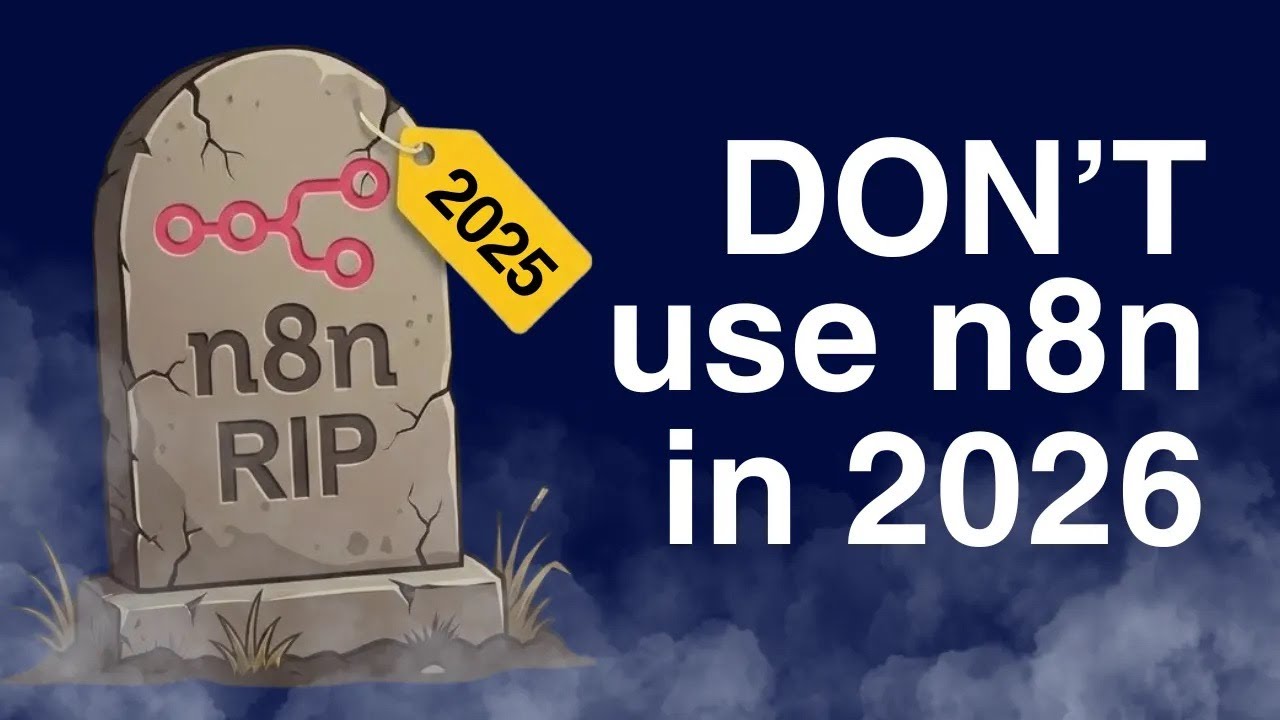
If you're learning NAED in 2026, you are wasting your time. All over LinkedIn, Twitter, YouTube, Reddit, there are influencers showing off these gigantic NAN make and zap year workflows and telling you, "Hey, look, this is the future of AI. " And that could not be further from the truth.
Here's what I'm going to argue. NAN was always a dead end. It was just the case however that if you didn't know how to code then you could develop some kinds of automations in editn without programming that you couldn't without coding.
However, today agentic coding tools like Codeex and Cloud Code have gotten so good that even non-technical people can create automations better than what they can make in NAT on day one and on day seven and on day 21. They can get hundreds of times more productive than they are in NADN. So, this video is going to be about what you should learn in 2026 and why NADN isn't it.
Just to give you some background, my name is Anik. I have a PhD in economics from Northwestern University. I worked as an ML engineer for zel for six years and now I run my own AI consulting practice.
So to begin, let's talk about NAND, what it promised and what it delivered. In the past, if you were a non-technical person who wanted to develop some kind of automation for your business, NADN developed you a way forward without needing to program. You could just drag and drop some nodes around and for fairly simple automations you could get the job done.
However, the promise of N8N was much bigger than that. What it supposedly allowed you to do was to implement very big, very complex workflows and let that be a critical part of your business. At that promise, N8N always failed.
What you would quickly notice developing non-trivial workflows if you actually made them is that your browser would crash. They'd be impossible to debug and you would just be reimplementing basic constructs like while loops, if statements, and for loops which in code take 30 seconds to write and in nadn require dozens of minutes perhaps hours dragging around nodes and just praying that they all work. Meanwhile, in the past, if you had just spent two or three months learning to program, you would have blown past what NAN was capable of doing.
Yes, it takes longer upfront, but the upside is unlimited. You weren't capped. So, even when NAN made sense, it was always a trade-off.
Very fast start and then also a very fast ceiling. The influencers who were selling NAD as a career path were always selling a dead end. They would show you these extremely complex NADN workflows, but they would never show you receipts.
They never show you here's the workflow actually working. Here is the money that I actually saved a real client. They just make false claims which are total Because the reality is these workflows are fragile.
They're always breaking and they're impossible to debug. The only reason I learned NADN is because clients have been deceived into thinking that NADN is what the cutting edge of AI automation is. And so it was incumbent on me to at least be able to speak N8N to hopefully convince them out of using NAND in the first place.
So the first key insight is that NAND was always trading off long-term potential for very minimal short-term success. And so it really has always been a dead end from day one. All right, so my second point is that that's how things were in the past, but today things have completely changed.
So the old trade-off was that NADN gave you results fairly quickly, whereas it took time to learn how to code, and so many people may just want to therefore use NAND without learning to code. But that's no longer even the case. Agentic coding tools have gotten so good that the barriers to creating productive workflows of the type that it ostensibly helped you produce in the past have completely disappeared.
You as a non-technical person today can boot up cloud code, ask it to have you scrape basically any website that you can imagine just in natural language and it will be able to do so. You can have it help you figure out how to create Python scripts that pull data from some API without even really knowing what an API is. It'll walk you through the process.
You can create agentic automations which are creating content for your YouTube channel or your X account or LinkedIn account in the particular way that you like having content created with your voice. And you can do this as a non-developer using cloud code. So practically what this means is that there is zero reason to ever use NATM.
Now if you learn programming, you can become much much more productive in cloud code because you'll be able to create more replicable workflows and automations and even more easily be able to make things that you could sell. You don't need to be a real programmer. You just need to know enough to be dangerous, enough to direct the agent, understand what it's building, and debug when things go wrong.
That's a much lower bar than coding from scratch used to be. If you're outside the Bay Area tech bubble, you may not realize how much things have changed. Inside that bubble, nobody is learning nodn.
It's widely acknowledged to be a joke. But if you're a semi-technical smart person on the internet who has expertise in your field of business, you may be deceived into thinking that where you should be investing time is learning some low code tool like NAN make or Zapier. In fact, it's just leading you down a rabbit hole to a dead end when much better options in the form of codecs, cloud code, and cursor already exist and are already accessible to non-technical people to build automations.
So, my suggestion is if you're considering learning NADN, don't. The economics have completely changed. Any time you spend right now learning agentic coding will pay off a hundred times or a thousand times over any time you spend learning NATM.
And that value that increased return is going to be right there for you on day one. Let me explain now why this economics has shifted between NADN and Agentic coding tools. So first NADN workflows are very fragile.
They break and they give very uninformative error messages which an LLM or a coding agent doesn't easily have access to to help you debug. An important aspect of why Agentic coding tools are so helpful now is that when they have access to your code, even if you don't understand exactly what the code does, but you know the intent to which you want to apply the code, if you're getting some error message, you can just copy and paste the error message without either understanding the code or the error message and the coding agent will be able to solve your problem a lot of the time. Second, building an N8N is painfully slow.
For many non-trivial tasks in N8N, you have to recreate constructs like while loops, for loops, or if statements. But N8N makes this an extremely slow process to do productively. And there's no real way to sort of create a class or branch out some sort of logic that's called as a service by other types of code.
So what you get in effect with N8N is a bunch of spaghetti code which is worse than spaghetti code because a large language model has no access to this workflow to be able to understand it organize it in such a way that's going to be best readable best usable and most testable. And then third, this is the killer. Obviously, Agentic coding tools can be used to help you write code.
But some people think that you can use Agentic coding tools to write end workflows. And this really unfortunately is not the case. A lie that I hear often is that uh Agentic coding tools are optimized for creating JSON and JSON is the format which is like underlies NAN workflows.
This is not true. Agentic coding tools can create JSON files, but they're not optimized for that. What they are optimized for is code.
If you ever actually try making something non-trivial, a non-trivial NAND workflow with an agentic coding tool, what you'll find is that often the JSON document that it gives you is broken in some way. There's some bracket missing or some important part of the JSON which is not there. And that's because like they're not optimized to make these.
And while Agentic coding tools can succeed at creating the JSONs in some cases, once you get to any kind of non-trivial workflow, it totally breaks. So the most powerful tools available today, Agentic coding tools, which are giving everybody else a hundred or a thousand times leverage, are not available to you if you're limiting yourself by using NAN, Make or Zapier. All right, so I've told you what not to do.
What should you do instead? Here's my advice for somebody who's just getting into this space with AI and automation. First, I recommend you spend some time learning Python.
In particular, the book I recommend is a book called How to Automate the Boring Stuff with Python. And the great thing about this book is that it teaches you enough of the theory that you need to know, but it also focuses on particular kinds of tasks that you or just anybody in any kind of business is likely to want automated and it shows you how to do this with Python. Now, the total amount of time that you need to spend with this book before going off and using some aentic coding tool, maybe spend 10 or 20 hours.
That's it. One week, a couple hours a day. At that point, if you spend a little bit of time learning Python, you will be way, way more productive using the Agentic coding tools.
But if you're eager or impatient, you can go straight to the agentic coding tools right now like Codeex or Cloud Code and just type in what you want to do and you will be able to get pretty far without getting stuck by just copy and pasting error messages and get out some very useful automations. The first time you build something with an Aenta coding tool and it works, you will wonder why you ever considered using NAND. You'll wonder why anyone bothers with nadn.
From there, you can build up incrementally filling in the gaps in your understanding as you go. One great thing about these agentic coding tools is that they themselves can be used to fill in the gaps in your understanding. So, if it's doing something that you don't understand or if there's some concept it has mentioned that you're unfamiliar with, you can simply ask it to explain it to you.
Now, if you're using NATN because you're in the AI automation space professionally, you do need to learn some more things. I would recommend learning Typescript for front-end development. You need to learn how to connect a front end to a backend.
Uh how to store environment variables for example. And I would get familiar with some CI/CD platforms like Versel or other platforms to deploy like uh render or railways. And here's the key difference in how you scale with NADN versus agentic coding tools.
If you want to scale with NAND, your only option is to hire more people to build NAND workflows for you. But if you want to scale with agentic coding, it's going to happen naturally just with time with you making no changes at all because the models themselves like Claude 4. 5 or GPT codeex and the harnesses like codec and claude code keep getting better and people make plugins and skills which you can graft on to codeex and claude code which let you take kind of the knowledge of some other very skilled developer who knows how to make an optimized web application or how to do your queries, right?
Install them and now your coding tool is going to be able to access those best practices without you even really needing to know anything about database optimization for example. So as better tools, better plugins, and better models become available, you naturally keep scaling when you're using agentic coding tools. Whereas this just isn't the case using low code tools.
So to summarize, if you're currently learning NAN, stop. NAN died in 2025. Open up claude code, tell it what you wanted to make, and see what happens.
If you enjoyed this video and want to learn more about how to use Claude Code and Agentic coding tools productively for your business, even if you're a not technical person, like and subscribe to this video, leave your comment, and I'll be sure to answer it. And reach out to me on X or LinkedIn, and I get back to everyone who messages me. Thank you.