It's 2016. Uber has spread globally at an unprecedented rate and broken every rule along the way. The company has been illegally surveilling drivers and customers for years.
They've violated local laws in dozens of countries and municipalities. They've stolen trade secrets and IP from competitors and at the time are secretly following journalists who have been critical of the company in an effort to blackmail them. At the center of the storm is Travis Kalanick, a brazen but brilliant CEO and founder who has, despite the mounting pressure, remained relatively unscathed.
But another year passes and the wheels come off. Pun totally intended. >> Stole about 14,000 confidential files.
>> Google sues Uber for stealing their trade secrets. The New York Times reports that Uber knowingly misled regulators about their technology. Female employees start filing sexual harassment lawsuits.
A video leaks of Kalanick berating an Uber driver. >> Kalanick is out entirely, at least as CEO of Uber, reportedly under pressure. >> Kalanic is finally pushed out and forced to resign a few months later.
Everything was lost. Or was it? Nah, let's be serious.
Nothing was lost. Kalanick walked away with a sweet ass $3 billion comp package, got plenty of funding for his other companies, and is now kicking back in his $43 million Beverly Hills mansion, counting his money and laughing about it. You look around and you see this in the world time after time.
The liar, the narcissist, the bully. They're not just surviving, they're thriving. They're on the covers of magazines, running billion-dollar companies, and racking up followers and influence.
And meanwhile, the honest, kind, decent people, burned out, broke, invisible. If that feels backwards to you, well, it's because it kind of is. And it's not random either.
In fact, there's a brutal logic to why the worst people often win in life. And in this video, we're going to get into why. But first, a quick word from the sponsor.
Now, let me ask you a question. Are you someone whose calendar is completely stacked with meetings? Do you ever find yourself digging deep into your brain trying to remember what was said when by whom?
Was that the marketing team that said that? Was it the ops team that said that? Do we even remember who the marketing team is?
If yes, then you really need to try out Granola AI. Granola is an AI powered notepad designed to make every meeting easier and more useful. And here's how it works.
While you're jotting down all of your own thoughts, Granola is quietly transcribing the entire meeting in the background. That way, you can stay fully present. And then when the meeting's over, you click generate notes, and it creates a clean, structured summary complete with all the action items, follow-ups, and even draft emails that you can send out right away.
Now, Granola doesn't just help in the moment. Weeks later, you can literally ask it questions about anything from any past meeting. It's like having your own searchable brain for everything that's ever been discussed, ever.
Granola works for Zoom, Teams, Meet, or even in-person conversations so that you can have smarter meetings to get more value out of your time. So, if this sounds like something you could use, click the link in the description below and check out Granola today. From the time we're young, we're taught that the world rewards virtue, being kind, playing fair, helping others.
And in early life, that mostly holds up. But that's only because the world we start in is small. When your environment is limited to family, classmates, close friends, altruism actually works.
Meaning that when you share and you help others and you're being considerate, you're not only showing good manners, you're practicing a strategy that is nurturing your development. In this way, your reputation is built on your character. You learn that doing good often leads to getting good back.
And for a while, that is true. But then things start to scale up. As we become adults, we move into larger systems.
Corporations, governments, [ __ ] Tik Tok, and we realize that the old rules start to break down. The feedback loops that once rewarded virtue become distorted or lost. You see, our moral instincts were designed for small groups where harm was immediate, visible, and personal.
But when you scale things up, when you add distance, complexity, and layers of abstraction, those instincts start to fail. Imagine seeing a child in front of you being forced into slave labor. You'd probably feel immediate outrage and try to do something.
But now imagine that same child hidden behind global supply chains, company logos, and a sleek online storefront. Oh, and also 5,000 mi away. And your attention is not on exploitation anymore.
Instead, it's on the shiny new product that's 10% off. Human attention is limited, and we can only focus on a few things at a time. usually things that we can see or people that we can talk to.
So when confronted with global complexity, our minds lose track of everything. We check out mentally. It's too hard to think about the child labor in Africa or the actions of the Russian government.
You just want to buy a [ __ ] watch. This is how moral clarity gets diluted. Emotional feedback, which usually helps us sense what's right from wrong, gets lost in the infinite complexity of our modern systems.
As a result, our natural ethical signals become very faint. And when they do come through, our attention shifts not towards what's most right or wrong, but towards what's loudest and most visible. This is why the moral outrages of the day are usually completely detached from reality.
More people die of coal pollution each year than all of nuclear power accidents combined across human history. Yet, environmentalists are protesting nuclear reactors and not the coal plants. This is the brutal truth.
In these large scale systems, people only care about what is the loudest and commands the most attention. And by constantly being distracted by what is loud, we open the door for those who are extremely good at manipulating attention and taking advantage of inattention. The egoomaniacs, the narcissists, and the tyrants.
In the early 1500s, Nicolo Makavelli lived in a world steeped in corruption and political upheaval. Unlike today, Renaissance Italy didn't have the glossy corporate veneer of an HR department or DEI codes of conduct. It had poisonings, public executions, secret alliances, and political backstabbing.
No, like like actual [ __ ] backstabbing. But despite the dangerous conditions he lived in, he wasn't just some armchair philosopher scribbling in isolation. Mchaveli was deep in the trenches, advising princes and kings.
For over a decade, he served as a senior diplomat and adviser to the Florentine Republic, negotiating with popes, kings, mercenaries, basically anyone who held the reigns of power. And through it all, he saw how the game was actually played. Power, he realized, didn't reward virtue.
It rewarded instinct, survival, and cunning. Power didn't favor the best or most morally upright men. It favored the last one standing, usually over someone else's dead body.
And so from this brutal landscape, Mchaveli offered a conclusion that still makes people squirm. It is better to be feared than loved if you cannot be both. Mchaveli pointed out something everyone saw but didn't really want to see.
The higher you climbed in the rungs of power, the more amoral you had to become. And the same traits that harm you locally can potentially reward you globally. Of course, nobody liked hearing this, so they killed Mchaveli and tortured him until he gave up names.
No, just kidding. He actually had a stomach virus. Anyway, as Nichzche later put it, terribleness is part of greatness.
Let us not deceive ourselves. So, I'd like to take a moment and discuss some of these traits that make you a horrible person to your friends and family, but actually might make you a billionaire or prime minister if you play your cards right. In psychology, they've identified three of these strategic personalities.
Together, they are called the dark triad. Mchavelianism is about strategic control or the willingness to manipulate people and [ __ ] with their heads. People high in mchavelianism are willing to lie, cheat or steal if they believe that they can get away with it.
They will mislead you, create drama to benefit themselves, turn you against the people you care about, divide and conquer. Narcissism, by contrast, is fueled by self-importance and the hunger for recognition. The narcissist is self-obsessed and deluded in their own high self-regard.
They believe that not only is everything about them, but everything should be about them because I mean, look how [ __ ] awesome they are. And finally, psychopathy is perhaps the most famous and the worst of the dark triad. It's marked by complete emotional detachment, a lack of empathy, and a really conspicuous boldness under pressure.
Psychopaths don't really feel fear the same way they don't feel love. And they acrue the costs and benefits that come with both of those. In a brutal and competitive environment, this can look like clarity and focus, even strength.
I mean, think about Steve Jobs. He wasn't a psychopath in a clinical sense, but he was certainly somebody who embodied a lot of psychopathic traits in business. He fired people for saying the wrong thing in a meeting.
He exploded at employees for even the most minor of mistakes. He ridiculed other people's ideas regularly. I already fired you.
Why are you still here? A former Apple employee once recalled, "He didn't want to just win. He wanted to crush you, and then he acted like it was your fault.
" Each of these traits reflects a distinct psychological strategy, a way of navigating systems that are too vast, too impersonal, and too competitive for old school virtue to consistently succeed. And no, they aren't exactly healthy or moral, but in certain environments, they can be very effective. But let's start with the bad news.
People high in these traits are in fact over represented in positions of power as CEOs, politicians, and major media figures made to react. >> But here's the good news. They are also over represented in prisons because that's basically the deal.
These are the high-risk, highreward personality traits. They help you thrive in a large, complex system, but they don't pan out well in stable ones, ones that require cooperation, trust, or long-term emotional support. In other words, what may help you win in the jungle is what gets you exiled from the village.
This is another flaw of our perception. Sure, we notice the narcissistic CEO or the egoomaniacal celebrity, not because they're common, but because their rise is loud, public, and cinematic. What we don't see are the thousands and thousands of people with the same arrogance, the same disregard for social norms who crash and burn without anyone noticing.
Most narcissists don't become icons. They get fired and dumped. Most machavelians don't outplay the game.
They get caught and banned from coming back. Most psychopaths don't build empires. They wreck their own lives and the lives of those around them.
Our bias makes it so that the failure doesn't trend, only the successes. And that's how our minds get tricked. By overvaluing the few visible winners, we start to believe that these traits work more often than they actually do.
That said, even among the few who do seem to win by wielding their dark triad traits, much of the truth is still hidden. They rise through manipulation, ego, and ruthlessness. Yet, I would argue that these people aren't really winning.
Why? Because behind closed doors, they are very likely miserable, lonely sacks of [ __ ] who [ __ ] hate themselves and are this close to sticking their head in a plastic bag or sucking on a tailpipe in their seven Bugatti garage. But don't take my word for it because we actually have research on this.
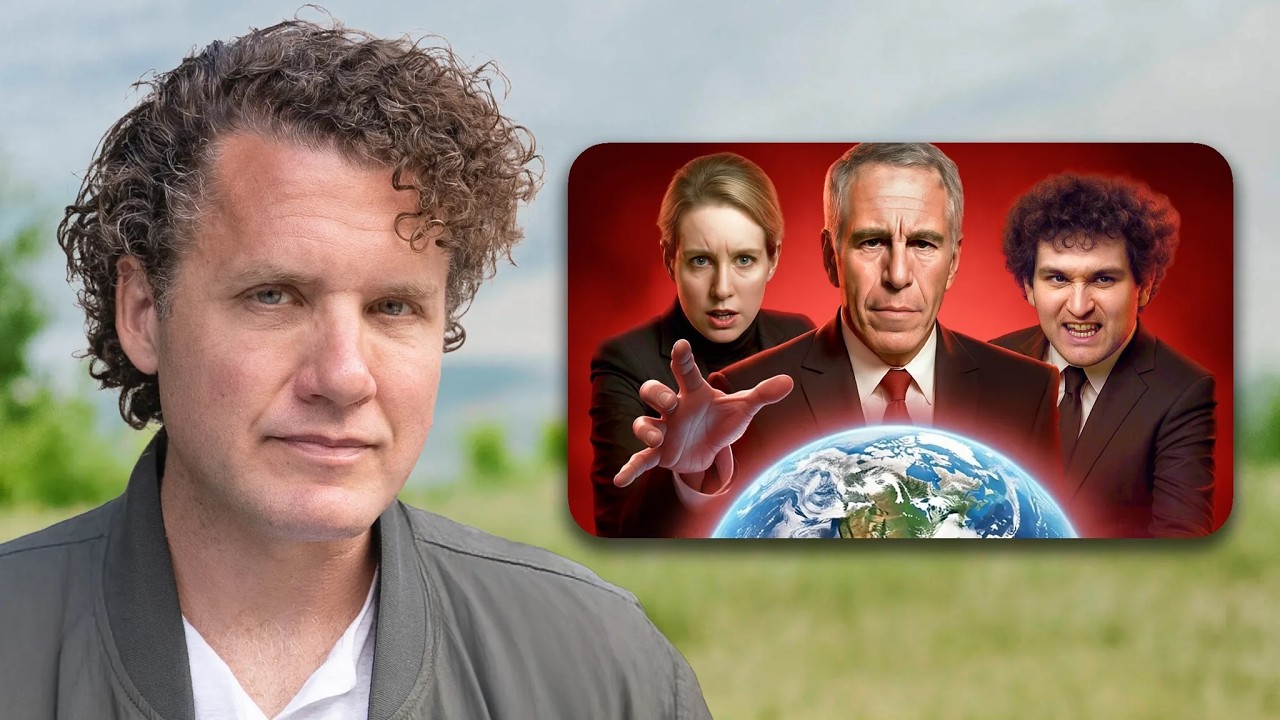
Elizabeth Holmes was too good to be true. A supposed Stanford prodigy who dropped out to start a revolutionary biotech company. She convinced her own business professor to become her first investor.
At long last, she was the female Vunder of Silicon Valley that they had been waiting for. A brilliant, confident, visionary woman who could finally redefine what a startup CEO and billionaire would look like. Her product was also too good to be true.
It promised things that were literally scientifically impossible. But Holmes didn't care. She faked the test cases at pitch meetings.
She lied about the results. And she just forced her narrative down everybody's throats. And what happened?
Well, investors lined up. The media swooned. Former presidents joined the board.
Basically, everything held up until it didn't. After 12 years, the lie finally got out. A public journalist exposed in 2015 that Holmes and her company were in fact too good to be true.
Now, what Holmes' story shows us along with Kalanics is that success built on a dark triad personality is never stable. When you treat people like tools or threats or just dirt, you don't build character, you build blind spots. In Hol's case, it was delusions of grandeur.
This is because when your identity is tied to achievement, there's no moral compass. Instead, your life's navigation system is solely driven by metrics and output. And over time that corrods you.
This brings us to an uncomfortable truth. What gets sacrificed on the road to success at all costs isn't just trust, connection, or reputation. It's guilt.
And that's where the real unraveling begins. Because here's the thing most dark triad personalities never realize. It's that chasing success without integrity doesn't just damage others, it damages themselves.
And not by making them feel guilt, but rather by making them incapable of feeling guilt at all. Now, you might think a life without guilt would actually be pretty awesome, maybe even an advantage, but it's not. Psychologist Steve Stewart Williams says that guilt may have started as a simple prompt to repay social debts, but it's evolved to do much more.
It's our internal alarm system, warning us that we're on the edge of self-destruction. And so, this tells us why the dark triad personalities are the truly dangerous ones. It's because they are those who train themselves not to feel guilt.
There's no feedback loop. There's no learning that happens from their mistakes because they never feel that they did something wrong. They never have to correct their actions in the future.
Instead, they shut those feelings off. And sure, for a while that might work. It might give them some confidence, some boldness, an ability to move forward without flinching.
But when they finally do get caught, guilt comes crashing back. And it doesn't come alone. It comes with backup like shame, fear, and regret.
So yes, you can succeed without integrity and listening to your guilt, but you will eventually pay for it. And history and mythology are replete with examples of these sorts of cautionary tales. From Edipus Rex, the Citizen Cain, the [ __ ] Hitler, they show that winning the global game of power often means forfeiting the local game of any connection or meeting.
But there is good news. You can still win without being a sociopathic narcissistic [ __ ] boy. And it's actually not not that hard to figure out how.
At the start of the video, I talked about how rigged the system can feel. How the worst people seem to rise while good people get ignored. And I also mentioned a reframe that could help.
It's understanding and accepting that morality is a localized strategy. It evolved to work in small personal networks. So naturally, when the system grows too big or too impersonal, our moral instincts can start to misfire.
But that doesn't mean we throw these instincts out entirely. It means that we adapt. We get smarter about how and when to use our virtues.
So the real challenge here isn't becoming like the worst people. It's learning what they get right about power and visibility without sacrificing your integrity and your [ __ ] soul. Point number one, empathize less.
This sounds cold, but stay with me. Empathy, like morality, evolved as a local tool. It's designed to be narrow and immediate, meaning you can only truly empathize with one person at a time.
And that makes sense in a tribal life. You needed to feel what your group felt to react to the same threats to signal loyalty to your friends and family. But empathy also has a downside.
It narrows your field of vision. In contrast, think of how it feels when you confide in a friend about being hurt and instead of validating your pain, instead of empathizing, they start defending the person who wronged you. It stings and you feel betrayed.
But ironically, that kind of perspective taking is exactly what we need in a large scale system. What we need isn't more emotional immediiacy. It's more compassion.
Unlike empathy, compassion is broader. It lets you hold multiple perspectives at the same time. It shifts you out of raw emotion and into a rational discernment.
exactly where you need to be when navigating complex social systems where the stakes are high and the relationships are not always personal. Say a colleague is struggling. Empathy might have you drop everything to help them, to feel what they feel, to fix it.
But compassion lets you pause. It gives you time to let your values weigh in the decision-m to ask yourself what's actually helpful here? What's the right amount of [ __ ] to give?
Is this even my problem? Am I perhaps enabling more of the problem? It's like watching someone fall in sink in the quicksand.
empathy immediately dives in after them. Compassion goes and finds a rope. In this kind of competitive world, strategic compassion and not reactive empathy is the skill that allows you to care without being consumed, to act with integrity without losing effectiveness.
In this way, you're able to adopt an aspect of the dark triad without going fully evil yourself. Number two, stop seeking universal approval. One of the most self-destructive traits you can carry into a competitive environment is the need for constant external validation.
And the tricky part, it often wears a disguise. It can look like kindness, cooperation, and humility. But underneath, it's just plain neediness.
Here's an uncomfortable truth for you. Wanting everyone to like you is itself a subtle form of narcissism. It's another version of making everything in the world about yourself.
Paradoxically, it is only when you find reasons that you're willing to be disliked that you will finally be able to stop living for yourself and do the right thing for the sake of doing the right thing. Number three, learn when to speak up even when you're uncertain. I say this because, as we talked about, the world doesn't reward who's right.
It usually rewards who is seen. And there's real science behind that. It's when our brains assume that the person who talks the most must be the leader.
In group settings, we subconsciously assign power to whoever commands the floor, regardless of what they're actually saying. That means in meetings, debates, even casual conversation, the one who speaks the most often will usually walk away perceived as the most competent. And not because they had the best ideas, but because they risked the most ideas and they had the most airtime.
So, what does this mean for you? It means you can't afford to stay quiet. If you have ideas, [ __ ] say it.
If you disagree, voice it. Because staying silent to avoid being wrong is how you get overlooked. But speaking up is how you get seen, remembered, and respected.
If you're unsure, speak anyway. Isaac Newton, the same guy who redefined physics, spent 30 years obsessed with alchemy, a [ __ ] pseudocience. He wrote over a million words on it.
And the reason you never hear about this is because it was [ __ ] stupid. Arguably the smartest man who ever lived spent most of his adult life on a pseudocience and nobody remembers it or cares. Because it's few good ideas were so great, nothing else mattered.
So here's the lesson. One great idea will undo the damage of a thousand bad ones. And until you speak up, you'll never know which of those ideas are the great ones.
It's kind of like YouTube videos. Sometimes you got to make a hundred of them just to figure out which ones is actually worth watching. Which is why you should watch this one.
It's pretty great, too.