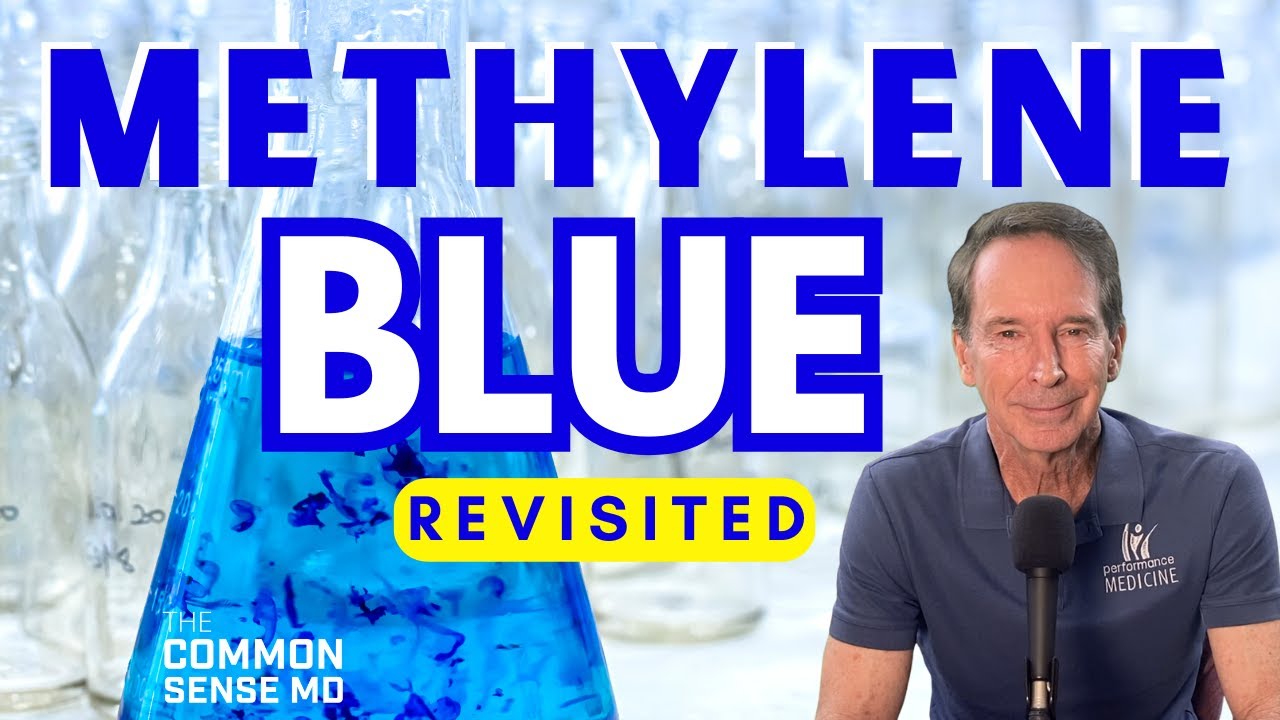
[Music] thank you hi this is Dr Tom Rogers at performance medicine coming to you with a weekly podcast which I call the common sense MD remember there's not enough common sense of medicine these days um so performance medicine we're able to think outside the box do a little more research and try to use preventive medicine rather than just writing you a script for the diagnosis we just gave you so we dive into things a little bit deeper and try to use common sense with a lot of things that we do um today I'm going to
talk about something that I did actually did a podcast on this last year but it's so important I want to revisit it and I'm going to call this podcast the amazing methylene blue Revisited so methylene blue which is something most doctors are probably never even heard about every ER doctors heard about it but in Primary Care maybe not so much anyway methylene blue which you think about it as being a Dye which it is is perhaps the oldest modern medicine that there is it was discovered in the late 1860s by these textile chemists that were
I guess figuring out how to dye blue jeans um so but there were chemists so they like to research things and use the microscope a lot so what they found was methylene blue was good at putting on a slide and staining using a stain if you've ever gone to college and done biochemistry or even chemistry when you put something under a microscope it needs to have a stain on it to highlight the different things like different parts of a cell are living organisms anyway so what they found out was this is a good way to
stain things to look under the microscope and they were able to identify a parasite under that microscope with the stain called plasmodium for those that know what that is that's the organism the parasite that causes malaria so they were able to identify malaria with that and what was even more amazing they noticed that this stain killed the plasmodium so it was a cure for malaria so and it also killed bacteria and viruses so it was really the first medicine to treat viruses bacteria and parasites as a matter of fact that's where hydroxychloroquine and chloroquine are
derived from methylene blue so it's been known for many years that it's an amazing medicine every ER doc knows where it's at because it immediately reverses carbon monoxide poisoning and also cyanide poisoning so every ER doc knows where it is and you give it IV in that matter it reverses something called met hemoglobinemia where oxygen gets displaced so it it definitely saves lives and also it reverses many chemical poisonings um but it's also very effective because it kills bacteria treating and preventing recurrent urinary tract infections it improves energy and improves oxygenation therefore breathing especially when
exercising by improving mitochondrial respiration you know we talk a lot about the mitochondria the energy parts of every cell that ATP has derived from but I started using it for covid not only for code but for long hauler covered because a lot of people have a hard time with breathing after having covid um along with LDN it's a really good outside the box treatment for long covid but what really interested me was its effects on treating Alzheimer's dementia um you know and I really started looking at it because I noticed that when I was treating
the long covered probably the main symptom of long covet is brain fog and it immediately improves brain fog in these patients um but remarkably this substance has been shown to prevent beta amyloid plaques from forming on the outside of neurons and it helps prevent Tau that Protein that's very inflammatory and these neurofibrillary Tangles that result there is a result of Tau um it's just interesting to look at the studies one study and I think it was 2019 showed treatment on real Alzheimer's patients before that it's mostly been treatments with mice methylene blue reduced cognitive decline
by 85 percent and it's interesting when they used the drugs currently approved for Alzheimer's which don't work the effects of the methylene blue disappeared so it's really interesting all these treatments for Alzheimer's are targeted towards reducing the amyloid plaque that's already there this works on preventing that plaque from forming and it worked especially best when combined with photodynamic therapy red lights a lot of these studies came out of the University of Texas where this PhD his whole life has been studying methylene blue for the last 30 years and he's really a devotee of methylene blue
and you should listen to some of his podcasts he's really interesting but when you look at methylene blue with these pet scans and functional MRIs methylene blue immediately crosses a blood frame barrier it gets in your brain really quickly it's also thought to help Parkinson's disease which is the fastest growing neurologic disorder in this country um and it's interesting because methylene blue is a nitric oxide inhibitor you know we're taught to believe that nitric oxide um was great for aging and athletic performance maybe not this theory has been kind of disproven because in fact nitric
oxide is it's a pretty toxic free radical so we're changing a lot of thinking about this because methylene blue is a direct no inhibitor so nitric oxide may be responsible for cell neuron death or so remember that not that it doesn't have some other useful things but um you know you need to take care of your brain first before you take care of anything else um a study out of the University of Texas recently showed that a single dose of methylene blue is able to increase the response um of brain regions that control attention and
memory again they use functional MRIs to study this thing along with short-term memory tasks I've had a couple patients tell me that their first dose they immediately started feeling better so definitely helps your attention span you know I really haven't tried it much for ADD but I assume it will probably work for that as well um so it seems that methylene blue works for dementia but it works definitely best when used early you know I talk a lot about prevention of these neurodegenerative diseases which is what is important because it's very difficult when that disease
process gets away from it very difficult to reverse it so you need to treat it before all the damage is done there's some recent studies out of Germany in mice that suggests that it can stop both Alzheimer's and frontotemporal Dementia in its tracks but only in the earliest stages you know they have ways of inducing these diseases in mice there's not not as many human studies yet on this um because you know it's dirt cheap I mean it's inexpensive over-the-counter dye if you take it of course you need to get the the pharmaceutical grade but
in a recent Journal of Neuroscience published in PubMed um a study found that daily consumption of methylene blue retention reduces attention deficits and also dopamine reduction in Parkinson's you know Parkinson's is a reduction of dopamine in your brain it's a movement problem which can also lead to cognitive decline in the end um it's just hard for me to believe that most doctors don't know the advantages of this it's probably because you know it's not going to be researched to the hilt and and all by big Pharma because they you know it's off patent it's over
the counter they're not going to make any money off of it um so it's an over the counter inexpensive drug I take it we use it in the form of liquid drops the dose is important so you need to come if you get on it you probably ought to come see us to the other thing I do is usually check something called a G6PD it's not an absolute because that's a rare disease that you have a glucose G6PD deficiency but it's out there so academically you probably ought to do it but it's over the counter
people have been doing it for years um off label so I don't worry about it a whole lot it's very safe drug especially in the doses that we use you know we're not using it IV um in an emergency room for carbon monoxide poisoning that's useful for that and they need it but what we're talking about is is use in oral drops for a completely different reason you know they they pregnant women should not use this definitely you should not use this for pregnant women and I used to think it was contraindicated for people that
were on ssris like Prozac and Zoloft and these things because it is a mild MAO inhibitor but really when I did a deep search on this it was it this only occurred in very high doses when they were tagging the parathyroid glands that are in surgery and I think that was five cases of people are on high dose Zoloft or Prozac so you're not going to get these kind of doses so it's an overblown thing so you don't you probably need to warn the patients that are on these medicines that if they get if they
feel really bad on it stop it of course and let us know but I've never seen this and I don't think many people have seen this the serotonin syndrome thing seems to be overblown in a lot of ways with other things as well but um and there's a possible contraindication for people with G6PD deficiencies which we check a lot anyway because when we give high dose IV vitamin C we need to do that to prevent hemolytic anemia again I've only seen one case of this deficiency around here it's more common in other continents but we
still check for it and so it's not a bad idea to get it checked but again it's really rare um but if you're going to get a higher dose or getting high dose IV vitamin C then you ought to get this G6PD blood test which is a one-time deal cheap inexpensive test that you ought to think about getting but so this methylene blue is it's really inexpensive it's safe the dose you need to come talk to us about um and we need to follow your progress with this but it's really exciting to me the many
uses that this drug which is the first drug known to man in Modern Times Really certainly way before penicillin or insulin were discovered it has a lot of uses and it's just since covid has been out there that it's really come more to light but I'm so interested in it for cognition because that's the thing people fear the worst is these neurodegenerative diseases that I talk about a lot so think about methylene blue you know you know do your own research and come to us if you want to talk about it and maybe get tested
for the g6p need efficiency and maybe some guidance on how to use this anyway I hope this helps I'll see you next week this is Dr Tom Rogers foreign [Applause] [Music]


![Methylene Blue: A Revolutionary Anti-Aging Molecule? [Study 202]](https://img.youtube.com/vi/zmogXFrx4Ys/mqdefault.jpg)