This is me in a garden at around 11 or 12 years old. That's how long I've been into [music] landscaping. I went to UC Berkeley to be trained as a landscape architect and I have never stopped gardening since.
So, in today's video, I want to give you the most important points that I've learned in 60 years [music] of landscaping. So, you won't have to use 60 years to get the same knowledge. [music] In this garden, there's not much of a problem with weeds, and we think a lot of the reason is a constant about 2-in layer of mulch that's retained or maintained.
Here, we've used the double ground shredded cedar, which I like as a as a mulch that stays put. If you have a gardener, a lot of mulches just blow away, whereas this kind of you can see it kind of cements together and um and stays put well. [music] So nothing's more frustrating than having bad neatodes.
Nematodeses that eat the roots of your plants. The traditional ways of treating bad neatodeses is with more and more toxic chemicals. And that usually renders the soil pretty much useless.
Even if you get rid of the bad neatodes, it damages the soil so severely. Bad neatodes are best controlled by good neatodes. And that's why building your soil with complex soil life is the way to avoid bad neatodes.
All our products, that's the whole point is we're going to build it with life that can get rid of the bad neatodes. Good neatodes are are the way to go. And applying them early morning, late evening in water, fairly easy process, maybe as often as once a year in the early spring.
a straight line [music] or very direct practical lines are better than saying, "Well, I need to be creative here, so I'm going to have this wrap around here and have this curly queue. " And you know, that's not really creativity. I don't I don't think I think it's good to be aware that a straight line can serve you very well.
When we walk through this, you'll see there's lots of straight lines here. And that's not saying that you couldn't have a more free form design and have it be very simple and attractive also, but we thought this house lent itself well to straight lines. Really, [music] it doesn't matter the plant.
An effective strategy for noise is to try to have more than one level, similar to what's done here. You start with a 3 or 4ft screen, go to about a five or six foot screen, then go to about a 10 to 15t screen, and you're directing those sound waves up over the area you want to keep the noise out of. What will improve iron [music] chlorosis?
Iron chlorosis is kind of a technical term. It means the leaves are yellow. Even when you have iron chlorosis, usually, not 100% of the time, but usually your soil has plenty of iron.
for one reason or another, your plants can't uptake the iron even though it's in the soil. Usually, you've already tried putting more iron in the soil and you still have iron chlorosis. So, what we want is soil that allows plants to uptake everything that's in it.
And the best solution for that is a solution you'll hear me talk about frequently, which is soil rich in life. Soil microbes make nutrients available to plants by breaking down organic matter through mineralization. And so we're trying to address this imbalance of minerals, even though we don't know exactly what the imbalance is.
What we want to avoid in every situation in gardening is interfaces. And that is where you have material of a certain texture where it's soil whether it's soil or gravel or whatever interfacing with a completely different texture. And in this case, if we put a bunch of gravel in the bottom of the pot and then we fill the rest up with a really good quality potting soil, that potting soil will not drain into and through the gravel until the top layer, which is a completely different texture, becomes saturated.
It doesn't just go through the soil and go through the rock because of the differences in tension and texture. It needs to become saturated first. And we don't want saturation.
We want drainage. So, you are impeding drainage when you put a layer of gravel like this. We want [music] certain plants, but they take shade, but you plant them in the sun and you think you can make them grow.
You probably can make them grow, but takes more water. Every time you use more water in a garden, that's higher maintenance because you have more weeds. You have more chance of diseases and fungal diseases of all kinds.
When we limit water, we limit maintenance. In this garden, we've limited water through the plant pallet and the design. [music] Does your dog walk into your house with muddy paws or covered in dirt?
We have a couple of tricks to solve that frustrating reality. One of the important things we did is instead of using mulch or leaving it dirt all around the plants, we used a 3/4 inch rock. That makes it so he doesn't seem to want to dig in the rocks.
And Petey has a reputation for digging. Chip, the angel that he is, doesn't do much digging. One thing that's important there is to make those rocks big enough.
There's a lot of of gravel or rock being used in landscapes that's 3/8 and they still tend to dig in that. But if you can make it 3/4 and bigger, that seems to not prohibit them but discourage them from digging in it. There's lots of different rocks available.
This is an attractive one called Rainbow. And we used it everywhere we could use it. And we didn't put it real thick because if you don't put it real thick, I think it's good for soil, good for the plants under the rock.
We used our products to improve that soil and put life in the soil. And then down the road as we want to make improvements to the soil, we can just throw it on top of the rock and it'll go right through the rock. Healthy lawns don't usually get weeds because they're so dense and healthy that weeds can't compete.
Some of you that have supplemental irrigation systems, make sure they work right. They will apply water evenly. You have head-to-head coverage.
Not where one sprinkler sprays to the spray of another sprinkler, but the spray of one sprinkler actually sprays to the next sprinkler. That's head-to-head coverage. One thing that can improve weed pressures is low mowing, but you only want to do low mowing if you have a lawn that does well with low mowing, like some kind of Bermuda or improved Bermuda.
If you have tall fescue or other types of cool season grass, you can't do low mowing, but you can do regular mowing. Change the path that you're mowing. And many, many weeds can't tolerate constant mowing.
Another technique that I like to use as a way of refreshing your lawn either once or twice a year and is effective on weed control because then we guarantee we have dense stand of grass is overseeding in the fall or in the spring. Water properly, we mow properly, we overseed. And now with all this competition, weeds don't know where to go.
They're lost. They can't get in there unless you do one of those improperly and you develop these bare areas and that's when weeds come in. So perennial rye does great in full sun, but it really doesn't perform well in the shade like lots of grasses.
In this backyard, since the trees that are shading it are deciduous, the trees drop their leaves and let in the light and the perennial rye needs the light and does fine. The problem we have is we as we get into next spring and the leaves come on the trees, those areas get shaded. Nothing grew there this last year.
A really creative idea, the most shade tolerant lawn seed you can use is a type of fescue, and there's several of them. Creeping red fescue, chewing fescue. Surprisingly, they actually look pretty good with Bermuda.
It's a nice compliment to a Bermuda lawn. And you almost can't tell it if you do a good job of growing these chewings and red fescue. And that is the most shade tolerant lawn you can plant.
So if that doesn't work, nothing will work. Some of these have blossom end rot that is more prevalent on certain varieties. Apparently whopper being one of them.
So we picked those. Some of them we threw away. Some you can just cut off the blossom end rot part.
And then we allowed more tomatoes to ripen and grow. And we've got a bunch of them growing now. And if you look on the bottom of all of these Whopper tomatoes, none of them have blossom in rot.
Same tomato plant. No more blossom in rot. It's not all about the calcium in the soil because the soil is exactly the same.
It's more like the plant's inability to uptake it. And that could be caused by a lot of different things including environmental factors. probably a hot spell or a spell where they were watered too much or watered not enough.
Hard to say, but some environmental factor, not a soil factor, is the reason why we had some blossom in rot. [music] You know, most people when they think of roses think of hybrid tea roses which supposedly have all these rules around pruning and those rules can be intimidating for people and sometimes make it so people don't want a rose like a hybrid tea because they think they don't know enough about roses to do so. I once went to a rose pruning seminar and he said, "If you don't know anything about roses and all you did is just grabbed it all and bunched it together and cut off twothirds of it, you'd be doing great and the rose would respond fine.
It wouldn't meet any of the very exacting standards of properly pruning hybrid tea rose, but it would perform great. Don't change [music] your potting soil every year. And this is what I might call a garden myth.
It's one that many garden centers promote because it's thought that if you are growing things in pots that mine the soil, the soil leeches very dramatically. But I like to use ways of enriching that soil so that you don't need to. And it's a lot of expense and a lot of work to be changing potting soil all the time in containers.
We infuse that soil with life on an annual and maybe even semianual basis with our products like blend and our penetrate liquid biotiller. So by having this light soil in pots that is constantly rejuvenated with not only nutrients but beneficial bacteria, good fungi, prozzoa and all kinds of life in the soil. Then we are able to have soil that doesn't need to be replaced.
It might need to be topped off now and then because you will get some settling. [music] Now, let's say you get a really good quality landscape fabric and you put it around plants in the first month or two as that landscape fabric functions just the way it's supposed to function, which is allow a good exchange of air and water, it's probably fine. It's not something um that I would recommend, but I think it would function fine because the landscape fabric is new and it's clean and we can get that air and that water to go right through it just like it's supposed to.
But over time, the problem with landscape fabric, particularly if you put it right up against plants, is it inhibits the ability of the plant to get water. that fabric gets a little bit plugged either with soil or decomposing mulch or a whole variety of things and over time that fabric becomes less and less able to exchange air and water. As that happens, it's it's not good for plants.
You could uh respond by saying uh well, we'll keep a big open area around the plants so that we won't have that delletterious effect right around the roots of the plants. But landscape fabric right around plants usually is a problem down the road. Not the day you put it in um but somewhere down the road as that fabric becomes compromised by soil and decomposing matter of all kinds.
The other thing that happens is as you as these plants start to grow, you get a lot of root growth and you get damage to the fabric that way where it starts becoming kind of a mess mixed in with roots. And so it's really doesn't work well. My experience is it does not work well at all in planted areas.
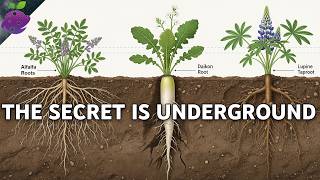
I would avoid it completely. The number one thing you need to grow a beautiful garden is healthy soil. That's what allows your our jasmine and cape honeysuckle and your fotinia and your hibiscus to thrive and bloom properly and not have pest and disease.
I don't know if you've been to a native plant community, let's say like a redwood forest. Why is it in a redwood forest? Everything looks healthy.
There's no aphid. Nobody's putting on any types of pesticides or fungicides. It's a self- sustaining plant community because the soil is being fed by the native plant community and that soil is rich and that soil is full of life, beneficial bacteria, fungi, good protozoa, good neatodes and that's what we're after in our gardens around our house in your garden in order to take care of it in a lazy way.
You're going to get great benefit from soil rich in microbiology. And the way to make your soil rich in microbiology is to either use compost, compost tea or our concentrated products where we take parts of compost and compost tea and we use them in very simple products that you can apply topically. in my life here in recent years, I've started eating healthier >> and by eating healthier, I'm not having to take the medications that I used to take in abundance >> to compensate for that unhealthy eating.
And I don't see really a difference in that and and the great products that I of yours that I use in the in the yard. >> That's an excellent analogy. It's exactly the same thing.
We're trying to um you know, put yogurt in your soil. You know, we're trying to build the microbiology like you're trying to build it in your own gut. And that's the key to good health for people and good health for plants.
Now, all these tips are great and will make you [music] as good as a professional gardener if you use them properly. But another big part of building thriving gardens is knowing what fertilizer to use and not to use. This video will tell you exactly what [music] will help your soil thrive.