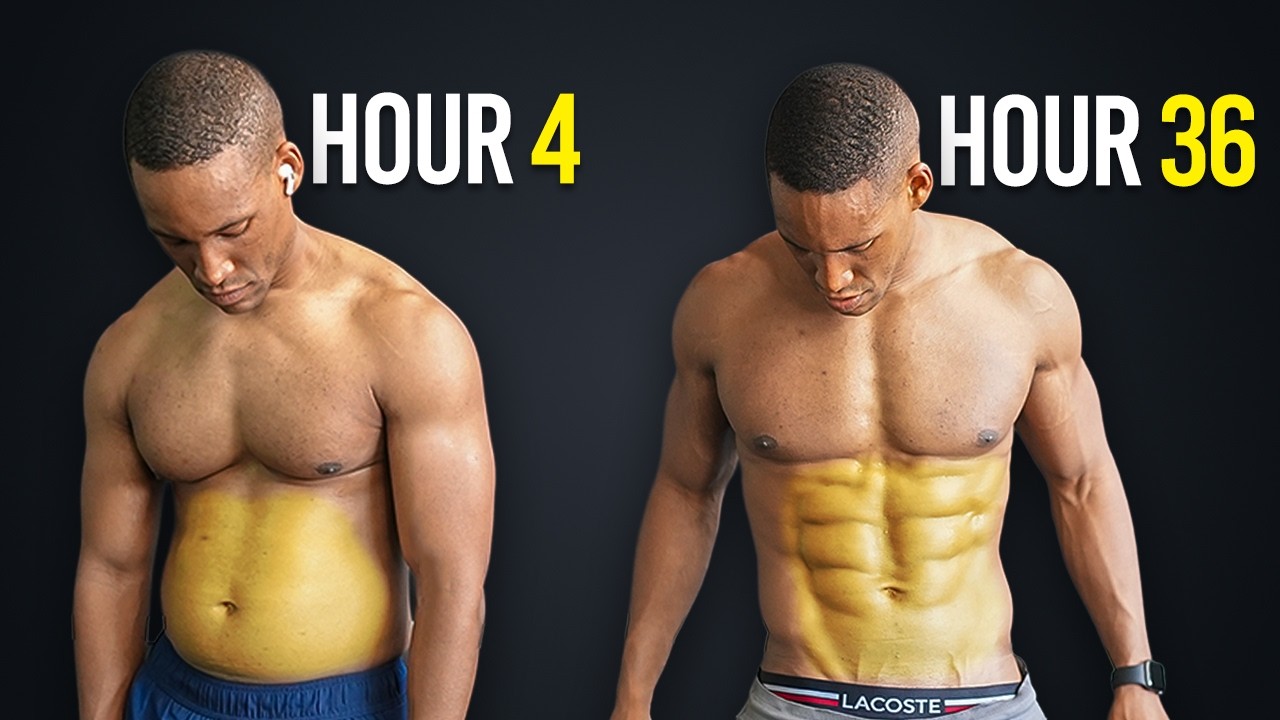
If you need to reset your metabolism to lose fat, kill your cravings, get your energy back, and finally get lean, you need a 36-hour fast. And doctors won't tell you this because they don't know. They never learned it in medical school.
I never did or my team. This is what a 36-hour fast really does to the body. And I've mapped out exactly what happens when you stop eating for 36 hours, especially when it comes to losing fat.
Recently, I got food poisoning, which destroyed my gut. And to fix it, I decided to heal it myself naturally and go through a 36-hour fast. Now, the first 12 hours are exactly what you would expect, but after that, your body enters a state that most people never ever experience.
It activates a cellular process that normally lies dormant because we're constantly feeding ourselves. My name is Dr Michael Diamonds. I am a medical doctor, scientist, and pro-natural bodybuilder.
And today, I'm going to take you through the most comprehensive breakdown of what actually happens inside your body during a 36-hour fast that you never ever see. We're talking about an hourby- hour change that is going to blow your mind. And I've personally done dozens of 24-hour fasts, and this one was my first 36-hour one.
I've guided hundreds of my clients through this process and I've studied every piece of research when it comes to extended fasting and what I discovered will change how you think about hunger metabolism and your body's incredible way of healing itself. So, let's dive into the five distinct phases your body goes through this incredible journey. So, phase one is called the glycogen depletion phase.
This is hours 0 to 12 and it's your body's first energy shift. So, let's start with what happens. There's something fascinating that most people don't know.
In hours 0 to 4, it's called the fed state transition. When you finish your last meal and officially start your fast, your body is still in what we call a fed state. Your insulin levels are elevated.
Your digestive system is working over time. And your body's happily burning glucose from your last meal. Your body stores up to about 400 to 500 g of glycogen in your muscles and roughly 100 to 200 g of that in your liver.
That is the equivalent of about 1,600 to 2,000 stored calories of energy sitting in there just waiting to be used. And most people have no idea that they're walking with this much backup as fuel. Now, during the first 4 hours, insulin starts to slowly decline from your postmeal levels.
And if you ate the typical dinner with carbs, your insulin levels might have spiked and then gradually coming back down towards base levels. Now, hour 4 to 8 is where the metabolic shift begins. This is where things get very interesting and your body realizes, hey, there's no more food coming and we need to start using our reserves.
Now, at this point, your liver becomes the star of the show. It starts breaking down the stored glycogen through a process called glycogenolyis. Basically, your liver is like an energy generator kicking in when the power goes out.
And there's an interesting 2019 study in cell metabolism that showed that the liver glycogen depletion happens at a rate of about 10 to 15 g per hour during fasting. So by hour 8, you've already burned through roughly 80 to 120 g of your liver glycogen stores. Your growth hormone starts to wake up.
One of the main functions of growth hormone is that it increases your metabolism by increasing protein synthesis and also promoting the breakdown of fats called lipolysis and also influencing your carbohydrate metabolism. Normally growth hormone is released in pulses especially during your sleep roughly at that 3:00 a. m.
mark if you're sleeping normal hours. But fasting is one of the most powerful ways to naturally improve your growth hormone stimulators. We're talking about a 2 to 3x increase in just the first 8 hours.
So hour 8 to 12, I call it the hunger games. Here's where most people start thinking that they're going to die from starvation. And the spoiler alert is you're not.
By hour 12, your liver glycogen is about 60 to 70% depleted and your body is getting the message loud and clear. You need to become more efficient at going through your fuel. And ghrein, your hunger hormone, is starting to have a party.
It's spiking to levels that's 30 to 40% higher than base levels, sending those feed me now signals to your brain. That stomach cramp pain you feel, that's ghrein. But here's the secret most people don't know.
This ghrein spike is temporary and it's also largely psychological. Your body isn't in actual danger. This signal will go away.
And I was experiencing it between 30 and 60 minutes. So, here is why you should push through it. Studies from the University of South California showed that people who push through the 12-hour mark report significantly less hunger in subsequent hours.
When my clients go through this fasting period, it actually resets this hunger signal that they always had by pushing through these 36-hour fasts. So, if you have cravings in your hungry all the time, this is one of the ways to fix it. Your insulin sensitivity is already improving.
And a 2020 study published in Nature Medicine found that insulin sensitivity improves by 15 to 20% just overnight. Imagine what happens next. This is the key insight here is that your body is designed for this.
Our ancestors regularly went through 12 plus hours without food. Your body has sophisticated backup systems that aren't being used or even warmed up. So, now we get into phase two.
It's called the metabolic switch. This is from hour 12 to 18. And right now, I want to see as a poll down in the comments below, how long have you fasted?
Let me know what's the longest you fasted or if you practice the 16-hour fasting and let me know what results you've gotten. I think this info to me is super insightful as a coach so I know which levels you guys have gone to and I also think it will inspire some people to try a fast. At this point, your body becomes a fat burning machine.
We're entering the territory where most people never experience this and this is really where the magic happens. So hour 12 to 15, this is the point of no return. This is the moment your body makes a fundamental decision.
It's switching from a sugar burning mode to a fat burning mode. And scientists call this the metabolic switch. And it's an absolutely incredible thing to witness yourself.
At this point, your liver glycogen stores are now 70 to 80% depleted. And remember that 100 to 120 g you started with, you're now at roughly that 20 to 30 g. And your body realizes that we're just not skipping a snack here.
We're meaning serious business. And here's what happens at the cellular level. And this is going to blow your mind.
Your cell starts increasing production of enzymes for fat oxidation. Now, not to get too nerdy, we're talking about carnitine pul transferase, CPT1, the rate limiting enzyme that allows fat to enter the mitochondria and get burned for fuel. And a study in the journal of applied physiology found that this enzyme CPT1 increases by 35% just in 14 hours of fasting.
Your body is literally rewiring itself to become more efficient at fat burning. Now from hours 15 to 18, ketone production begins. This is where things get super exciting.
Your liver starts producing ketones. This is premium fuel for your brain and for your organs. And here's the science.
Your liver runs low on glycogen and it starts breaking down fats, fatty acids through a process called beta oxidation. And these are the byproducts, ketones, specifically accetoacetate, beta hydroxybutyrate, and acetone. By our 18, your blood ketone levels rise from virtually zero to about 0.
5 to 1 mill. And now that might not sound like much, but it represents a complete metabolic transformation. You're now producing your own internal energy source that actually becomes more efficient than glucose.
And research from John Hopskins shows that ketones provide 25% more energy per unit of oxygen consumed compared to glucose. Your body becomes a more efficient machine and your brain also starts to use ketones for fuel. The bloodb brain barrier has specific transporters called monocaroxilate transporters that allows ketones to cross over the bloodb brain barrier to feed the brain.
And this is why most people start reporting mental clarity after extended fast. Your brain is starting to get premium fuel. Now let's go into the ghrelin paradox, right?
It's not all liies in the valley. This is something that surprises a lot of people is that your hunger will start to decrease, right? And I'm sure at this point you're probably like, "Huh?
Shouldn't you be hungrier after not eating for 15 hours? " Your body is essentially saying, "Okay, we get it. No food is coming anytime soon.
Let's stop wasting energy on hunger signals and focus on what we have, our stored fuel. " It's like your body has a built-in wisdom that kicks in once it realizes that you're committed to fasting. And it's incredible if you're thinking about it right now.
Let's get into phase three of five. Deep ketosis and autophagy activation. This is from the hours 12 to 24.
Your body's cellular cleanup crew gets to work. And this is where your body starts doing things that's almost supernatural. We're entering a phase where real transformation is happening.
Our 18 to 21, the ketone explosion. Your liver has now transitioned to ketone production mode. And we're talking about a 400 to 500% increase in ketone production compared to your fed state.
Your blood ketone levels are also climbing towards that 1. 5 to 2 millm moles, which puts you in what research calls nutritional ketosis. But here's what's really wild.
Your brain can now derive up to 60 to 70% of its energy from ketones instead of glucose. I want you to think about that for a second. Your brain, which normally demands 20% of your body's total energy and runs exclusively on glucose, is now running on fat derived fuel.
You're literally training your body to be more resilient. Now, talking about that 21 to 24-hour phase, this is where autophagy goes into overdrive. So, I'll break it down for you.
Autophagy is like your cleanup crew that goes through every cell in your body, identifies damaged protein, worn out organels, and cellular junk, and then breaking them down into recycling components that can be used as fuel. And under normal fed condition, this process operates at about 20 to 30% of its capacity. But after 20 hours of fasting, we're talking about a 300 to 400% increase in the autophagy activity.
And it's groundbreaking. And a study published in cell found that the protein mTor, right, which normally promotes cell growth and muscle growth and suppresses autophagy, decreases by 50% during the extended fast. Before I continue, let me know if you guys enjoy this amount of research in this video, then just leave it with a gentle thumbs up.
I don't know if I do too much or too little, so that feedback will be helpful. And it takes a tenth of a second. Growth hormone search.
Here's where things really get exciting for anyone interested in preserving muscle and burning fat for fuel. Your growth hormone levels are now spiking to incredible levels. We're talking about five times an increase in men and get this, 14 times of an increase in women.
This is exactly why it's called a metabolic reset. This isn't just a minor hormonal fluctuation. This is your body releasing one of the most powerful fat burning machines and muscle burning hormones known to science.
And at this point, if you are a busy professional, you're a business owner, you're entrepreneur, you are an executive, and you've been struggling to get your energy right, you're feeling tired, you want to work with a team of doctors who know their science, fill out the first application linked in the description to work with me and my team of medical doctors. will get you in great shape. So, this is what growth hormone does.
It tells your body, hey, you're in a fasted state. Let's preserve our muscle mass and let's use our stored fat instead. And research from the University of Virginia found that growth hormone surge is so significant that it completely counteracts any potential muscle loss during the short-term fasting.
Your body is literally protecting your muscle while accelerating fat loss. So, for all of those who are afraid of losing muscle, don't worry. You're good.
At this stage, insulin sensitivity skyrockets. By hour 24, your insulin sensitivity has improved by 30 to 40% compared to your fed state. This means that when you do eat again, your body is going to get incredibly efficient at using nutrients instead of storing them for fat.
So, the moment you put food in, that food is put to work. A 2018 study in cell metabolism found that even a single 24-hour fast can improve insulin sensitivity for up to 72 hours afterwards. And these are one of the things we start doing with our clients immediately.
You're essentially giving your insulin receptors a reset button. And think about this, in just 24 hours, you've transformed your body into a fat burning, muscle preserving, cellular optimizing machine. And we're not even done yet.
Now in phase four, this is peak metabolic transformation. This is that hour 20 to 30. This is where the body reaches levels of metabolic efficiency that our ancestors experienced all the time, right?
And we've just never accessed it. Now our 24 to 27, we have maximum fat oxidation. And studies show that fat burning peaks at around 160 mg per minute during this phase.
That's nearly triple the rate of fat oxidation in a fed state. Now, here is what's incredible. Your liver is now producing ketones at such an efficient rate that your blood ketone levels reach 2 to 3.
5 millles. Now, for reference, diabetic ketoacidosis, that's the dangerous condition, doesn't occur until your ketones reach 15 to 20 millles. So, you're nowhere near dangerous levels and you're in an optimal therapeutic range.
And on top of that, your respiratory quotient, RQ, it's a measure of your fuel that your body's using has dropped to 7 to 75, indicating that you're burning almost pure fat for fuel. And comparing that to the fed state, your RQ of8 to 1, where you're burning a mix of carbohydrates and fats. And there's a 2019 study from Yale that showed people in deep fasting states were burning fat at rates that normally would require two to three hours of moderate exercise.
Except you're doing all of this while you're sitting on your sofa. Now hours 27 to 30, cellular regeneration starts peaking. This is where autophagy processes reaches absolute peak.
The cells are now operating at the most efficient phase and the molecular biology here is mind-blowing. So these are the key autophagy markers. It's called LC32 and it increases by 300 to 400% while P62, a marker for cellular junk, decreases dramatically.
Your cells are literally cleaning up in the deepest level. But here's what's really exciting. It's called neuronal autophagy.
Research shows from PMC that the brain's autophagy increases by 400% in an extended fast. This means your brain is cleaning out all of its damaged proteins and reducing risks of neurodeenerative diseases like Alzheimer's for example. The protein deposits associated with Alzheimer's disease.
Your brain is essentially taking out the trash that accumulates from daily living. Now you also get a BDNF boost. Brain derived neurotrphic factor BDNF often called the miracle growth for brain or the fertilizer for brain.
and it increases by 200 to 300% during this phase. BDNF promotes the growth of new brain cells. It strengthens connections between neurons and protects existing brain cells from damage.
This is why so many people report mental clarity during extended fasts. Your brain isn't just running on premium fuel, which is the ketones. It's actively upgrading its hardware.
By hour 30, your hormonal profile also looks completely different. Growth hormone is five to 14 times higher. Insulin is 50 to 70% lower.
Cortisol, optimally elevated for gluconneogenesis, norepinephrine increased by 40 to 50%, boosting your metabolism. This hormonal cocktail creates the perfect environment for fat loss, muscle preservation, and cellular repair. It's like your body's activated its own internal optimization program.
Finally, the phase five of this is the reset and recovery. In this phase, your body is preparing for the eventual return to feeding while maximizing the benefits that you've gained. So, from hour 30 to 33, we get this metabolic flexibility peak.
Your body has now achieved what researchers call peak metabolic flexibility. This is the ability to seamlessly switch between fuel sources and you've just spent 30 hours training in the system. Your mitochondria, the powerhouse of your cells, are operating at peak efficiency.
And research from Harvard shows that extended fasting increases metabolic biogenesis. The creation of new mitochondria, and that's by up to 40%. You're literally growing more cellular power plants in your body.
From hour 30 to 36, the preparation phase. This is where your body starts preparing for refeeding while maintaining all the benefits that you've achieved. Your digestive system has now been in reset mode for over 30 hours, beginning production of small amounts of digestive enzymes in anticipating food.
This is completely controlled by your circadian rhythm and completely neutral. and growth hormone also remains elevated, ensuring continued muscle preservation and fat burning until you break your fast. Your insulin sensitivity is also absolutely peaking.
And when you do eat, your body will be primed to use your nutrients optimally and these are the cognitive benefits. By hour 36, many people report intense mental clarity and focus through this fast. And research shows that the ketones provided a more stable energy source compared to glucose, which can cause energy spikes and crashes.
Your brain has been running at premium fuel for hours, and it shows. Now, what to do when breaking the fast, the critical window. Here's something most people get wrong.
The way you break your fast is important as well. After 36 hours, your digestive system is in a very sensitive state. Your first meal should be small.
I'm talking 300 to 400 calories, easily digestible, and focus on nutrients more than satisfaction. Bone broth, I recommend steamed veggies. Your insulin sensitivity is so high right now that even a small amount of carbohydrates will trigger a very powerful anabolic response.
Avoid those binging temptations. Your stomach is actually shrunk slightly and those satiety signals are incredibly sensitive. You'll likely feel full on a lot less foods.
And the incredible results, you've accomplished this 36-hour fast. You have a metabolic reset. You trained your body to efficiently burn fat.
You've had your cellular cleanup. You've activated autophagy to clean your cells junk and your damaged proteins. Your hormones are optimized.
You've boosted growth hormone. You've improved your insulin sensitivity. Your brain has increased brain fertilizer, BDNF.
Your inflammatory markers are lower and it's marked throughout the body. Metabolic flexibility and cellular function can last for 72 up to 96 hours after breaking your fast. I'll leave the video there.
If you're not a healthy individual, then I wouldn't recommend doing a fast and I'm putting a list of people who should be weary. But let me know if you guys enjoyed this video. If you want to see what foods you should be eating specifically after a fast or how to build a plan, watch this video right here.
It's incredible. And I'll see you guys in the next one.