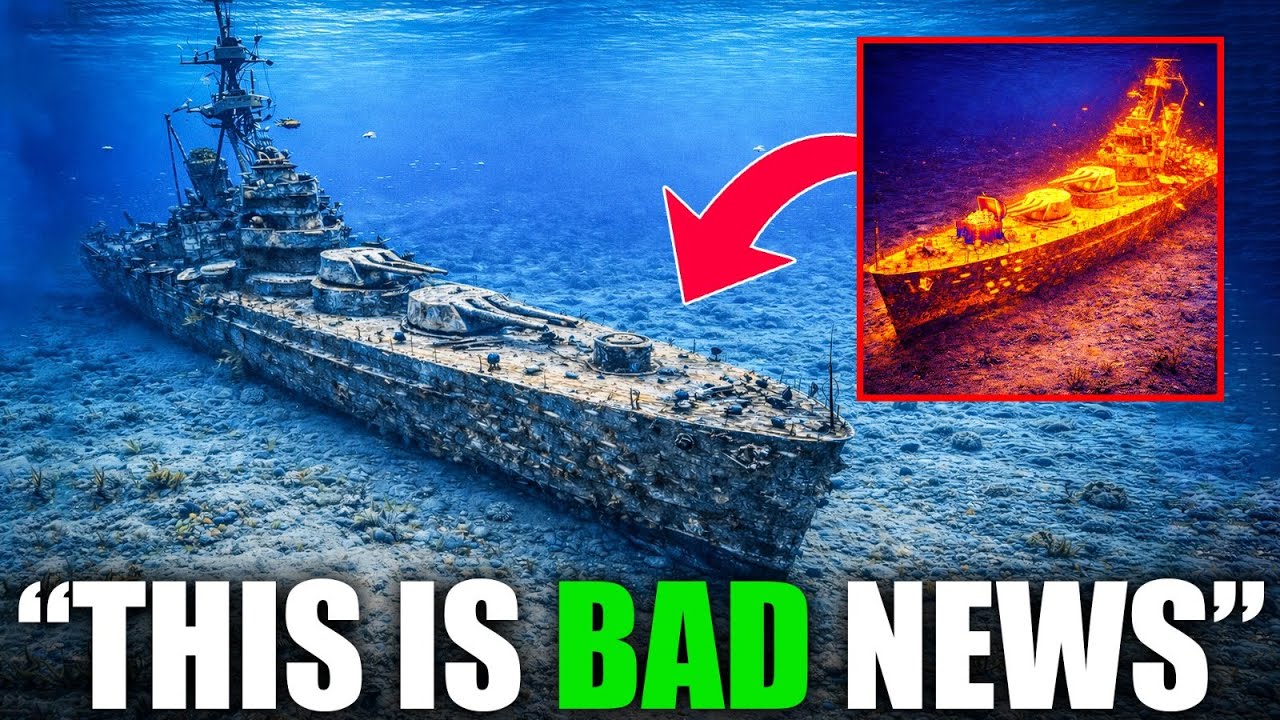
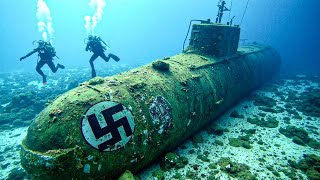
At the end of May 1941, some of the world's most powerful warships jeweled in the middle of the Atlantic. All revolving around the flagship of the Germans marine, Bismar. They told us the Bismar was a tomb, a silent mountain of steel resting in the crushing darkness of the Atlantic.
We thought we had mapped every inch of her broken hull. From the shattered gun turrets to the debris fields scattered across the ocean floor, but we were wrong. A state-of-the-art submarine drone just uncovered a sealed chamber no one knew existed.
And here is the part that no one is ready for. It is not empty. It is warm.
It is signaling. And it has been sealed tight since 1941. >> The world had almost turned upside down.
What on earth could the could the Bismar do next? >> What is pulsing behind those armored walls? A forgotten experiment?
A warning system still running on 80-year-old batteries? Or something even more disturbing that defies explanation? The dive and the heat anomaly.
The Atlantic Ocean is a place of absolute crushing finality. Once you go down past a certain depth, the world of the living vanishes. The sunlight fades into a twilight blue and then into a heavy suffocating black that has existed for millions of years.
This is where the Bismar lies, resting 3 miles down or roughly 16,400 ft below the surface. To put that into perspective, that is deeper than the height of M Blanc stacked on top of itself. At that depth, the pressure is over 6,000 lb per square in.
It is enough to crush a standard submarine like a soda can in a fraction of a second. For decades, the only way to see the wreck was through tiny port holes of manned submersibles or grainy footage from early remote vehicles. But 2024 was different.
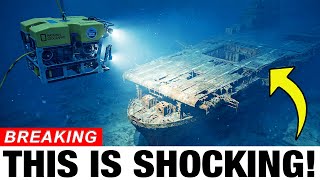
This was the year researchers deployed the Prometheus 10, a Hadal class submarine drone built with one purpose, to go where humans physically cannot. This machine is a beast of engineering designed to withstand pressures that would pulverize titanium. It was equipped with multisspectral scanners, thermal imaging arrays, and a level of autonomy that allowed it to make split-second decisions in pitch black conditions.
When the team lowered it into the water, the mood was electric, but also tense. They were looking for structural details, maybe some new damage assessments for the historical record. Nobody expected the history books to be rewritten that day.
As the drone descended, the telemetry monitors on the surface ship glowed with the usual data, depth increasing, temperature dropping. By the time Prometheus 10 reached the bottom, the water temperature should have been barely above freezing, a consistent flat line of cold death. That is how the deep ocean works.
Everything down there is frozen in time, motionless, and devoid of heat. But then the thermal alarm on the control deck started blinking. At first, the lead technicians thought it was a glitch.
They tapped the screens, rebooted the sensor arrays, and assumed the drone was malfunctioning. But the data held firm. As the drone glided over the port side of the hull, scanning the massive armor belt that once protected the ship from British torpedoes, the sensors picked up a spike.
It was faint, barely a fraction of a degree warmer than the surrounding abyss. But down there, that is a massive red flag. Metal that has been sitting in freezing water for over 80 years does not generate heat.
It physically cannot. The drone moved closer, its thrusters kicking up small clouds of silt that had settled decades ago. The camera focused on a section of the hull that had always been overlooked.
It was a 320 mm thick armored wall, a section of the citadel that had remained sealed through the sinking and the violent impact with the seafloor. The heat was radiating from behind that wall. This discovery sent a shock wave through the control room.
You have to understand, ships usually cool down to the ambient temperature of the ocean within hours of sinking. For the Bismar to still be emitting thermal energy implies an active source. Some experts immediately jumped to chemical theories.
They argued that perhaps the metals were breaking down in a way that created an exothermic reaction, a slow rust fire burning in the absence of oxygen. But the chemistry did not add up. The reaction was too steady, too localized.
It was concentrated directly behind a specific reinforced bulkhead. Theories started flying around the room. Could this be the ship's electrical nerve center?
Historians pointed out that the Bismar had independent oxygen scrubbers and backup battery banks designed to keep critical systems alive even if the main engines failed. But those batteries were lead acid or nickel iron. They would have corroded and died 70 years ago.
There is no known battery technology from the 1940s that could hold a charge this long, let alone generate heat. Then the whispers started. Was there classified equipment inside?
something the German Navy never documented in the official logs. We know that toward the end of the war, technology was advancing at a terrifying rate. There were rumors of experimental power modules, sealed gyrobased targeting systems that could survive massive trauma, and magnetic anomaly sensors that were years ahead of their time.
But even prototype tech needs a power source, unless the power source was something entirely different. The drone operator adjusted the contrast on the thermal feed. The heat signature wasn't a blob.
It had geometry. It looked almost rectangular, like a bank of servers or a row of capacitors running in standby mode. The implication was impossible.
Yet, there it was on the screen. The Bismar wasn't just a dead wreck. A specific part of it, a room deep within its armored gut, was acting like it was still alive.
And if something is generating heat, it means something is consuming energy. The team decided to move in closer. Prometheus 10 extended its manipulator arm, not to touch, but to get the sensors as close to the metal as physically possible without triggering a collapse.
They needed to know if this was a natural phenomenon or something artificial. And that is when they saw the warping. The steel plates around the heat source weren't just rusted.
They were distorted, bent outward slightly, as if something inside was pushing against them, or as if the pressure inside the room was different from the crushing weight of the ocean outside. This changed the mission instantly. It went from a survey dive to an investigation of an anomaly that defied the laws of physics.
The ocean is supposed to claim everything eventually. It crushes, it corrods, and it erases. But this chamber was fighting back.
It was maintaining its own environment. And just when the team thought they had seen the weirdest part of the dive, the external cameras picked up something on the surface of that warm steel that made everyone in the control room go silent. But here is the catch.
The heat was just the invitation. What they found physically clinging to the hull was the warning, the mystery of the synthetic residue. The drone hovered inches from the warped plating.
The lights from Prometheus 10 cut through the darkness, illuminating the scarring on the battleship's side. But the researchers weren't looking at the rust anymore. They were looking at a substance that had no business being 3 mi underwater.
Around the seams of the sealed plating, oozing out from the microscopic cracks in the armor was a thin, oily film. It was transparent, shimmering slightly in the artificial light, almost gelatinous. In the deep ocean, you expect to see biological growth.
You see rusticles, which are icicle-like formations of rust created by iron eating bacteria. You see algae, deep sea coral, or just thick layers of silt. You do not see clear, viscous slime that looks like industrial lubricant.
The lead scientist commanded the drone to take a sample. This was a delicate operation. The manipulator arm of the Prometheus 10 is precise enough to pick up a wine glass without breaking it, but scraping a sample off a decaying battleship requires nerves of steel.
One wrong move could destabilize the plating or damage the drone. Slowly, the mechanical claw extended. A suction sampler tip pressed against the hull.
When the sample was brought back to the surface hours later, the analysis began immediately. The team expected it to be some strange deep sea bacteria or perhaps a pocket of fuel oil that had leaked and congealed over decades. Fuel oil from World War II ships is a common find.
It turns into a thick black sludge, but this was not black and it was not sludge. Under the microscope, the substance was clean. It didn't have the cellular structure of biological material.
It wasn't bacterial. It wasn't fungal. and it wasn't hydrothermal discharge.
It was synthetic. The chemical breakdown revealed a polymer-like structure rich in silicone and lithium compounds. This result baffled the lab at Geomar.
Silicone polymers of this grade were not standard issue in 1941. While silicone research existed, it was in its infancy. This material looked like a decaystabilized energy gel, something you might find in a modern damping system for high-tech electronics or nuclear cooling arrays.
It was thermally reactive. When they placed a tiny drop of it in a vacuum chamber to simulate the pressure of the deep, it didn't freeze or shatter. It thickened.
It reacted to the pressure by becoming more durable, almost like a seal that gets stronger the harder you push on it. A chemical engineer on the team went on record hesitantly, calling it a smart fluid. But how could a battleship built in the late30s possess a fluid that behaves like modern aerospace technology?
This fueled a new wave of theories. Was the chamber that the drone found a storage unit for experimental materials? We know the German war machine was desperate for advantages.
They were experimenting with synthetic rubber, advanced fuels, and rocketry. Was this gel part of a vibration insulation system? Imagine a room housing delicate prototype radar equipment or a mechanical computer.
If the ship fires its massive 15-in guns, the shock wave would shatter glass vacuum tubes instantly. You would need a shock absorption system. This gel could be the hydraulic fluid for a shock mounted room, a ship within a ship designed to keep sensitive gear safe, even if the rest of the vessel was being blown apart.
But there is a darker theory. Some historians have pointed to the whispers of Project Navalhorn, a rumored initiative to create sealed command compartments that could survive the sinking of a vessel. The idea was borrowed from early Yubot innovations, create a capsule that could withstand the crush depth, preserving the codes, the machinery, and perhaps even the crew inside for a retrieval that never came.
The presence of lithium in the sample is the smoking gun for many. Lithium is a key component in batteries and energy storage. Finding it in a liquid suspension leaking from a warm room suggests that whatever is inside is leaking battery fluid, but not the acid kind we know.
It suggests a highdensity power storage medium that has degraded into a semi-liquid state but is still chemically active. The conspiracy theorists of course went full throttle. They looked at the clear preserving nature of the gel and started talking about cryogenics or biopreservation.
While that sounds like science fiction, the concept of medical preservation was being explored, albeit crudely, during the war. Was this residue evidence of a failed attempt to keep something or someone in a state of suspended animation? It sounds insane until you remember the heat signature.
A chemical reaction breaking down this much lithium gel would generate heat. So, we have a sealed room. It is generating warmth.
It is leaking a synthetic fluid that acts like a pressure seal. And it is sitting in a ship that was supposed to be dead technology. The researchers were already on edge, trying to make sense of the chemistry when the ocean decided to throw them another curveball.
The drone went down for a follow-up dive. They wanted to see if the leak was growing. They wanted to map the extent of the heat.
But nine hours into the descent, the sensors stopped looking and started listening. And what they heard turned the confusion into genuine fear. It is not that simple, though, because the ship wasn't just leaking fluids.
It was trying to speak. The impossible signal. Sound travels beautifully underwater.
Whales can communicate across oceans. Submarines can hear a propeller turning from miles away. But the deep ocean is usually a place of natural noise.
the shifting of tectonic plates, the groaning of the wreck settling in the mud, the flow of currents. It is a chaotic random soundsscape. But what Prometheus 10 picked up was not random.
The drone's acoustic sensors were running a standard passive sweep, listening for the structural groans that might indicate a collapse was imminent. Suddenly, the audio visualizer spiked. A sharp rhythmic ping cut through the static.
It bounced off the inner wall of that sealed chamber and echoed out into the water. At first, the team assumed it was feedback. Sonar pings can bounce weirdly in tight spaces.
Maybe the drone was hearing its own thrusters reflecting off the armor plate. They cut the thrusters. The drone drifted in silence, hovering in the void.
The sound continued. Three short pulses, three long pulses, three short pulses. silence.
Then 62 seconds later, it repeated. The silence in the control room on the surface was absolute. Everyone knew what that pattern was.
You learn it in Boy Scouts. You see it in movies. It is the universal cry for help.
SOS. But ships do not send Morse code anymore. And certainly sunken battleships do not send Morse code.
The electrical systems on the Bismar were destroyed by shellfire. and seawater before she even slipped beneath the waves. Even if a generator had miraculously survived, it would have run out of fuel in 1941.
Even if there were batteries, they would be dead. So, how was a pattern of distinct rhythmic pulses originating from inside the wreck? The technician analyzing the waveform noted the precision.
It wasn't a human tapping on a hull. That would sound organic, irregular. This was mechanical.
It was precise to the millisecond. This suggested an automated system. An old naval historian aboard the expedition remembered a footnote in a declassified operations manual.
He pulled up a digital file on his tablet searching for emergency protocols. He found a reference to a lastditch distress system. The protocol involved pre-programmed electromagnetic relays.
These were simple, rugged devices, basically clockwork mechanisms connected to a heavyduty capacitor. If a ship were lost and if the main power died, this system could be triggered to emit a low-frequency pulse using a dedicated sealed chemical battery. The idea was to help salvage crews find the wreck.
But those systems were designed to run for 48 hours, maybe a week at most, not 80 years. This is where the signal 9 theory comes into play. The pulses were separated by exactly 62 seconds.
Why 62? Why not 60? Why not 10?
In German naval coding, specific time intervals were used to denote the status of the vessel. 62 seconds was not a standard interval for I am sinking. It was a specific obscure interval that some researchers believe indicated vessel sealed, cargo intact.
The implications were terrifying. Was there a machine inside that room that had been waiting, dormant for eight decades? Perhaps the arrival of the drone, the lights, or the active sonar pings from Prometheus 10 had woken it up.
Some systems are designed to be acoustic activated. They sit in standby mode, consuming zero power until a specific frequency hits them, triggering a chemical reaction that brings the battery to life for one final broadcast. Had the researchers accidentally turned the key?
The SOS repeated four times over a 6-inute span. Then it stopped. The silence that followed was heavy.
It felt like the ship had spoken and then gone back to sleep. But the data was recorded. It was real.
Some skeptics tried to debunk it immediately. They claimed it was magnetic reverb, a phenomenon where the metal of the ship interacts with the ocean's magnetic field and releases stress in rhythmic bursts. But magnetic reverb doesn't spell SOS.
Others suggested it was a prank by a hacker interfering with the drone's feed, but the signal was localized to the hydrophone on the drone 3 m deep. You cannot hack that from the surface without leaving a trace. The most chilling possibility remained.
The system was working exactly as intended. It was a beacon. But a beacon for whom?
And if a machine was still running inside, protected by that strange gel and generated heat, what was it guarding? The answer might lie in the paperwork that never made it to the history books. Because when they checked the crew manifest against the size of the sealed area, the numbers didn't add up.
And that is putting it lightly because 32 men were about to become very important. The ghost crew of the Citadel. History is written by the victors, but it is also written by the bureaucrats.
And bureaucrats love lists. Every sailor, every cook, every mechanic on a warship is accounted for. The Bismar was no exception.
We have the lists. We know that over 2,200 men went into the water. We know that only 114 were pulled out alive.
It is a tragedy of immense scale. But recently, a German naval historian named Clara Hennes started digging into files that had been gathering dust in a basement in Keel. She was cross-referencing the official crew lists with the logistical ledgers from the companies that supplied the ship.
That is when she found the discrepancy. There were 32 names on the provision logs, men who were issued bunks, rations, and security clearances who did not appear on the official naval roster. Who were they?
Hennis tracked their affiliations. They weren't standards marine sailors. They were listed as technical specialists.
Their employment records traced back to civilian contractors. Seaman Shukert, Lawrence, and Telefuncan. These were the giants of German technology.
Seamans built power systems. Telefuncan built radios and radar. Why would 32 civilian engineers be on a battleship heading into a combat zone?
And why were their names scrubbed from the final casualty reports? Typically, when a civilian contractor dies at sea, there are insurance payouts, letters to widows, and legal proceedings. For these 32 men, there was nothing.
No letters, no memorials. It was as if they ceased to exist the moment they stepped on board. Henish found a single internal memo dated February 1941.
It referenced a special detachment assigned to compartment B. The memo stated that this detachment would operate under a total blackout protocol. They were to bypass the captain and report directly to a specialized technical command in Berlin.
This suggests a ship within a ship. A group of men working in a sealed environment guarding technology that was so secret even the ship's commander might not have had full clearance to see it. Now look at the sealed chamber the drone found.
It is located deep in the Citadel, the most protected part of the ship. It has independent life support connections. It is shielded by armor.
And now we know it is full of civilian experts who vanished from history. The pieces start to fit together in a disturbing way. If you were testing a new type of communication system, a new cipher machine, or a prototype guidance system, you would need engineers to run it.
You would put them in a secure room. And if the ship went down, that room designed to protect the technology might also become a tomb. But not just a tomb, a bunker.
The Project Nebblehorn theory suggests that Command 9 was a directive to seal the chamber in the event of catastrophic damage. The goal was to preserve the data and the prototypes at all costs. But what about the men?
Were they sealed in there, too? The heat, the gel, the SOS, they all point to a life support or preservation system that tried to do its job. The idea that 32 men could survive for 80 years is of course impossible.
But the idea that they were part of a mechanism meant to survive is not. It gets darker. If those men were civilians, they might not have been bound by the same codes as the sailors.
They were there for the machine. And when the water came rushing in and the bulkheads slammed shut, they were left alone in the dark with their creation. The drone scans showed no way out of that chamber.
No hatches were open. The bolts were rusted shut, but they were engaged from the inside. Someone locked the door, and if they locked the door, they might have left a message.
Basically, the drone didn't just find a room, it found a crime scene or a sanctuary. And then, just as the team was processing the reality of the missing men, the audio sensors picked up one final transmission that shattered every assumption they had made. So, here's the question.
If that system is still active, and if it was designed to protect something so vital that it was sealed in a fortress of steel, should we try to open it? Or are some secrets better left at the bottom of the ocean? Let us know what you would do in the comments below.
And if you enjoyed this video, hit that like button and subscribe for more mysteries from the abyss. Thanks for watching.