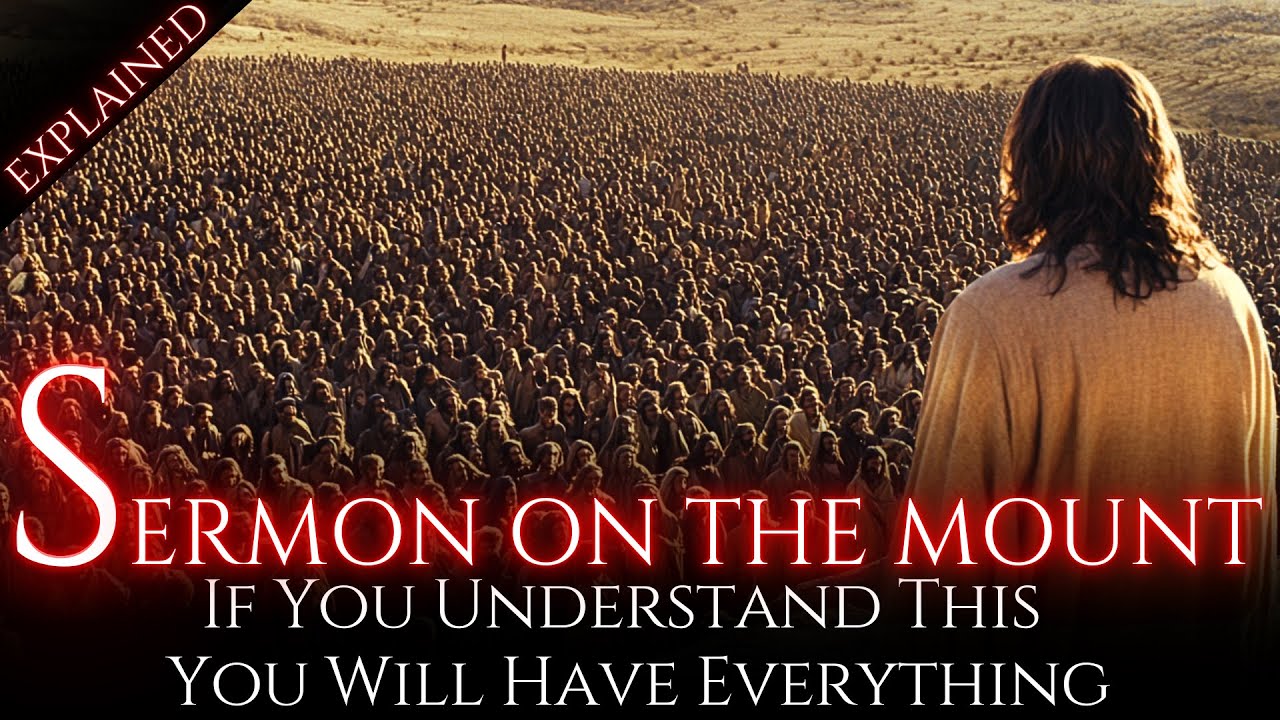
Over 2,000 years ago, on a quiet hillside in Galilee, something happened that would echo across every generation. The wind stirred through the olive trees. A crowd gathered, restless, farmers, mothers, zealots, beggars, all drawn by rumors of a man unlike any other.
Not a king, not a rabbi like the rest, not a soldier or a prophet calling for war, but a carpenter from Nazareth, a man who would speak, and the world quietly, irrevocably would begin to turn. And then he sat down. No throne, no platform, just a rock and a voice.
And with that first word, blessed, the ground beneath the old world began to crack. What followed became known as the sermon on the mount. But it was never meant to be just a sermon.
It was a revolution of the heart, a collision between heaven's values and earth's assumptions. And if you really hear what Jesus said that day, it will challenge your ideas of strength, success, justice, even what it means to follow God. So why does this message still matter?
Because in a world like ours filled with anxiety, division, betrayal, and noise, Jesus didn't just teach us how to live. He revealed the kind of people God calls blessed. And it's not the rich, the powerful, or the loud.
It's the poor in spirit, the peacemakers, the ones who mourn, the merciful, the forgotten. You're about to see why Jesus said that the meek, not the dominant, will inherit the earth, and how that one phrase still breaks every rule the world believes about power. And later in this video, we'll uncover something even deeper, a hidden thread running through the entire sermon, one that leads straight to the kind of foundation your life is really built on, and the storm that will test it.
So stay with me. Because what Jesus taught on that hillside wasn't meant for the crowd that day. It was meant for you right now.
And the question is no longer whether you've heard his words, but whether you're ready to live them. He opened his mouth and began to teach them, saying, "Blessed are the poor in spirit, for theirs is the kingdom of heaven. " With that one sentence, Jesus overturned everything the world thought it knew about blessing.
In that moment, Matthew 5:3, Jesus wasn't just giving comfort. He was redefining reality because the crowd that stood before him had lived under Roman oppression. They had been taught that blessing looked like wealth, status, or religious perfection.
But Jesus looked at the broken, the outcast, the humble, and called them blessed. Not because of what they had, but because of who they were becoming. Blessed are the poor in spirit, not the arrogant or self-sufficient, but those who recognize their deep need for God, the spiritually bankrupt, the ones who come to the throne not with trophies, but with empty hands.
Jesus says that's where the kingdom begins. And then he continues, "Blessed are those who mourn, for they shall be comforted. " Matthew 5:4.
This isn't shallow sentiment. It's not keep your chin up. It's a divine invitation to feel, to weep over brokenness, sin, injustice, and to know that your tears are not wasted.
Jesus promises comfort not by removing sorrow, but by walking into it with us. Blessed are the meek, for they shall inherit the earth. Matthew 5:5.
Now, this is where the crowd likely froze because meekness was not a virtue in that world or in ours. It sounded like weakness. But in Jesus' kingdom, meekness is controlled strength.
It's the waror trained to move only at its master's command. It's having the power to retaliate and choosing instead to love. And here comes the hunger that drives the rest of the sermon.
Blessed are those who hunger and thirst for righteousness, for they shall be filled. Matthew 5:6. Jesus is speaking to those who feel the ache.
Those who long not just for justice in the world, but for holiness in themselves. This isn't spiritual apathy. This is desperation for the life God created us to live.
And then the turn comes. Jesus begins to describe the kind of people who not only receive grace but reflect it, the merciful, the pure in heart, the peacemakers. He paints a portrait of a kingdom citizen not defined by domination but by transformation, not by outward power, but by inward purity.
And just when it seems like blessing means comfort and reward, Jesus drops the last line. Blessed are those who are persecuted for righteousness sake. Matthew 5:10.
Blessed not despite the persecution, but in it. Because when you live like this, you will not fit the world system. And that Jesus says is exactly where the kingdom begins to shine.
What Jesus said next must have shocked even his closest followers. Do not think that I have come to abolish the law or the prophets. I have not come to abolish them, but to fulfill them.
Matthew 5:17. The crowd likely held its breath because these were not casual listeners. They were people shaped by centuries of tradition raised on the law of Moses.
And now Jesus was speaking as if he had authority not just to interpret it but to complete it. But he wasn't discarding the commandments. He was reaching deeper past the surface into the soul.
You have heard that it was said to those of old, "You shall not murder. " But I say to you, Matthew 5 21. Here it is, not a change in the law, but a piercing of the heart behind it.
Jesus says that anger, the kind that simmers and stews, is the root of murder. That insults and bitterness are not lesser sins, but early signs of a life disconnected from love. In other words, it's not just about what your hands do.
It's about what your heart harbors. And he doesn't stop there. You have heard that it was said, "You shall not commit adultery.
" But I say to you. Matthew 5 27. Now he addresses lust.
Not just the act, but the intent, the glance that lingers, the imagination that wanders. He isn't adding rules. He's revealing how deeply holiness reaches.
not to restrict us but to set us free from the things that silently corrode our souls. Jesus is peeling back the layers. And in doing so, he shows us that God's law was never meant to be just behavior management.
It was always about love, love for God and love for people. That's why he says, "Unless your righteousness exceeds that of the scribes and Pharisees, you will never enter the kingdom of heaven. " Matthew 5:20.
That would have landed like thunder. Because the Pharisees were seen as the gold standard of righteousness. But Jesus is pointing to something higher.
Not more rules, but more depth. Not stricter performance, but deeper surrender. This is not a heavier burden.
It's a different kind of righteousness. The kind that only begins when we stop trying to impress God and start letting him transform us from the inside out. And if that sounds impossible, maybe that's exactly the point.
Now Jesus says something that doesn't just stretch the mind, it confronts the heart. You have heard that it was said, "Love your neighbor and hate your enemy. " But I tell you, love your enemies and pray for those who persecute you.
Matthew 5:43-44. This isn't a metaphor. He means it.
In a culture built on honor and revenge, where Roman soldiers could strike you with impunity and the Zealots dreamed of violent revolution, Jesus wasn't just challenging personal grudges. He was undermining the very system of retaliation that defined their world. and ours.
Because if we're honest, loving our enemies is still the command we avoid. It sounds beautiful until it costs something. Until the enemy has a name, a face, a memory, until forgiveness feels like injustice, until blessing the one who hurt you feels like betrayal.
But listen to what Jesus says next. That you may be children of your father in heaven. Matthew 5:45.
This isn't about being nice. It's about becoming more like God. Because our father, the one we claim to follow, sends his reign on the righteous and the unrighteous.
He gives breath to those who praise him and to those who curse his name. His love is not reactive. It's redemptive.
And that's the model Jesus gives us. Not weakness, not silence in the face of abuse, but a love that refuses to mirror the hatred it receives. A love that breaks the cycle of retaliation by choosing mercy instead of vengeance.
Because anyone can love those who love them. Jesus says even the most corrupt people do that. But enemy love, that's divine.
And this is where the sermon on the mount turns from inspiring to unsettling. Because Jesus isn't giving us suggestions. He's describing what kingdom people look like.
And this is at the center of it. Not just loving our family or friends. Not just being kind to those who agree with us, but learning how to extend compassion where it's least deserved.
Because that's exactly what God did for us. Later in this video, we'll see how this same principle shows up again when Jesus warns about judging others because underneath both teachings is the same truth. How you treat the people who hurt you says more about your faith than how loudly you worship.
And the more you understand the cross, the harder it becomes to withhold the kind of love that saved you. Do not judge or you too will be judged. That's how Jesus opens Matthew 7.
And it's one of the most quoted and misunderstood verses in the entire Bible. Because Jesus isn't saying abandon discernment. He's not telling us to ignore sin or silence truth.
He's warning us about something far more dangerous, hypocrisy disguised as righteousness. He continues, "Why do you look at the speck of sawdust in your brother's eye and pay no attention to the plank in your own? " Matthew 7:3.
Can you picture it? A man walking around with a wooden beam jutting from his eye, trying to fix someone else's tiny floor. It's absurd.
And that's the point. Jesus uses exaggeration not to shame, but to expose. He's showing us how easy it is to become blind to our own brokenness while obsessing over someone else's.
The issue isn't correction. It's pride. It's the spirit that says, "I would never do that.
" The voice that feels justified in pointing fingers because its own sins are more socially acceptable. The heart that forgets it too needs grace every single day. And Jesus doesn't leave it at mockery.
He offers a path forward. First take the plank out of your own eye and then you will see clearly to remove the speck from your brother's eye. Matthew 7:5.
This is powerful because it's not a call to silence. It's a call to humility. It's a reminder that real correction only works when it begins with repentance.
So ask yourself, when was the last time you examined your heart before correcting someone else? What if the goal isn't to win a moral argument, but to help restore someone with the same mercy that God keeps extending to you? And what if just like in the biatitudes, the people God blesses aren't the ones with perfect eyes, but the ones willing to be honest about their blindness.
We'll see this thread again in just a moment when Jesus gives us a blueprint for how to treat others and ties it to the entire story of scripture. But before that, take this with you. The ones who see clearly are those who've allowed God to deal with what's clouding their own vision.
So in everything, do to others what you would have them do to you. For this sums up the law and the prophets. That's Matthew 7:12, the heartbeat of Jesus' teaching.
We call it the golden rule. But we rarely grasp how radical it really is. Because Jesus isn't just saying avoid harm.
That would be easy. It would only require staying quiet, staying distant, staying uninvolved. But what he calls us to is something active.
Proactive mercy. It's not don't do what you wouldn't want. It's go do what you would hope for.
That means taking the first step. It means imagining what someone else needs and then meeting them there even if they never return the favor. It means choosing kindness before it's earned, compassion before it's convenient.
This is not emotional sentiment. It's spiritual warfare. the kind that pushes back against a world of indifference and self-interest.
And what's even more stunning is what Jesus attaches to it. This sums up the law and the prophets. In other words, all the commandments, all the covenants, all the ancient scrolls, they find their fulfillment in this one posture.
Treat others the way you would want God to treat you. So, what does that look like when you're misunderstood, you're mistreated, you're ignored? Jesus doesn't just want us to answer that with words.
He wants us to live it. And here's the challenge. In a little while, we'll hear him tell us not to worry about our lives.
But maybe part of the reason we're so anxious is that we're trying to control others instead of loving them. Because the more you live with open hands toward people, the more you begin to trust that God is holding you. This golden rule isn't soft.
It's bold. And when it's practiced by spirit-led people, it can change everything, marriages, communities, even enemies. But to live like this, you have to let go of the fear that says, "If I don't protect myself, no one will.
" Therefore, I tell you, do not worry about your life. That's how Jesus begins one of the most tender and yet challenging parts of the sermon on the mount. Matthew 6 25.
And let's be honest, that sounds almost impossible. Don't worry, in a world like ours with bills, sickness, deadlines, uncertain futures. But Jesus isn't dismissing the weight we carry.
He's not offering shallow optimism. He's pointing us to a different kind of security, one that doesn't depend on circumstances, but on a father who sees. Look at the birds of the air, he says.
They do not sow or reap or store away in barns. And yet your heavenly father feeds them. Are you not much more valuable than they?
Matthew 6 26. It's a simple image, a bird flying free. Not because life is easy, but because provision is certain.
And Jesus isn't telling us to be careless. He's telling us to trade control for trust. Because worry is what happens when we imagine the future without God in it.
He continues, "See how the flowers of the field grow. They do not labor or spin. Yet I tell you that not even Solomon in all his splendor was dressed like one of these.
Matthew 6 28-29. Creation doesn't panic. It blooms because it knows it was made for beauty, not for performance.
And then he brings it all home. But seek first the kingdom of God and his righteousness, and all these things will be given to you as well. Matthew 6:33.
This is the center of it. Jesus isn't saying our needs don't matter. He's saying they're not the foundation.
That when we make God's kingdom our first pursuit, not comfort, not reputation, not approval, everything else falls into place under his care. So what would that look like? What if your first thought in the morning wasn't, "What do I have to fix, but whose kingdom am I building today?
" What if your security wasn't measured by the size of your income, but by the certainty of his promises? And what if trust wasn't a feeling, but a choice renewed daily in the presence of a father who has never failed to provide? In just a moment, we'll see how Jesus takes that same idea where your focus is and confronts something even more powerful than anxiety.
The love of money. But for now, hear this. You are not just seen.
You are cared for. And the God who paints flowers and feeds sparrows has never once forgotten you. Do not store up for yourselves treasures on earth.
That's the warning in Matthew 6:1 19. Not because earthly treasures are inherently evil, but because they don't last. Moths eat, rust corrods, thieves break in, markets crash, health fails, and what once felt secure slips through our fingers.
But Jesus isn't just pointing out the obvious. He's offering a deeper truth. Where your treasure is, there your heart will be also.
Matthew 6 21. It's one of the most piercing lines in the entire sermon on the mount because it reveals that what we pursue reveals who we are. Our heart always follows our treasure, never the other way around.
And here's where the contrast becomes sharp. You cannot pursue the kingdom of God and the kingdom of self at the same time. Jesus drives this home in verse 24.
No one can serve two masters. Either you will hate the one and love the other. You cannot serve both God and money.
He doesn't say should not. He says cannot. Because at some point one will shape your values, your time, your decisions, your soul.
And this isn't just about wealth. It's about what we value most. The approval of others, the next purchase, the endless chase for just a little more.
These things don't just distract us. They slowly disciple us into a version of ourselves that no longer resembles Christ. But there's another way.
Jesus invites us to invest in a different kind of treasure. The kind that doesn't wear out. the kind that isn't measured in dollars, but in faithfulness, in love, in mercy, in kingdom impact.
Because every act of generosity, every moment of obedience, every decision to say yes to God instead of comfort, it all builds towards something eternal. And the beauty is the more we invest in heaven, the more our hearts long for it. The more we treasure God's kingdom, the more it becomes the place we feel most at home.
In just a moment, Jesus will teach his disciples how to pray. Not for more things, but for daily dependence, divine forgiveness, and deliverance from evil. But first, ask yourself, if someone looked at your treasure, what would they learn about your heart?
This then is how you should pray. With those words in Matthew 6:9, Jesus gives his disciples not just a prayer to recite, but a blueprint for how to live. Our father in heaven, hallowed be your name.
Right from the start, he reshapes everything. God is not a distant force to fear, but a father to trust. A father whose name is holy, set apart, sacred above all, and yet near enough to call ours.
Your kingdom come. Your will be done on earth as it is in heaven. This isn't a passive phrase.
It's a surrender, a declaration that we want his ways to rule over ours. That we're not just asking God to fix the world. We're asking him to start with us.
Every time we pray this, we're saying, "God, may my life look like heaven's priorities right here, right now. Give us today our daily bread. Not a year's worth, not tomorrow's provision, just today's.
" Jesus teaches us to ask not in greed, but in trust, recognizing our dependence, not just for food, but for everything, strength, wisdom, grace. And notice the word our, not my. Even in lack, Jesus reminds us that we are part of a community, that our prayers should stretch beyond personal comfort to the needs of others.
Forgive us our debts as we also have forgiven our debtors. Matthew 6:12. This line stings because it ties our receiving of grace to our willingness to give it.
Jesus is not offering a loophole. He's offering a mirror. Do we want mercy for ourselves and judgment for others?
Or are we willing to become channels of the same forgiveness we've received and lead us not into temptation, but deliver us from evil. Jesus acknowledges the battle. Life is not neutral.
There are traps. There is evil. And we are not strong enough on our own.
This is a plea not just for protection but for guidance, deliverance and rescue. And while some versions end with yours is the kingdom and the power and the glory forever. Even if those words were added later, they echo what this entire prayer builds toward.
A life centered not on ourselves but on the reign of God. This prayer is short but it touches everything. God's greatness, our needs, our relationships, our struggles, and our hope.
And Jesus didn't say, "Recite this when you're in trouble. " He said, "This is how you live a kingdom life. " One prayer at a time.
Some of the most unsettling words in the sermon on the mount come from the lips of Jesus in Matthew 5:es 29-30. If your right eye causes you to stumble, gouge it out and throw it away. If your right hand causes you to stumble, cut it off and throw it away.
It's jarring, visceral. But Jesus isn't advocating self mutilation. He's using intense language to reveal something we often minimize, the destructive power of sin.
Because we tend to treat sin like a mistake, an accident, a phase. But Jesus treats it like a fire. Something that doesn't just linger, it consumes.
And he's not being harsh. He's being honest. He knows that what starts in secret doesn't stay small.
That unchecked desires grow. That compromise doesn't stay in the shadows. It takes root and spreads.
So when he says to take radical action, he's not speaking to our bodies. He's speaking to our boundaries. What are we allowing into our hearts through our eyes, our hands, our habits?
What are we tolerating that we should be removing? Jesus calls us to purity. Not because he wants to restrict us, but because he wants to free us.
free us from guilt, from addiction, from the quiet shame that gnors away at our joy. And sometimes that freedom requires sacrifice. Maybe it's a relationship that constantly pulls you away from God.
Maybe it's a device or app that leads you where you know you shouldn't go. Maybe it's a pattern of thought, jealousy, bitterness, pride that you've carried too long. Whatever it is, Jesus isn't asking you to make a small adjustment.
He's calling you to cut it off because some things won't fall away gradually. They have to be thrown away decisively. And not out of fear, but out of faith.
Faith that what God has for you is better than what sin pretends to offer. Faith that purity isn't about perfection. It's about direction.
faith that your soul is worth more than momentary satisfaction. We'll reach the climax of the sermon where Jesus compares two foundations and a storm that tests them both. But before we go there, pause.
What's keeping you from pursuing the purity your heart was created for? And are you willing to cut it off? As Jesus brings the sermon on the mount to a close, he doesn't end with poetry.
He ends with a warning and a choice. Therefore, everyone who hears these words of mine and puts them into practice is like a wise man who built his house on the rock. Matthew 7 24.
It's a vivid image, a man building, not just with stones and tools, but with conviction. Storms will come, rain will fall, winds will beat against the walls, but the house stands firm because its foundation doesn't shift. Jesus isn't just talking about construction.
He's talking about you, about me, about every life that hears his words and decides what to do with them. And then comes the contrast. But everyone who hears these words of mine and does not put them into practice is like a foolish man who built his house on sand.
Matthew 7 26. Two builders, two houses, same storm. The only difference was the foundation.
Jesus doesn't promise a life free of storms. He promises a faith that stands through them. But here's the subtle brilliance of the parable.
Both people heard his words. Only one acted on them. And that's the test.
Not how much scripture you know, but how much you live. Not how loud you sing and worship, but how deeply his words shape your choices when no one's watching. Because sand is easy.
It's convenient. It requires no depth. But when the flood comes, and it will, only one foundation holds.
This is where the entire sermon leads. Obedience rooted in trust, not out of legalism, not to earn salvation, but because the king has spoken and his words are life. Jesus isn't calling for admiration.
He's calling for transformation. And in this final moment, he doesn't just ask, "Did you hear me? " He's asking, "Will you follow me?
" Because storms don't wait for the perfect moment. They come unexpectedly. And when they do, it's too late to dig.
So, what are you building your life on? Comfort, control, appearances, or a rock that doesn't move? The storm doesn't shape your foundation.
It reveals it. We return now to that hillside in Galilee. The wind has quieted, the crowd is still, and the words of Jesus, once so simple, now weigh heavy with eternal significance.
What began with, "Blessed are the poor in spirit," ends with the image of a storm and a foundation. But this wasn't just a sermon. It was a revelation of the kingdom and of the kind of people God is calling to build it.
Not the proud, not the powerful, not those who impress the world, but the humble, the pure in heart, the merciful, the ones who hunger and thirst for righteousness, the ones who forgive, who trust, who love when it's hard, who choose the narrow road even when no one else walks it with them. This is what the kingdom looks like. And now the question is no longer what Jesus said.
The question is, what will you do with it? Because the sermon on the mount doesn't ask for admiration. It asks for response.
Will you build your life on what he taught? Will you forgive when you're hurt? Trust when you're uncertain, obey when it's uncomfortable?
Will you surrender control and chase the kingdom first even when it costs you something? This sermon was not a collection of sayings. It was an invitation to a new kind of life.
A life rooted not in religious performance but in relationship with the father. A life not shaped by fear or pride but by a love that cannot be shaken. And this is your moment.
The storm may not be here yet, but it's coming. And when it does, your foundation will be tested. So build now.
Build today. Build with forgiveness instead of resentment. Build with prayer instead of panic.
Build with mercy instead of judgment. Build on the words of the one who does not change. And if this message stirred something in you, if it awakened something you've been missing, don't let it fade.
Let these words take root. And if you believe others need to hear what Jesus really said on that hill, help us spread it. Subscribe for more truth centered content.
Share what part of the sermon spoke to you most. Send this video to someone who's facing a storm because the world is still full of shifting sand, but the rock still stands and his words still speak.