"Exu is coming. He comes by a path. " "He comes very cheerful and dancing.
" Lebara is the Exu who guides the paths, the destiny. "I salute you, I'm glad because you're coming to amuse us, to dance with us. " The music in candomblé has a huge responsibility to keep traditions alive.
Through what you call music and we call songs, songs, which in Iorubá is called Orin. We have songs to work on, to make the offerings. We also have the songs for the leaves.
The songs of the Candomblé temple, the Orikis, are millenary and in Brazil they are secular. It is a culture that is passed orally. What arrived here was sedimenting, was being transmitted.
All this through orality. The ogã has in his hands the heat of a Candomblé ritual. If he is intelligent, he knows how to keep the level from 8.
5 to 10. This is the candomblé hot the whole time, is that candomblé in which you feel the presence of the Orixá, people get excited. The saints come and incorporate, people cry I leave everything I am doing just to praise my Orixás, you know?
Being an Ogã to me is an immense satisfaction, it’s a pleasure. The importance of being an ogã to me it´s this, is what I like to do. Atabaque!
To change the leather of the atabaque. The responsibility to sing for the orixá. To play for the orixá.
My relationship with the candomblé’s drums started inside my mother's belly. I am the fourth generation of the family in candomblé and my mother always danced, even pregnant! Up to 9 months pregnant.
So she was incorporated and I was in there. receiving energy from the drums. Since I went to the first class of the Rum Alagbê Project, I have not stopped.
It's a place where I felt at home, where I feel at home. So it was with Iuri that I started to understand the name of each rhythm. To which Orixá it is played.
And I went to learn how to play the keys. Differentiate each one of them. The project began in 2001.
In the first place, the intention was to preserve the rhythms of the candomblé. We put on the drums in front of the Candomblé temple and invited the children and teenagers from the community, to play with us. Every day we meet to play and a 3-year-old arrives, you know?
And then another 80-year-old arrives, to play too. All together, learning together! Today I bring Rum Alagbê with love in my heart.
When the atabaque is played it contagious me, you know? It is an energy that comes from below and that you . .
. Only you can feel it to understand it. It's very exciting.
It is contagious! That! It starts with that hand.
Yes! You got one already. An atabaque is just an atabaque.
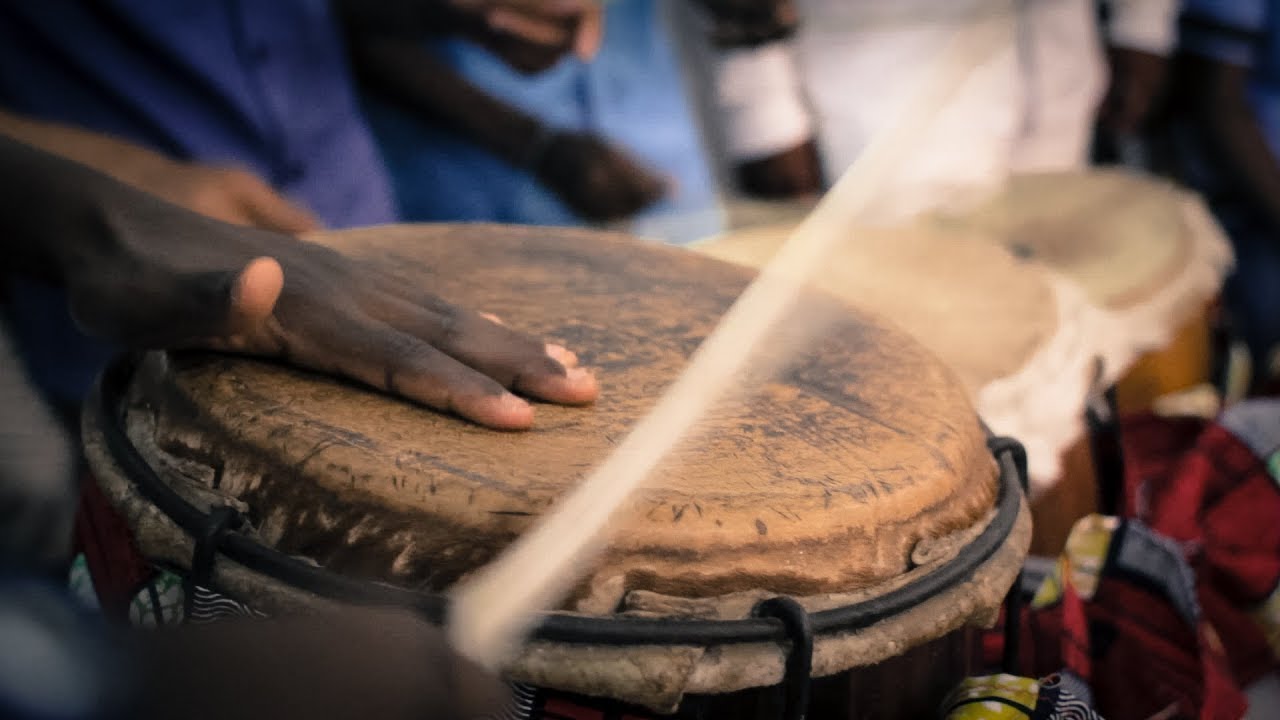
From the moment it passes through the fundament, it ceases to be a mere instrument and becomes an object really important in the worship of the Orixá. It’s through percussion, singing and dancing that we invoke, invite and draw the Orixas to Earth. Basically, there are these three types of atabaques.
The lé, the rumpi and the rum. It has an order from the smaller to the bigger one, being that the largest one has a different beat that marks the dance of each Orixá. So thi s is the bigger one, known as rum.
A word originated in Gêge dialect. The second one is called rumpi. And the third is named on Iorubá dialect.
Lé, which means small. Rum is the heart of the atabaques, it's the center. It drives, calls and marks.
It speeds up the heartbeat! At the opening of my concert I start to show my origi ns. I'm singing my Oriki, my ancestral.
So I start to sing to an Orixá of a region, then I sing to an Orixá from another region and I sing to Exu, who is the guider , the communicator! Brazilian popular music comes from candomblé! At first, I'll start with the word Samba.
Samba is an African word of origin quibundo that the black angolans brought. The translation of the word samba means "pray. " So when the blacks who were in the slave quarters finished their arduous works, they went going to do Samba.
And this started to overjoy all the people. The rhythm, the melody. We've identified a very clear candomblé beat which generated the fundamental cell for the several kinds of Samba.
There are about 200 subgenres of Samba. But most o f these subgenres follows the same metric in its smallest portion. And that beat comes from the nation of Angola, called Cabila.
Dorival Caymmi is totally influenced by the music of candomblé. His music has a lot of influence. And then everyone who came after him too, right?
And it's natural, what a lot of people do. Napumoceno already did this with "Os batuques". The maestro Abigail Moura, with the Afro-Brazilian Orchestra, Moacir Santos .
. . So, that was always done!
The beat that was most incorporated into popular music until today It’s the Ijexá. Because of its rhythmic ease. You play like this.
There was the group “The Tincoãs”, which contributed a lot so the people could understand more about these rhythms that comes from the candomblé temple. About those beats. It was all very spontaneous.
It did not have a discipline or specific method. They were experiences that were being made, perhaps even with no intention of doing so. We were not the intellectuals from the outside that went to the root, searching the root and doing the modifications.
No! We were part of that root and in the evolution of time we evolved as well, along with the root. And we were doing a job based in what we were by nature.
While we were having lunch we sang . . .
Yo u understand this? Teaching and learning were like this. The sound in candomblé is connected to everything we do.
In the moment that we arrived at the Candomblé temple, we clap the Paó. There’s the sound of the Adjá, the atabaque . .
. And the running of the river is also Axé! The sound you hear in nature, the sounds of birds, all this is filled with Axé!
Axé is in the world that surrounds us, in the natural and human world . . .
For the blacks, the musicality is something that comes from within. The sound of atabaque is something very powerful, regardless of a religious connection. The atabaque has the ability to stir with people, to make a connection with this heart beating.
The people who are there, follow this rhythm and go dancing . . .
This ancestry is in the collective unconscious of all. Everyone goes dancing together. Even if you don’t think of religiosity, there is.
It seem s a simple instrument, but we started here. If someone says it has not started by the gã, I wont believe it. We have the gã, or agogô, and the atabaques, which are used to maintain the basic rhythm.
The instrument that starts is the agogô. Someone starts the song, the Candomblé priest, the Alabê or the oldest Candomblé priestess. This person starts the song and the person that plays the agogô needs to know what rhythm should follow that song.
The gã, or agogô, is the master instrument. The agogô is the one who gives the order. It sets the beat.
There is silence. So you hear an agogô doing this . .
. Wherever you are, everybody goes near to where the agogô was played. What is understood?
The agogô is a sign, a clock. So it's calling. to say something.
When you analyze a clef, for example, you may notice that the gã, is very similar to the gã in other rhythms. It can play . .
. Some can increase speed, as in Alujá. You'll notice the difference between the gã in some specific rhythms, such as Agueré.
But if you observe this gã, which is the mother cell, then after comes the rum, the rumpi, the lé and the song. Each one goes exactly in the right place, but you never understand exactly where the right place is. Because it’s not any fit.
It has an exact place. Of course for those who doesn’t know, the repertoire seems all the same. Until you realize that there are several rhythmic structures and there’s a right way.
There are two parts distributed asymmetrically in these rhythmic patterns. So you may feel dislocated, but I think that whoever is not exactly from the group of musicians, wont realize it. Generally it sounds this way .
. . But n o.
There is a rhythm, there is a progress. And there is a certainty when the movement should change. The movement is like this.
and suddenly it changed! It's all synchronized! Some say that Ogum arrives before Exu .
It depends on the path, you understand? I know that Ogum is the third Orixá, after Olodumaré, which is the destination, and Oduduwa. He is the third.
He is the one who brings the Orixás from Orun to Ayê. He makes an iron chain with its own guts, holds the chain and tells the other Orixás to come down. It's very fast, he's fighting.
He does like this and he comes fighting. When you play that rum . .
. It is the moment when he goes to the ground and fights against an invisible enemy. When the rum finishes giving the notes, that speaks with the body, the Orixá rises and returns to the previous position, that is fighting.
He rotates 360 degrees, goes on the street and back. And he rotates . .
. Then he goes to who is playing and begins to fight. So the dance is the expression and the identity of each Orixá.
That is, of each Spirit, of each Vodun or each Inquice So the dance is really intimate. It is closely involved in the process between the singing and the Orixás manifestation. What does atabaque do?
It is the forerunner of the movement. It sounds attracts our spirits, our gods. It is very difficul t to say who commands whom.
I'd rather be in doubt. I don’t know if the Orixá commands the rum, or if the rum leads the orixá, or if they change roles. I think it's a very strong symbiosis.
It's very difficult to say. It's like the chicken and the egg’s story. You see?
I don’t know if it can be said. The wind moviment of Iansã The departure of Ogum for the war, the galloping of the dance of Oxossi, It’s all very beautiful! The collect of the dance of Oxalá.
Each one has a specific way to present itself, to show which of the nature elements he rules. Obá means "King"! Ayê means "Earth" and Olu means "owner," or "lord.
" The King, Lord of the Earth, is what Obaluayê means. When Obaluayê steps on the ground, the rum speaks louder. And he treads on earth with more force!
He has a bigger energy to macerate the earth. to knead the earth, which is the element of his nature. Opanijé is the characteristic rhythm for the dance of Omolú, or Obaluayê.
The person who plays the rum needs to know it since his childhood. Because he has a big responsibility. Once, to play the rum the person needed to be initiated for this.
It couldn’t be just anyone. Because the rum is the main drum, It’s the head of the Candomblé priest. It’s always guarded.
It can’t be just anyone who can reach and play Only qualified people. If it’s not like that, no one plays that drum. In the temple White House, for example, nobody plays.
You can play the rumpi and lé, but not the rum. The alabê has the function of keeping the rhythms. He is the atabaques and rhythms priest.
His job is to take care of the atabaques, to play, to know how to sing . . .
In fact he needs to be complete. He needs to know about everything. and how to do everything.
He is like a priestess. Because the alabê is the one who plays. He is the one who has the energy, has the power for that sound to come out and invoke the Orixá!
The ogã can also be an alabê, but the function of the alabê is to be the head of the orchestra. Many people believe that the ogã and the alabê have the same function. I don’t disagree, but there’s these details that makes the difference.
Ogãs are priests who are responsible for invoking the orixá. They are responsible for the beat, for the offerings, for the song. For all that’s necessary so that the Orixá stay close to us.
During the Confirmation Ritual of an alabê, he receives the aguidaví to play the atabaque. In the confirmation of the ogã, he doesn’t receive the aguidaví. He is welcomed by the brothers and goes to sit in the chair.
The orixás takes him to the chair. The process is similar, but there are these small differences that changes the context and the meaning of the ogã and the alabê. This is an agbé.
It's the gourd. I learned that the agbé players are the real alabês. The word Alá means "Lord", or "he that keeps.
" Alagbê, or Alagbé. The Lord, the Agbé’s owner, which is this here. Let's go with rhythm!
Congo, from the Angola nation. Let's understand the basis. .
. Open and closed. Although the project Rum Alagbê doesn’t have the objective of forming alabês for the temple, we already have a generation with 20 to 30 alabês in the temple.
Some have already made their religious obligations and already plays. When I came in, I didn’t know how to play. Almost anything.
Iuri started teaching me. I learned how to play with him. He keeps me balanced, It makes me less angry and more happy at school.
The purpose of the project is to embrace the children’s of the community. It is a form of communication, to educate children, and to interact with the elders. Candomblé itself is culture, and not just the musicality.
The responsibility also. The child already begins to have this vision from an early age. Many of those who are there already lost their parents.
Or th e mother has 5 children, and raises them all with difficulty washing clothes, selling popsicle or cleaning. We need to create a conscience that we must overcome the difficulties. And don’t perpetuate the exclusion system.
Music is the weapon! It has contributed for many years for the integration of Africans in Brazilian society. In the third chapter, I approach the way of how to become an alabê, the concept of being an alabê and his role within candomblé.
I start by making a reflection on the role of the alabê within the candomblé temple, about the learning inside the candomblé temple and I also bring the difficulty of teaching the atabaques. This is one of the questions of my research, focusing on teaching through the person of the alabê. I approach this as well as my work with the Rum Alagbê Project, in the Gantois temple.
I believe this is the first time in which an alabê presents a master's work and becomes, as it seems, a master in ethnomusicology, or music. In the way that, what you say in the beginning and repeated many times, since the title: "The alabê between the temple and the world". "The subject who is evocative of the sacred and his art of playing atabaque.
" You are now making a third movement. The alabê that not only evokes the sacred, produces and develops the art of playing the atabaque, but he also transits in an institutional space, which is an important space of power, of transit, of the production of new senses and new subjects. Here are the Gantois alabê, in a photo from the 1930s.
From left to right is Amorzinho Assobá, with a suit and a cap. Mr Valter, Alexandre and his father, Hugo, Eduardo and his son, Vadinho Boca de Ferramenta. In this photo also appears, Dudu, playing the lé, the small atabaque, Helio playing rumpi, the average atabaque and Vadinho playing the rum.
Undoubtedly, this trio revolutionized much of what we play today in candomblé. And this is Gamo. Without a doubt, Gamo is one of the most responsible for this research.
He is the master who taught me to play. He took my hand, to show me the right way to play. Without him, I wouldn’t be right here today.
And this one is Gabi Guedes. Both came perpetuating what I like to call a new cycle, that influenced several generations of percussionists. This possibility of being in candomblé and to work professionally as a musician.
Today Gabi is one of the biggest musicians, recognized throughout Brazil, taking the art of playing atabaque in orchestras and in his work. Inside the candomblé, he is also a great representative of the culture. It’s a path that is already traced.
Once the person is in there, inside the temple, he will learn to play several different rhythms and he will understand music easily. To know what is dynamic, how to improvise, and know the time to play harder. .
. Ready! He comes out here, he can pass through academy and study a little "papa mama", the basic, the fundamental techniques.
This is a lot easier. But it is hard for a professional percussionist, who is in the market, or studying at the academy, to simply reach the temple and play. In the temple is much more complex!
In my point of view, the music needs to be perfect. If it’s is not perfect, It doesn’t receives an answer. It rarely happens, but it happens.
I once recorded a moment like this. Someone started to play, then stopped and corrected, because the fit between the rhythm and the melody was out of the norms. I have seen moments like this.
I think it already happened with me too. I don’t remember exactly when, but I know it has already happened. I've played something wrong.
and the Orixá just stopped . . .
and looked at me. So you know that there's something wrong. If he stops dancing, stops manifesting, it's because something is wrong.
Because there are orixás who waits for you to answer in rum for him to continue to do his choreography. If you are lost, the Orixá do it and you don’t respond. So there is no connection, no dialogue, which is fundamental.
The dialogue between rum, the alabê and the Orixá is very important. You play along with the Orixá that is dancing. And sometimes you whim in the musical variations, originated from the variations that are being offered by the Orixá that is dancing.
They are called "feet of the brush". In Candomblé, not every time is the time to sing. Just as there is the moment to sing, you need to understand when is the moment of silence.
The moment of silence it’s the moment of concentration. It’s the moment when you let energy flow. Because if you stay singing all the time, you miss the real reason at the time of singing.
You need to understand the moment to sing and the moment to enchant. These are different moments, when you must remain silent. Exu is the Orixá of communication, of movement.
There is a myth that Exu was the one who played the atabaque. At the beginning of humanity, when the Orixás came here to Ayê, they needed to dance a lot, because Exu played all the time. A lot!
That began to weary the Orixás. And they came to the consensus that they should ask Exu to stop playing. They asked Exu and he stopped playing.
Then, Exu stopped playing, time passed on and the cult started to die. . .
because what gave life to the cult was the atabaque. The people forgot how to dance, how to make the offerings. The atabaque was what used to wake this all up.
The Orixás realized that they couldn’t remain without the atabaques, so they went to seek for Exu. And they asked: Come back to play, we need the sound of atabaque. Proudly, Exu answered no!
They insisted, but Exu denied and replied: I'll ask a friend. that is called ogã. .
. " and I'll ask him to play in my place. .
. " "But I don’t play anymore! " Then the ogã went and played.
Ogã is a great friend of Exu. It’s only possible to have a deep connection in candomblé through music. And this connection with the trance, happens through atabaque.
The owner of the atabaque, the spirit that lives inside him, is named Ayan Agalú. His cult was forgotten in Brazil, but in Cuba it is very much alive! I was in Cuba and there they worship Ayan, The Orixá that speaks through the body of wood and the leather that covers it.
Brazil has the memory of the obligations, to make an obligation for the drum. of feeding the drum, just like any other Orixá. But we forget to worship Ayan Agalu.
The atabaque goes through a ritual. The atabaque eats! This serves to strengthen it.
For the communication between the Orixá and the atabaque to happen, the atabaque must be strengthened! There are secrets about the process of initiation, that can’t be revealed. But, the atabaques, they .
. . remain in recollection.
Like us, they have an specific Orixá to each one of them. But it is an internal process. Someone's here .
. . He goes through fundamentals in here.
After that, it ceases to be only a percussion instrument and becomes something enchanted for us. The tuning is very important, to get the best sound. Each atabaque has a different tuning.
We need to strain the leather, until we reach the ideal tone to play. I know atabaques that are made of wood trunk, but only in a few temples. It is rare today, but it used to be common.
I've seen it in two or three places. The atabaques were made with an unique wood. You make an obligation for the tree.
First you make the offering and then you cut the piece that you will use. If you don’t do like this, it goes wrong. Everything you do when you use it, will go wrong.
So if you make an offering, And if you cut what will be used. And then you must dig. You can realize that this one here is dug It’s origin is fon.
And who plays between the fons. . .
who plays that drum, is called runtó. They kept the memory. When I see all this here.
. . I realize that the one who did not maintain the shape, kept the rhythm in his head.
The blacks did not reach Brazil with musical instruments. They did not bring instruments on the slave ship. They didn’t even had clothes.
. . People remembered the instruments and rebuilted it.
The atabaque model that became the standard was observed, from some drum of Arab origin, in my opinion. Their construction is very similar. These drums were smaller, but the construction was very similar with bundles and rings.
I mean it’s physical part. There are many types of different atabaques. Some people say that they used to use a tree trunk.
An external cut was made only with determined angulation. This was considered an atabaque, or drum. The origin of the atabaque is the drum.
There is the atabaque in the form of a cigar, which is the straight one. There is also the atabaque with bulge, which has this larger belly, bulge layer. The sound gets accumulated in the bulge and then it spreads.
If the bulge is not adequate, to have the bass, the middle and the high pitched, the sound is lost. When I was seven, my father would bring me to the workshop to learn. Unfortunately, today is not like that anymore.
First, we learned how to make the hardware, we built the threads and The screws, the hoops . . .
Only after we changed for the atabaque itself. Formerly it was all done by hand. Nowadays we have machines.
This one, that one. They were developed by ourselves, in here. But, in the past everything was manufacture.
These wood strips were made by hand, one by one. We need to align the opening of the atabaque. When the ships came with the slaves, each person went to a different place.
Some went to slave quilombos, because they managed to escape . . .
But each one brought its musical collection and its religious heritage. Then some passed on a certain set of songs and others passed on another set of songs. Some sing something and then others sings something completely different.
I call this chapter agreement of the slave quarters. I believe it happened this way: There was a space where some slaves were in a precarious situation. They could only practice music once a week.
In this same space, it could have a person of Mozambique, with the Bantu language. Beside him, there might be a person of Daomé, speaking the Fon language. And also a Nigerian, speaking the Ioruba language.
These people had different cultures and, consequently, they played in different ways. One played with his hands. The other one used a drumstick, or aguidaví.
Whenever I attend a candomblé party, from the most known nations such as Gêge, Ketu or Angola, or even when I participate in the services of babá egun, I observe the music. I realize that it has a combination of various nations, of various African influences. There is no pure candomblé!
There is no pure nation! Forgive me, but that's impossible. from the musical point of view.
You clearly notice the influence from one to another. When you're playing with your hand. If you stop playing with your hand and hold the aguidaví, it's like if you were going to another place in Africa.
This difference can represent a distance of 2 thousand kilometers. Although they already have some written records, the Afro-descendant culture was passed orally. It’s passed by mouth to mouth.
This can either enrich the form of music, or distort it. The Ioruba that they sing here arrived in Brazil about 200 years ago. It was transformed and took on a Brazilian shape.
He took the syntax and the accent from the Portuguese. Undoubtedly! So of course the older people, who have learned from the elders, can say what they have learned with the elders, Related to the meaning of the song, pointing out some words and saying: "That word means that.
" But, Ioruba is a tonal language. So if you do not have a certain sound between the severe, medium acute, the melody that goes from above to low and goes undulating, if you do not have it, the meaning is lost. There are an infinity of songs in a single temple, which may be similar to those in the repertoire from another temple, from which it descends.
Even so, there are a lot of different ones. It’s very difficult to measure this. How many songs are there?
There is something in common, there is something different . . .
Because they are migrating. Within this universe, you have a perception of the known. When you go to a party, And you can recognize some songs.
But you won’t recognize others. You may notice that this is an unknown song, but with a known rhythm. Sometimes I get to a candomblé party.
and I listen to a completely new song. This happens in all nations. Since the worship of Orixás, Inquices, Voduns.
. Even the Caboclos, who are the Brazilians Orixás. That's a lot of information!
They are very creative. Especially the caboclos. That's a lot of different information.
Every party is like something new. The Caboclo as a spiritual entity is able to create. It recycles, it brings in the memory, the air, the context .
. . They pass on a message.
He may be there singing a song at the same time that he gives you a warning. He communicates with you through musical language! There are reports that in Ketu, until the 40s and 50s, the priestess created.
They created songs because they still dominated the Ioruba. Maybe also in Fon, but I couldn’t say for sure. With the loss of the domain on the spoken language, there is no further increases in the number of songs, it has a decrease.
- You memorized the lyrics, right? Mirô "Ia orô nirô. " "Nirô".
- Oh, I get it. "Nirô". "Omin ni nã, omin ni nã, Iê iê Oxum da mi nã ".
Then the people correct: "No, it's not orô mi nã, its orô mi nã". But the correct one really is "omin ni nã". Omin means "water", Ni means "to produce" and nã means "fire.
" When the water falls from the waterfall and hits the stone, it hits the land, it produces electricity, that burns and gives shock. I don’t know how good it is For the religion these attempts of correction. People often correct it in the wrong way and they end up changing the meaning.
So when I say that In this city everyone is from Oxum, I am referring to an Oxum oriki. I do not need to sing Oxum’s candomblé song in the Ioruba language. No one will understand.
So I say, "Man, boy, girl, woman. . .
" "all these people radiate magic . . .
" "presented in fresh water, presented in salt water . . .
" "and the whole city shines! " "presented in fresh water, presented in salt water . .
. " "and the whole city shines! " "Be a lieutenant, or a fisherman's son .
. . " "or an important debtor .
. . " "If he gives gifts it becomes one thing .
. . " "The force that lives in the waters Doesn’t make distinction of color .
. . " "And the whole city is from Oxum!
" In the temples there is no tonal tuning. There is no such musical notes and tuning. It's not just a song, it's a sound space where a ritual takes place.
She's the trance soundtrack! It's not like our traditional western setting. It is not like the "tempered scale" that we know.
It's another kind of thing, it's micro tone. It's another harmonic relationship. It is not necessarily a third higher, or lower third.
Sometimes it is halfway between one tone and the other. In a moment, it's a way and at another moment it may be different. It's a very organic thing.
It is not rigid. There’s a part in which some of you are not reaching the tone. But that’s not a problem.
It looks good too! When it goes up . .
. This happens. But overall it's cool.
It's natural. You don’t have to be too perfect. or we end up losing the real spirit of candomblé.
In this disc there is a song of mine called "Rum, rumpi e lé", which are the atabaques. It is a homage to the atabaques, to the parents of music. "The atabaques that call me, I do not know where they come from .
. . " "I don’t know if they're from Oxóssi .
. . " "I don’t know if they're from Omolú .
. . " The atabaques that calls me, I don’t know where they come from.
Because when they play, they may be sounding in a quilombo, in a wood, or in a candomblé temple. The intensity of the atabaques is to call our spirits, our gods. "Oxalá!
"The atabaques that calls me they came from Africa! " It is the energy of the atabaques that calls the spirits to earth. The atabaques sings, they speak.
You evoke the moments from that Orixá. Then, at a certain moment he will get there! Who is Iemanjá?
She is the Great mother! The mother of all Orixás. So when you sing to her it is certain that most of the Orixás comes to answer the call of their mother.
There are specific songs for Iemanjá that speaks exactly about her being a mother, but at that moment none of her sons are near her. So if you are in a circle of candomblé, if you are dancing and you are concentrated in that moment, you hardly ever will go into a trance. For us, we have this music in our genetic code, it is very mantric.
It has the rhythm of rum, rumpi, le and gã. These four instruments forms a body sound. I think it takes you away from yourself and puts you in touch with the Freudian ID, with your cosmic part.
But what triggers the phenomenon is that. Repeating this, in a short time you stop thinking I think that this kind of music, this kind of rhythm, when it is invoked Its always going to connect you with some type of energy, no matter where you are, inside or outside the temple. I totally believe it!
Regardless of a religious connection. This has something to do with energy. With connection!
I believe in music as a particle, in music connected with quantum physics. I'm going in that direction. I think music as a particle, it can reach people by other means.
Not just by the hearing. There is a certain piece of music that, when it plays I start to daze, even with the stroller. I can have canes, I may be seated When you have a certain letter, or movement of the drum, certain beat of it with my Orixá, The tuning happens!
For me, the real invitation that You make to the saint is done through emotion. When the orchestra is good, the choir is good. and the atabaque’s players are good.
. . Hail Mary, it thrills me!
The sound of the atabaques, the agogô, the voice, the palm. . .
the xequerê, the beating foot, the priestess bracelet helping in the percussion . . .
the sound of the slipper. All of this is sound! And all this creates a general, global context, that induces and attracts the Orixá by the beauty, by the desire to sing, by the energy involved.
If you close your eyes and sing, you get in direct connection with the Orixá This is very beautiful for those who know how to feel, for who knows how to see this kind of thing. Perhaps the essence is in these hypnotic clef, you know? This brings the dance and brings the movement.
Consequently, the bonding happens. So, it happens through music. The force of the music makes the connection with the whole.
The idea is to use the rhythm as a reason. The rhythm is the main reason of the Afro Symphonic Orchestra. Its born from singing and rhythm That it, as it is in Candomblé.
What me and the Afro Symphonic Orchestra look for is really to praise and to show the glowing and the strength that Candomblé has. You know? Artistically!
People can go find the sacred inside the Candomblé temple. But on stage, we are artists who are extolling this culture. When I first heard the Opanijé rhythm, with its three atabaques playing live, I remember well.
My great friend, Valnei, was playing. And I imagined this rhythm. .
. "Aware of the strength and power of healing that shuts your body. .
. " "aware of those who doesn’t have self-esteem, is sick or dead. .
. " "Not every king begged in the streets, And he knows what it is. .
. " "The body heats and the soul feels the beat of Opanijé". - Our name is the junction of the sacred and the politic.
- Exactly! The sacred is in the name of the beat itself "You fight ignorance With the right medicine. .
. " "doses of information, the right books always close. .
. " "Politic infected with kleptomania". .
. And the politic its in the abbreviation we created. "Popular African Organization of Blacks that inverts the excluding game".
It’s the letters of O-P-A-N-I-J-É. My personal relationship with Candomblé, started because of my music. I didn’t had much contact, until I went to work in a Candomblé temple.
What instigated me to follow the ritual Was the music that came in the office. And I used to think: "I need to feel how this works". "If you want to test your faith, you have to learn how this is.
. . " "to see if this is what you want, The beat of the rum, rumpi and lé.
. . " In my case, it was a matter of ancestrality itself.
My militancy as an afrodescendent, made me search for my culture. To search my culture as a whole! "I’m only ashamed if I think the cause is lost.
. . " "I won’t put my head down while time passes by.
. . " "and life goes on like this, for free.
. . " "The time that goes I know it won’t come back.
. . " "temporarily, simply, I ask for peace.
. . " "and I run after it.
It’s without ceasing, I am safe. . .
" "Holding my courage I knocked over another wall. And my future. .
. " It’s impossible to deny the importance of me being here, in the university, For my black people For the people of Candomblé. We came out of this exoticism, right, Which our religion was seen from many researches.
And now, we’re in this moment. Us, from the community talking about our process. This is very important.
Since we have a varied class, The fact that the score is written there, is just a detail. Right? To who is not immersed in this universe, the important thing is to comprehend the rhythm.
It’s just one black dot there, right? The black dot represents this open sound. And the triangle represents the clap sound.
The Africans rebuilded All of this in Brazil through orallity. However, we arrived at a moment where the official knowledge needs to stay in dialogue with this reality, because this is a reality, it’s a form that is kept for thousands of years. Now that we’re warmed up we’re going to play the rhythm Cabila or Cabula, from the Angolan nation.
Following the first system there. The agogô. If you take the rhythms out of the Candomblé music, what will be left?
The Baião, the Samba with its various designations. Samba Chula, Samba de Roda, Samba Duro. .
. Côco. In all of this genres, you can observe that each rhythmic cell Has its origin in one beat from Candomblé.
Man, pay attention in Brazilian popular music. You’ll see that Candomblé is inside all genres - Its present even in Rock! - Its inserted.
If you observe the funk played in Rio de Janeiro, it has that beat. . .
The Golden Congo. It’s not often played in Umbanda and it has influenced a lot of artists like north americans. Black music is based in repetition.
If you listen to a James Brown disc You’ll realize that he uses that rhythmic cell, and he will repeat it during 6 or 7 minutes. He will evolve based on it. If you enter in a Candomblé temple, you’ll see the rum, The rumpi, the lé and the gã.
The rumpi, the lé and the gã will make the repetition, and the rum will evolve based on this repetition. It’ll make the solo. What Fela Kuit and James Brown did, what Rap does, it was already being made long years ago.
Creating a music based on a rhythmic concept, from a repetition, and evolving on top of that repetition. Every music originated in Africa Has a structure based on draws generated by percussion. So, this system is the natural system.
We naturally apply this in samba. When João Gilberto plays a samba, you can notice that the rhythm of the guitar sounds a tamborim. This is natural, It’s not an invention.
It’s not like the harmonic series. This nobody invented. It’s like a characteristic of the music originated in Africa.
It’s additive, It’s not divisible. The compass bar wasn’t a fact studied in this music. The patterns are build based in the rhythmic patterns.
The Rumpilezz Orchestra emerged as a way of demonstrating an idea. I had this need to observe this systems of african baiana music, mainly, and how they were organized with rigor. When I played this certain clef, There was a specific variation drawing.
And with a body movement as well. I kept observing and I started composing based on that. I think that Gabi’s importance It’s the bridge he makes, between the sacred music and the popular music.
He knows exactly how to make this transmission, from the sacred and the magic, to the music played in the streets. I thought in a horseshoe as a way of putting the percussion in the spotlight, in front. And also because the horseshoe Is a symbol of strength, It reminds me of Ogum as well.
The fact that they’re dressed in character is to reinforce even more the place of importance of the percussion. Although the Candomblé music has All this influence on the brazilian popular music, Society doesn’t respect Candomblé’s culture and religion. I took one of our cds to a store in Brasilia and I putted it inside the stereo to play.
There was this guy from the Rap scene He listened to it, and he was extremely affected. He thought we were Promoting Satanism. Rap’s own community discriminates us, sometimes.
They don’t accept the work we do. They confront us, and they say we don’t play Rap, they say is black magic. What makes us confront them, is this.
We ask for respect to our religion. If we respect Jesus, they have to respect Candomblé too! I was invited many times to record the percussion in another artists album who said: - "Don’t play Candomblé’s rhythms".
You know? And I answered: - "Ok. But can I play this drum?
" - "Yes, you can! ". And I played Candomblé’s rhythms inside their record.
And that was it! They don’t even know it was from Candomblé, Only I know! - "So?
Was it good? " - "The beat was awesome!