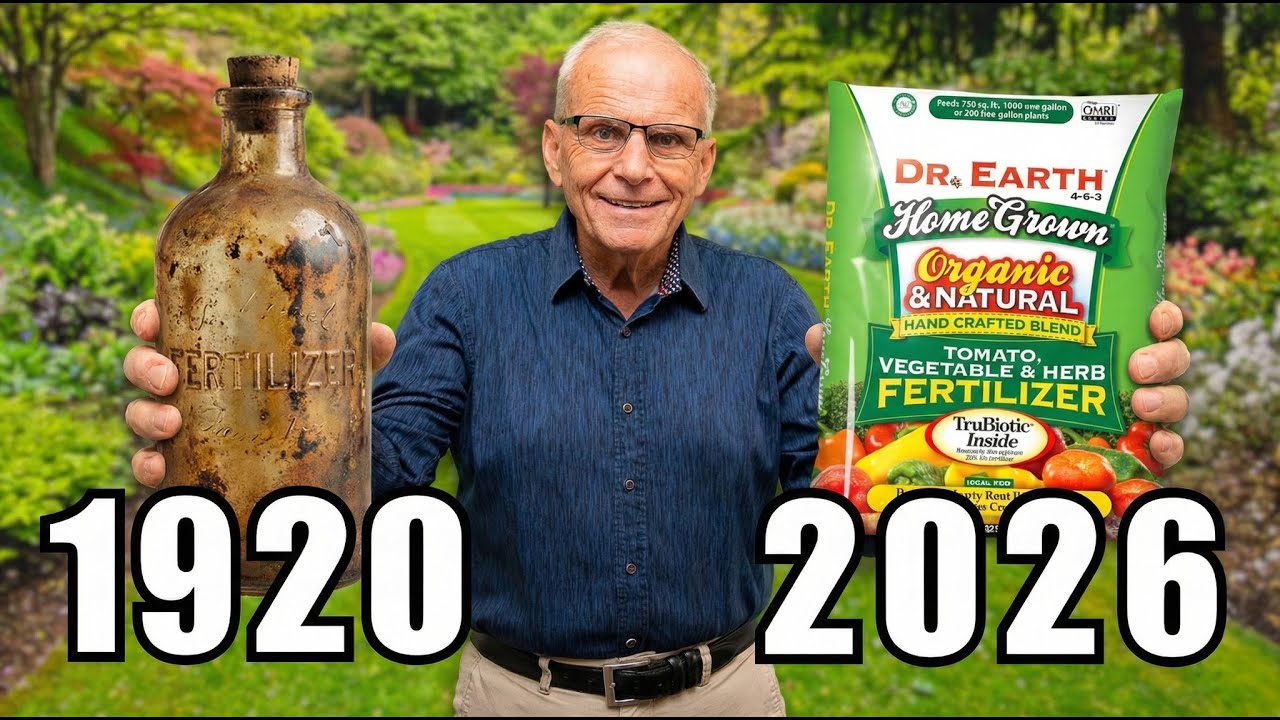
We track down fertilizers from every decade over the last 100 years. Eddie the lazy landscaper and I will rate which ones are best >> and which ones went horribly wrong. >> So, let's quickly start with the prefertilizer era.
There was no Home Depot, no garden centers. If you wanted to feed your garden, you had to go to the barn. >> Yes, you did.
for important things like um horse manure, bat guano, you know, things like that. >> There was a reliance on manure, kitchen scraps, cover crops, all really excellent ways to feed soil and feed plants. What was occurring was really nutrient cycling.
That's an excellent way to garden. Then a dusty white powder started showing up and it's probably something different than what you're thinking. I do remember the 1920s, John, because my favorite rum I had to get from a couple of guys that had a boat.
>> Yeah. >> Yeah. I prohibition just darn near dried me out.
And gardeners were putting this powder bone skeleton powder on roses. >> Skeleton of what? >> Skeletons of I'm afraid to ask.
>> Cows. I think in the 1920s we had bone meal and blood meal. At the time it was pretty much regarded as a good way to fertilize plants.
There are some important nutrients and micronutrients being provided. It's actually very effective. One of the concerns I have about both products is they both inhibit the growth of microisal fungi which really assists plants in uptake taking water nutrients and it's one of the main things we want to encourage.
Another negative is it does encourage wildlife and dogs to dig in the soil. They're attracted to the scent ingested in good quantities. They can be toxic to dogs and cats.
>> John, when you talk about that, I know Chip wouldn't want to hear that, but it maybe this wouldn't be a highly recommended today. >> In its time, it probably was a pretty good product. And when you look at the options, it was probably the best option.
Today, I would give it a very low rating. What's our rating scale? 1 to 10.
>> 1 to 10. >> I'd give it a three today. By the 1930s, the hottest fertilizer on the market came from the desert of Chile.
>> Well, it was the Great Depression. Uh, when I think of the Great Depression, I actually think of my wife's family's reaction to our getting married. >> It came from salt peter deposits in Chile.
1930s nitrate of soda. Nitrate of soda provides nitrogen without acidifying the soil which is fairly unique when we compare it to synthetic fertilizers today. Almost all of them acidify the soil whether you want your soil acidified or not.
Also a pretty good source of some trace elements. Good on everything from roses to lawns. And you know you had people beginning to hybridize things including roses and develop all kinds of cultivars.
And I think that there wasn't a lot to use. >> And so when they did find a product like this, especially the more sophisticated gardeners and landscapers, >> it made sense. It seems like it might be better than a two or a three.
I think it's a pretty practical product for home gardening, especially on a lawn where you're constantly trying to make it as green as possible. And that's what nitrogen does. as a nitrogen source for things that really like nitrogen and have no downsides of nitrogen.
I would rate it like about a seven or eight. And that's the way it is. >> And that's the way it is.
I'm Walter Kronite and that's the way it is. >> Then World War II hit and we got a militaryra boost. So, of course, the first half of the ' 40s, World War II, as the war wound down, John, they stopped making ammo and started making plant food.
Talk about a plot twist. I was going to say they asked me to serve and I said tanks, but no tanks. >> The World War II time, especially right after World War II, really used extensively in agriculture.
And as you might imagine, something high in nitrogen really got some results and started a whole boom in synthetic fertilizer use. 1940 ammonium sulfate, those chemical sources can make soil more acidic and can have some long-term negative effects in salt buildup in soil. We're applying synthetic nitrogen and it's making plants grow like crazy.
So the natural conclusion is it's good for plants and everything associated with plants. >> Unfortunately, as we've moved on, we found out that excessive use can have some environmental problems with runoff polluting our water table and our groundwater. >> So what would you rate this uh then and would you use it today?
>> So in the time I think it really had its place and I understand why it was treasured. If I put myself in that time, I don't think I would be understanding the negative parts of it. Today, I'd give it a one or a two.
In the 1950s, fertilizers went mainstream and one blue powder became a suburban icon. >> Suburbia was booming. Barbecues were being lit.
In some cases, the people barbecuing were being lit. This was the first real popular consumer gardening product line that really was for gardening. 1950s Miracle Grow.
Miracle Grow was the brainchild of two ingenious marketers. Most people know you as being a lazy landscaper. You have another avocation which is marketing.
>> This is ordinary potting soil. This is Miracle Grow potting mix. Maybe you have appreciated the key ways that they marketed Miracle Grow and what seemed to be a model for many decades to come.
>> The 50s were really, I'd say, the beginning of serious advertising, being able to sell the concept and and dress it up and whether the product was good or not. Miracle Grow has been outrageously successful and when used in moderation, it can address the goals of the original formulation 153015. This is what they identified.
They were trying to do the best leaf growth and color, root strength and overall health. And it can do that with the plant itself. Unfortunately, over the decades, subtle problems with its chemical formulations have multiplied into real negatives, and those are characteristic of almost all synthetic fertilizers.
They can disrupt the soil pH, make the soil more acid, and it can lead to a buildup of salts and chemicals that plants can't use, and more importantly, that your soil doesn't like. Viewers, do you still use Miracle Grow today? It's still a very successful product.
Let us know in the comments below. >> Well, John, how are you going to rate Miracle Grow? >> Well, Miracle Grow deserves a 10 from my business standpoint.
Uh, you can do nothing but admire what they've done with the brand, built it into iconic status and widespread use. For use today, I rank it very low. I would probably give it a two today.
So Eddie, there's a lot of talk about Miracle Grow, but there's really only one way to have the greenest lawn, the biggest flowers, the most production. Do you know what that one way is? >> Yes, I do, and it's to subscribe to this channel.
>> Then the 1960s rolled in with peace and love and a new fertilizer that was hopefully a little more loving to your soil. Ah, the 1960s the Beatles were on the radio and they were also in my lawn at the time. The momentum started by Miracle Grow in the ' 50s continued in the60s.
1960 10 10 chemical fertilizer popular because of its simplicity but many of the themes that we established in the earlier decades continued. This was easy to use, had every macronutrient in it in equal amounts, which isn't necessarily good, but it was a very popular formulation, and was effective at feeding lawn and plants. Again, in the same way where it goes directly to the plants and pretty much ignores the soil.
>> What do you think about this product, John? I mean, what would you rate it then and now? >> I would not rate it the same as its formulation.
I would see no reason to really recommend it, but it is an effective synthetic fertilizer. I would give it a rating of three today since it was successful, seven or eight in its time. So, in the 60s, we had chemicals for our gardens and for humans.
Now, into the 70s, we veer into an even more interesting direction. So you know the 70s I mean from what I can remember uh >> so 46 now not 20some not 10 10 10 but 46 that's the ultimate in nitrogen formulation 1970s ura fertilizer 4600 chemical releases fast and boom easy to burn things um little easier to damage soil all the same problems that we've already talked about with salt and damage to microbiology, especially if you overuse it. They build on the last decade with something even faster, even stronger, even more noticeable, more profound, but still no nod to the soil yet.
So, I think it earned a low rating then and now. I think we should have known better than to use 4600. Today, you can find an appropriate use for it, like maybe once a year, a week before your party that you didn't know about, and you want a lot of nitrogen to release real fast and turn that lawn real green, it could be justified.
But in general, as a as the most popular fertilizer of the decade, I would give it a one in 1970s and a one uh today. By the 80s, convenience was king. And the answer came in these little pellets.
>> Big hair, big phones, and pellets hiding in your potting mix. I remember big hair, but you know, she still was a really good real estate lady. She really was.
>> So, the goal of this idea was to make something more convenient that you didn't have to apply as much and to eliminate the possibility of burning. 1980s osmmaote slowrelease fertilizer pellets. Osmmaote still around still used a lot in containers by nurseries but it really is a synthetic fertilizer encased in resin or some people say encased in plastic and and you see residue from it frequently.
I think in many ways it accomplished its goal of being something that did increase convenience because it does release slowly and has, you know, a lot of the same downsides of synthetic fertilizer, but it was a interesting innovation in fertilizer, one that's being appreciated even to this day. >> And it doesn't take up a lot of space considering the potency of >> of these pellets. >> That is a big difference between a lot of these other products.
They have high rates of application. >> What do you think of this product? >> Well, Osmma Coat's a pretty darn good product.
I would give it a seven. It is a synthetic fertilizer wrapped in plastic, which doesn't sound very good, but it is an excellent product that solves a lot of problems and uh I I rate it highly. In the '9s, the advancements in fertilizer were all about the way we apply it.
>> Those were the days of the infomercials that promised you six-pack abs. And this product was featured in a lot of infomercials. >> I did get a liquid application for my lawn.
Now the six-pack abs became more pony cake abs if you will. 1990s liquid feed lawn products. Now we've put it in a format where it's already in solution.
And since it's in solution, it works really, really fast. Again, you could, if you're not careful, burn your lawn. Chemical fertilizer does all the same things to soil that we've been talking about.
It's only good for your lawn. Over time, could result in lots of other problems. You know, we've talked about the environmental problems of toxic runoff, but also we have the problems of when we damage life in the soil, then we're more likely to get fungal disease and pests.
And uh so we're not addressing this as a whole ecosystem of soil and lawn. We're just feeding lawn acting like the soil is non-existent >> for the average homeowner who doesn't want to have to invest in a special applicator or any other kinds of equipment. This was ready to go.
All you had to do is stick your hose in here and tighten it up. Everybody's got a garden hose. So again, it was a more convenience and it was an era of convenience.
>> I give it a pretty low rating. I'm not going to go any higher than a four or a five, but in terms of turning your lawn green fast, which is usually why you would use this in the first place, it's a good product. In the 2000s, we finally started realizing what matters most for our gardens and landscapes.
Oh, I remember this time cargo pants became popular. In fact, 25 years later, >> Wow. >> I still wear cargo pants.
wears cargo pants. So, this is an excellent example of this compostbased fertilizer that was much more ecological in emphasis and also focused on being safe for kids and pets. 2000s organic compost blended fertilizers.
And when you look at the ingredients in this, you see very low macronutrients, 444, because you can't supply huge percentages of nitrogen like you do with synthetic fertilizer. And then on their label, they have all kinds of beneficial microbes, microisa, and all kinds of things that are good for soil and pretty good for us. And so, it's a whole new era in fertilizers.
And you've got gardeners responding to this and starting to recognize that maybe we shouldn't just be feeding plants, but we should be feeding soil and plants. In the 2000s, right along with Dr Earth is when John and Bob's came out with our first product, which was a soil builder. And that's a way of improving the health of our soils with food for microbes and attractants for microbes.
What do you think of this product? >> I would give it um a nine. It would get a 10 if it was a John and Bob's product, but Dr Earth, I'll give it a nine.
2010, not only phones got smarter, something else got smarter and started taking over gardens all over the world. >> Gosh, smartphones, smart homes, and even smarter plant food. >> 2010, smart bioertilizers.
The whole purpose of bio fertilizers is to build life in the soil and make soil that has lots of complex life. Not just bacteria but bacteria, fungi, protozoa, good nematodeses and allow the soil to do what it's supposed to do. Not only feed our plants but make it so our plants and trees and flowers and lawn don't get sick.
We don't get fungal disease. That's all perfectly implemented by biofertilizers. Products like this one focused on that which has really interesting ingredients like humic extracts, fulvic acids, humic acids, organic matter, potassium, nitrogen.
So, it's kind of a combination of biological with some macronutrients thrown in. >> So, you know, this has a lot of good things to say about it. I like all its ingredients.
So, I will rate it an eight. So, that leaves us with 2020 to today. And let's just say it's complicated.
>> A lot of your neighbors are spreading chemicals. And the other half is brewing compost tea. And they both swear they're right.
>> We think it's very simple. At John and Bob's, we believe in a simple truth. Feed the soil and the plants will follow.
Definitely. >> Ah, there he goes. After a 100red years of fertilizer experimentation, the takeaway is simple.
Healthy plants start with healthy soil. And if you want healthy soil as quickly as possible in this video, I explain how to improve your soil the lazy way, the way Eddie the lazy landscaper would do it. You didn't ask me yet to rate our John and Bob's products, but I would rate our soil optimizer a 10.
I would rate our penetrate liquid biotiller 10. I would rate our maximize a 10.