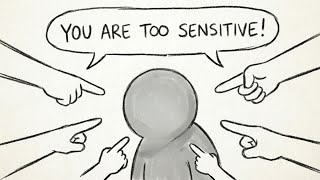
Have you ever been in the middle of an argument, feeling a righteous fire in your chest, ready to defend yourself, and then suddenly your vision blurs? You feel that familiar, dreaded lump in your throat. Your voice cracks and against your will, tears start to spill over.
You aren't sad. You are furious. You are frustrated.
But your body is doing something you didn't ask it to do. The person you are arguing with looks at you and their expression changes. They see weakness.
They might [music] even say, "Why are you crying? It's not that big of a deal. " And that only makes it worse.
You are humiliated by your own reaction. You feel like a child having a tantrum when all you wanted was to be a strong, assertive adult. If you know this feeling, I want to start by offering you a [music] completely different way to see yourself.
We often think that crying during conflict is a sign that we are [music] fragile. We think it means our system is weak. But I want you to consider the opposite.
You are not crying because you lack capacity. You are crying because you have an excess [music] of caring. Most people can stay cool in an argument because frankly they are only 50% invested.
[music] They are detached. But you, you are allin. You are running at 150% capacity.
you care [music] deeply about the truth, about the relationship or about the injustice. Any engine that runs at 150% [music] generates heat, a lot of heat. So today we are going to decode the phenomenon of angry [music] crying.
We will explore why your body tries to cool you down when you get too hot and I will give you a toolkit of invisible strategies to help you stay in the room and stay in [music] control. To understand your tears, we need to step away from psychology for a moment and look at [music] biology. Think about a marathon runner.
When they sprint, their muscles work incredibly hard. Their body temperature spikes. If they get too hot, their system will shut down.
So, what does the body do? It sweats. It releases water to cool the surface of the skin and regulate [music] the internal temperature.
When you see a runner sweating, you don't think, "Wow, they are so weak. " You think they are working hard. Their body is doing [music] exactly what it needs to do to keep them running.
Angry crying is just [music] emotional sweating. When you are in a high stakes conflict, your nervous [music] system is sprinting. You are in a state of [snorts] high physiological arousal.
Your brain perceives that your internal temperature, [music] your stress, your focus, your passion is reaching a critical limit. To prevent you from overheating, your brain triggers a cooling mechanism. It activates the parasympathetic nervous system.
This is the rest and digest [music] system. It releases acetylcholine. It slows your heart.
And the visible side effect of this cooling [music] process is tears. So the next time the tears come, I want you to reframe the shame. Tell yourself, I am not breaking down.
I am just emotionally sweating. My body [music] is cooling off the engine so I can keep going. But there is another layer to this.
Your body isn't just trying to cool you down. It is trying to save your life. I know you might feel betrayed by your body in these moments.
You might feel like it's sabotaging your argument. But I want you to imagine that your body is an [music] ancient overprotective bodyguard. This bodyguard loves you fiercely.
But it is also very old-fashioned. It thinks every conflict, even an argument with your boss or your partner, is a life ordeath situation [music] with a saber-tooth tiger. When the conflict gets intense, your bodyguard gets scared for you.
It thinks, "This is getting too dangerous. The aggression is too high. If we keep fighting like this, we might get hurt.
So, it steps in front of you. It forces you to cry. Why?
Because of a fascinating piece [music] of evolutionary biology. Recent research shows that human tears contain a chemical [music] signal, an odorless pheromone. When opponents smell or see tears, their testosterone levels drop and their aggression centers power down.
Your tears are a chemical blanket. They are biologically designed to send a signal to the other person that says, [music] "Lower your aggression. Stop attacking.
" Your body isn't betting against you. [music] It is trying to deescalate a fight it thinks you might lose. It is trying to ensure you survive to see another day.
So, you can thank your bodyguard. You can say, "Thank you for trying to protect me, but I am safe. I don't need this shield right now.
Now, we are going to move into the toolkit. I'm going to give you specific techniques to manage this. But before I do, I need to say something important.
When you are in the middle of an angry cry, your prefrontal cortex, [music] the thinking part of your brain, is often offline. You are running [music] on pure adrenaline. It is very likely that you will forget everything I am about to say, [music] and that is okay.
You do not need to memorize all of these. I want you to listen and just [music] pick one tool. Just one that feels easy for you.
Master that one tool. Don't try to be a ninja. Just try to be a person who [music] has one good trick up their sleeve.
We have organized these tools into three levels depending on where you are in the storm. Let's start with level one. These are invisible tools.
You can use these when you are alone in your room fuming about an email or when you are in a conversation and feel the heat rising but the other person [music] hasn't noticed yet. Your first option is the look up hack. This is a purely physiological trick.
The moment you feel that prickle in your eyes, [music] physically look up, tilt your chin slightly and look at the ceiling or the top of a bookshelf. Looking down signals introspection and feeling to [music] your brain. Looking up signals visual processing and alertness.
It mechanically keeps the tears in and neurologically tells your bodyguard we are still watching the world we are not shutting down. If that doesn't work, try the math hack. The part of your brain that cries, the libic system, and the part that does logic, the prefrontal cortex, share a blood supply.
They are like a seessaw. If one goes up, the other must come down. Force your logic brain to wake up.
Do a specific math problem in your head. Not 2 + 2, that's too easy. Try 100 - 7, that's 93 - 7, that's 86.
[music] And goes on. It is neurologically impossible to maintain intense emotion while doing complex subtraction. you are forcing the blood flow away from the tears.
And finally, if you feel like you are floating away or losing control, try [music] sensory grounding. Anchor yourself in the room. Quickly find five things you see, four [music] things you can touch, three things you hear, two things [music] you smell, and one thing you taste.
This pulls you out of your internal storm and back into reality. [music] But sometimes the wave is too strong. The invisible tools aren't working and you are about to sob.
In this moment, you need to get out of the situation without looking like you are running away. You need a strategic pause. The best way to do this is the water break.
If your voice is cracking, say this. I'm going to grab a glass of water. I'll be right back.
This is not a retreat. This is a [music] tactic. Here is why this works.
When you get the water, take a slow sip. [music] The act of swallowing physically forces the glauus to relax. It resets the muscle spasm that causes [music] the sobbing sound.
This 60-second break gives you time to shake out your hands to release adrenaline, take a sip, reset your glauus, and return to the room on your own terms. Finally, let's talk about the hardest scenario. It's too late.
The tears are falling. The other person is looking at you. You feel the shame creeping in.
If this happens, I need [music] you to follow one absolute rule. Do not apologize. Do not say, "I'm sorry.
I'm [music] such a mess. " That signals weakness. That signals that you have done something wrong.
You haven't. Instead, I want you to label and pivot. You need to tell them exactly what is happening so they don't misinterpret it.
Say this. I want you to know that these are tears of frustration, not sadness. Or if you can, be even bolder.
I care deeply about this issue, so I'm [music] having a physiological reaction. Please ignore it. I am listening and I want to finish this conversation.
By saying this, you do something incredibly powerful. You assert your agency. You are telling them, "My biology is reacting, but I am still in charge.
" There is immense dignity in that. To cry and yet to keep speaking your truth. That is not weakness.
That is [music] the definition of courage. I want you to know that this journey takes time. There will still be arguments where the tears come before [music] you can catch them.
And that is okay. Be gentle with your overprotective bodyguard. It is trying [music] its best.
Do not add the second arrow of shame to the first arrow of anger. Your capacity to feel this deeply, [music] to be so invested, so passionate that your body literally overflows is also the source [music] of your empathy, your creativity, and your power. You are not weak.
You are just a high performance [music] engine that sometimes runs a little hot. So the next time the tears come, take a breath, look up, and remember, even your tears are proof that you are fully unapologetically alive. If you want to understand more about why you are wired this way, why you feel everything so deeply, click this video right here to decode the super sensor mind [music] and subscribe to Unordinary Mind.
Let's decode your humanity together.