welcome to this presentation on conceptual frameworks and masters and doctoral writing I'm using the term conceptual framework as a catch-all term for a whole variety of broader perspectives in the research field so depending on your discipline the term you use might be you know theoretical framework Theory theorists that might be how it's framed in your discipline or it might be models concepts topologies frameworks so depending on your discipline you might describe a conceptual framework differently you might use different words for it but I'm going to use conceptual framework to talk about all these different ways
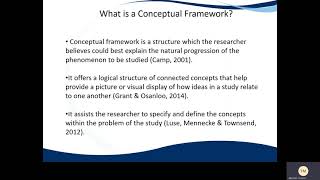
of looking at research from a bigger broader perspective so the conceptual framework is the perspective they're frames your study it's what connects your study to the larger ideas beyond your particular data and it's the system of assumptions beliefs theories and concepts that supports and informs your research now the conceptual framework is often quite difficult for new researchers to understand so I think it's useful to look at some of the metaphors used in the research literature and I've just noted a few here blueprint framework foundation guide bridge mat campus ecosystem these are all terms that are
used to describe the conceptual framework and what you can see from these metaphors is that there really are three different things going on here one is that the conceptual framework is a foundation it's the kind of building blocks the second one is that it is a guide or a map or a bridge so it's something that takes you through something else and then the third thing is that it is an ecosystem it's something that pulls the thesis together so that's why conceptual frameworks or complex it's because they're doing these different of work in a thesis
setting it up helping to shape it and providing a way through it pulling things together so just to go over that what is a conceptual framework and a thesis it's a framework that shapes your entire project it's the assumptions that underpin your research and we'll go through this in more detail it's it provides the rationale for why you are investigating core concepts so so whatever core concepts you've decided on the conceptual framework provides the rationale for using those concepts and the and the relationship between the concepts that you're using it guides and directs the study
and it helps both you and the reader make sense of the study what do conceptual frameworks do they explain they can predict they help us to understand phenomena and they might challenge the way we think about things they really help us to understand our own research data but the most important thing they do is that they extend existing knowledge so when we go out and collect data we are creating new knowledge but what the conceptual framework does is it provides us with insight so that we understand that new knowledge in different ways so the conceptual
framework helps us deliver an original contribution one of the things I wanted to point out before we get further into the presentation and that is that if that it really is very difficult to talk about and describe a conceptual framework generically really you would need to look at the conceptual frameworks within your particular discipline and look at examples so that you could you would be familiar with these theories based on all your course work that you've done and it then it would be easier to explain how a conceptual framework in your field worked within your
particular discipline but I am going to talk about concept Ceramics genera t i just wanted you to be clear that you would need to take this back into your discipline and you would need to apply it within the disciplinary requirements of your field so the way to do that would be to talk to your supervisor to other faculty to other students in your area or field you could also read finish dissertations to see how other students have framed conceptual frameworks not not only you know into in terms of their broader thinking but how they've incorporated
it into their writing and as you reading for your thesis you could also have a look at the published papers on your desk and see how authors have used conceptual frameworks and how they've articulated that in writing as well okay so I'm moving on to talking generically about conceptual frameworks and I want to just take a little step back before I discuss conceptual frameworks to talk about personal beliefs you know within academia there are different kinds of theories but I'm going to talk about two here tes its theories the theories that we carry with sometimes
without even knowing that we carry them and more formal theories so the tacit theories are our own personal beliefs beliefs that we have developed over time from our cultural social religious contexts and they're tied to what we value about life people in our environments so these are personal to us formal theories are representations of realities that other people have developed to explain a describe predict various phenomena now it's important to understand our personal beliefs in relation to the more formal theories because we really want these to align in our dissertations now most of the time
they do because we are drawn to theories that fit with our personal beliefs but sometimes they're not because in many disciplines we are told that we have to separate ourselves from ours and we have to be objective and sometimes there's a misalignment between our personal beliefs and our formal theories and that can often lead to contradictions in a thesis so it's worth thinking about you know what do I believe about this what do I value and then thinking how that relates to the theory or conceptual framework that you're going to use in your thesis even
if you're trying to be objective understanding your own perspectives can help you see where you where you might have overlaps between your personal beliefs and the formal theories that you're drawing on so I just want to give you an example and I hope that this also explains how formal theories are a level of abstraction away from the tacit theories so here are two test theories they are very different and there these are common tested theories in the field in which I work which is graduate student writing so the first theory is I believe that some
people are born writers others are not born with this talent so writing is hard always hard for them I wasn't born creative so I can't rights and the second test of theory is I believe that one can learn to write well we just need to pay attention to writing and work at it over time I can be an excellent writer so those are personal beliefs now if we go out looking in the research literature to see if there is some explanation to help our understanding of these test theories we might as I did come across
limper and Elvidge and and look at their explanation for these tested theories and what they say is writing research shows that they are beliefs about fixed writing traits and malleable writing traits students who believe writing traits are fixed have lower self-efficacy in writing tasks there is a link between writing beliefs and writing performance so you can see that for the Tesla Theory example number one there is a fixed belief about writing and the second example is a malleable belief about writing so the the formal theory has provided an explanation for those two tested theories that
that give us an insight we didn't have by just looking at the tested theories so that's what conceptual frameworks do is they provide us with a step back and abstraction but they help us with understanding what we're dealing with conceptual frameworks always contain assumptions and assumptions are things that are accepted without proof something that is assumed to be true I want to provide you another example from my own area of research writing studies particularly academic writing so I'm there on the one side here I've got three different theories about academic writing these are certainly not
the only theories about academic writing but there are three that I am in contact with quite a lot and then on the other side are the assumptions inherent in those theories so I'm going to go through all the theories first and then we'll unpack the assumptions so the first theory says many people believe that writing is a set of skills the second one is others believe that writing is process of socialization in into academia so we're talking about academic writing here and the third theory is that academic writing is a complex set of academic literacies
so if we unpack the assumptions under the first one what is inherent in this approach is that writing is an individual cognitive skill that once learned is stable and what that means is that for example if you learned how to write at school by the time you finished school this perspective believes that you should be able to write in any context because you've learned how to and and that once you've learned how to write you know how to writes because this is this perspective assumes that this is an individual cognitive skill the assumption is that
the individual is responsible for writing quality and production so the whole process is very much an individual process so if you come into an academic context the assumption is you will know how to write and that it is up to you to produce quality writing under the second theory that academic writing is a process of socialization into academia the assumption here is that writing is a social practice dependent on the social context so in this case the social context is academic contexts and that what this perspective is arguing is that when you come into an
academic context you are writing to a particular audience which is what makes it social because the writing is being shaped by that audience and the other thing that's inherent in this argument is that since the social context is academia what you're really being socialized into through writing is into the broader social practices of academia another assumption within this corner within this perspective is that if you know the context then we can predict the writing practices so for example if you know that students are required to produce essays and essays are a particular form of writing
in academia that that's [Music] constitute part of the socialization process then we can teach essays to students coming into first year and to show them how this is a part of the socialization process because we understand essays and essays pretty much stay the same that's the inherent assumption with this perspective if we go on to the third perspective or the third theory that writing is a complex set of academic literacies the assumptions are a little different here so with this the belief is is that writing is part of a complex set of literacy practices that
include reading critical thinking and other kinds of literacies and there these literacies are continually being recontextualized in response to evolving situations so writing practices and expectations are unstable dynamic and dialogical so from this perspective the assumption is is that although writing is a social practice and it may contain elements of individual cognitive skill that context is continually changing and writers have to adjust to social context continuously so it would be difficult to teach an essay to students because their essay might play out differently in different contexts and another assumption that is part of this particular
approach is that writing is always written in context of power which has an an impact on the way we write so you can see that the behind the theory are all these different assumptions that help you to build up a picture of that theory and and in unpacking the assumptions what you're really doing is explaining away the kind of contradictions and describing why the particular conceptual framework suits your study and your approach to whatever it is you're doing so when we apply a conceptual framework really what we're doing is we're moving away in terms of
abstractions and there are lots of different levels of abstractions with conceptual fear with conceptual theories so at the broadest level we'll be kind of paradigm attic theories and here I'm thinking of post-modernism post-rock realism the really big theories and then you might have some middle range theories and that would be theorists who work within the broader paradigms and then you have lower-level theories and these would be researchers who have used that theory in their research so to give you an example again using my own research the paradigm might be post structuralism um you know within
post structuralism I'm very drawn to fucose theory of discourse and then the conceptual framework that I most often use comes from researchers who work in the field and who have articulated it but within academic literacies there are links to Foucault theories of discourse and to post structuralism now depending on what kind of project you're doing a doctoral or a master's thesis that will shape how much detail you'll go into for my purposes when I'm publishing a paper I generally only describe academic literacies and if you're doing a master's that's probably what you would do as
well for a doctoral thesis you might need to explain further up into the abstractions again if you are looking at an issue that is related to the paradigm then of course you would focus on the paradigm but if you really only needed to look at the lower-level theories then that's what you would do so my purpose for explaining this is to show you not only are these things linked but there are different levels of conceptual frameworks and depending on your discipline or your field you would decide what level of theory or conceptual framework you would
need to draw on one thing that's very important in terms of conceptual frameworks is that it really does shape the entire project so if I have a look at my research design I would almost always use qualitative method because that fits with my PO structural thinking in this case I might use a narrative methodology because aligned with academic literacies and post-structuralism is this belief that students experiences are important what what students feel and value are valid so a narrative methodology might fit with that and then a research question would be how much choice two students
feel when they're writing a thesis and that would fit with academic literacies with the broader theory and paradigm because I'm what I would be looking at there is where the students feel like they have agency or whether they feel constrained in writing a thesis so I'm not sure if this explains it well for you but the conceptual framework really does inform the whole research design and the research questions it shapes what kind of project you intend to do so it's really important to work out what your conceptual framework is and then to look at that
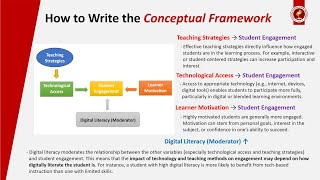
alignment across the whole project okay so although I am based within qualitative research and I tend to always focus these presentations on qualitative research you will find conceptual frameworks right across the board in academic work both in qualitative research and quantitative research and in most other research paradigms right so with in quantitative research you will most often find conceptual frameworks that revolve around testing concepts testing theories developing hypotheses you might also find conceptual frameworks that show relationships between variables qualitative research is a little bit different because they are so mean different methodological approaches in qualitative
research so a conceptual framework actually plays quite a significant role because it sets up the assumptions within the study so qualitative researchers really do need to pay attention to their conceptual frameworks if we look at the levels between masters and doctoral research the difference in in each of these is on the levels of abstraction so within masters research you would have lower levels of abstraction you might draw on one Authority you might draw on a researcher who has drawn on another Authority but you may not have to go in to the roots of the broader
paradigm and you may not have to engage in the deeper assumptions of the conceptual framework again this really depends on your field because if you're working in philosophy then you probably would have to do that but generally for a master's thesis you you would have to explain the conceptual framework at a lower level in terms of doubtful research the conceptual framework really contributes to your contribution to scholarship so here you would need to explain the kind of higher level paradigm attic assumptions of your conceptual framework you would need to look at the roots of the
conceptual framework and perhaps how it's changed over time and you would need to read original authors so for example at the Masters level if so if lillas quoted Foucault you would probably just talk about lillas whereas at the doctoral level you would need to go and read Foucault yourself okay what I wanted to explain here it was that at the Masters level you probably only need to look at researchers who have used the theory but again you know take this in terms of what you find out about your discipline because depending on your thesis you
might have to engage and match more okay when is the conceptual framework developed again this really depends on the discipline or the field but there are some studies that use a conceptual framework right from the beginning so right from the outset this is what I tend to do is to say I'm coming from this perspective from an academic literacies perspective and this is what frames my thinking so then it sets up the whole thesis you could also develop your conceptual framework out of your research data and this is what happens in grounded theory so this
means you would end with your conceptual framework this would be the endpoint of your research and and the research itself would be about getting to that conceptual framework the third way of developing your conceptual framework is through reading the literature and you might for example develop a conceptual framework by looking at how different concepts are related and developing a construct or a model so this this would be developed through the process so just to say this a little bit differently you could use an existing theory or framework from your own field or borrowed from others
something somebody else has developed you could construct your own theory or conceptual framework using research data and developing a new theory which is often done in grounded theory well you could derive theory where you pull together concepts from the literature of course they must fit together logically and be theoretically aligned so their assumptions can't be in contradiction just to provide you with some examples of conceptual frameworks these there's a certainly not an exhaustive list it's really just to give you some ideas and hopefully if you are already thinking about your conceptual framework you see something
here and that will confirm that you're on the right track so we've talked about the paradigm attic level theories like post-modernism critical theory we've talked about one key Authority for example Foucault or it could be Darwin it could be anyone and the types of conceptual frameworks could be process frameworks where one thing leads to another there could be typology or classification systems there could be descriptive frameworks where perhaps you are describing how systems work in a particular organization they could be models where you say to have an ideal type and then try and see how
close your research data comes to that ideal type and there could be causal or associative frameworks where you're looking to see if one thing leads to another you might also focus on a particular concept so within writing studies process writing is a very popular concept so if I were going to do research on that and use that as my conceptual framework then what I might do is Trace that concept over time and look at the assumptions of changing debates and then come out at the end of it with a perspective on process writing that will
help me to understand my data so just a few small examples again just to help you try and locate your own conceptual framework Darwinism from biology cognitive information process from processing from psychology Rogers theory of innovation of diffusion from technology critical race Theory from the social sciences behavioral epidemiology from Health Sciences Systems Theory from management customer satisfaction models from business so these are just examples of different kinds of frames conceptual frameworks that people might use you will need to have a look at your own field and look at the kinds of conceptual frameworks that are
most often used in your field you don't necessarily have to use a conceptual framework from your field you could borrow from another field but the starting point would be to look at what is being used in your field to frame research so where do you start looking for your conceptual framework you begin with reading of course and looking at those authors or perspectives that appeal to you to your tacit beliefs examining their conceptual frameworks reading up on theories models and concepts in your field identifying the concepts in your research would be important reading up on
those concepts specifically and then creating genealogies histories or CRO not chronological order for how these concepts have been understood over time in your field so reading is the short answer that's where you would find your conceptual framework of course you can also talk to other people your supervisor other students the people within your field so if I wanted to develop a model for a conceptual framework from the beginning you know if if you were using a conceptual framework at the beginning of your study then this is the model I would propose that you would conceptualize
your research then do your literature review although I have to say that you would need to do some of your literature review too in order to conceptualize your research but through the literature review you would add into our core concepts the key concepts that you willing engage with in the study and you then might select an appropriate framework and this might be you know we you've developed something out of those core concepts or you draw on a framework that's external or you decide a particular theorist will help you to understand so you select a appropriate
framework and then you develop that framework and what I mean by that is you articulate it you explain it you provide examples you unpack the assumptions in in essence what you do is you interrogate your conceptual framework so you don't just accept it you question the framework you unpack the assumptions you note the limitations and to do this obviously you need to read widely and I think I've said this before that if you're a doctoral students you need to go back to original documents the reason why I'm suggesting that you really get to know your
conceptual framework is that often when I examine dissertations I can see how just these slight kind of contradictions creep in if someone isn't really familiar with their perspective or conceptual framework and an example that I've just come across recently is you know if you situate your research with in a postmodern framework which in which there is an assumption that there's never one stable identity but then keep referring to identity in the thesis instead of identities then you're contradicting the assumptions of the theory that you're basing your study in so I hope you can see that
so the more you understand your conceptual framework the the list you will find those contradictions creeping in so writing in the conceptual framework what do you need in order to explain it well you need descriptions you need to be able to describe the framework what are the components of it what are the you know who has what are the who are the authorities in this what is the historical context of this framework so you need description you also need analysis which is breaking down their theoretical framework into the assumptions and comparing this theoretical framework with
others questioning the assumptions and then providing ultimately a rationale for why this conceptual framework is still valuable and then you need synthesis at the end which acknowledges that there are all these different points of views debates and and contested areas but in the end you want to show that this framework is still valuable so what you're doing then is you you are describing you're analyzing it but coming up with the conclusion that this is still a valuable conceptual framework where does a conceptual framework appear in the thesis it appears in the introduction chapter where you'll
provide a brief overview of the conceptual framework and why it was relevant to the study it will appear strongly in the literature review because this is where you would unpack the roots assumptions characteristics debates etc the level of engagement in your literature review will depend on whether you're doing a masters or a doctoral degree on your discipline and the relevance of the framework and what I mean by that is that if your thesis is very conceptual then your literature review will be largely composed of unpacking that conceptual framework if the framework is only really one
small part of it then the literature review then you will only use a small portion of the literature review to explain it the other thing that you might do in the literature review is to set up a framework that will help you to analyze the data later on you will also write about the conceptual framework in the discussion and conclusion chapters this is when you revisit the conceptual framework now that you've done the days for analysis what insight have you gained from this process what can you say now at the end of this what can
you add to this conceptual framework two quick points about conceptual frameworks and published papers so some papers are conceptual papers so the whole paper will be about a conceptual framework but when you are doing a research paper and the conceptual frame the framework is only one part of it it usually only consists of a couple of paragraphs and here's an example from a paper that I'm working on right now and I've just taken it off my desktop and I'm gonna read it to you because I just want to show you a few things here my
approach is framed by an academic literacies perspective academic literacies is a critical approach to writing both in the areas of research and teaching that aims to make writing and language visible in disciplinary practices it identifies writing and text production as socially situated activities within context of traditions of knowledge making and highlights the way in which power and identity are inherent in literacy practices this approach acknowledges that students need to acquire skills to master the surface features of texts they also need to be socialized into disciplinary cultures and discourses through writing however an academic literacies approach
also advocates that students need to be aware of the power relations and institutional practices in relation to writing and the identity making nature they're characterized as scholarly writing in other words this approach questions our normative stanza way of inducting writers into legitimized literacy practices by asking how have these practices become legitimized whose interests do they serve what other alternatives might they be so what I want to show you here is that you can see from the first sentence that I'm drawing on a lower level conceptual framework as put forward by Lillis and Scott and then
I'm describing what that conceptual framework consists of providing characteristics of it which really are the assumptions so I'm out laying the assumptions there with sources to provide evidence that other people see this in the way then if you move further down this approach acknowledges that students need to acquire skills you'll see that I've brought in the other two theories or conceptual frameworks around writing to show that I am aware of other conceptual frameworks but I'm pointing out the problem with those conceptual frameworks and and explaining why academic literacies is much more valuable so I hope
you can see that in a nutshell just a few final words on conceptual frameworks to meet conceptual frameworks provide the Wow of research it's it's that kind of light bulb when you're looking at your data you apply the conceptual framework and then suddenly you can see what this all means so they're very valuable in in helping us to not only frame our research understand our research but to provide coherence throughout a thesis but my caveat as always is that the depth breadth and levels of abstraction and how you apply us will depend on your discipline
your degree purpose your degree program and your purpose so you really need to apply what I'm saying here to your specific context but yeah I've got some further reading for you for you if you are interested in reading up on this a little bit more and I have other videos on thesis writing if you want to look those up as well but I hope that you enjoy working out your conceptual framework and that you find it to be extremely satisfying and something that provides you with the insights and contribution that you want to make your
thesis really quite significant ok bye from me