Oh, good evening traders. This is day trader rockstar and tonight we're going to do a video on trading futures and this video is going to be a u you know I want to bring you the best information here. It's going to have a lot of great information but I also want to because I haven't put out a a update in a in a couple weeks on the futures methodology. I want to go back and kind of get people um on board of the methodology and and how important is to stick to the rules because I
haven't I was I wanted to name this video um I want to show you how to be successful for trading, but you're still not going to be able to do it. But I don't know if that uh that um that name is going to even fit on the title bar. But what I what I mean by that sarcastically is the the methodology that I teach has been developed over 20 years and it's based off of uh the stochastic oscillator and George Lane's methodology of divergences. But I've also added different things to that to make it
even better and the timing better on this. And the rules that I apply to the methodology keep a safe and basically there is nothing out there that is going to be as good or as accurate as uh what I'm going to show you tonight. So with all that said, I could show you the spots and what we look for. It's important for you and your part of it is going to be able to be able to not trade, you know, not overtrade until those that that criteria is met. When we have these the situation set
up in our trade, be it a chart pattern or a certain combination of indicators lining up, that's when the odds are in our favor. And I use a lot of analogies on the show and and let me start off by saying that I am a host of day trading radio and I do broadcast live every every evening uh every day actually any evening and we trade futures live. It's at daytrading.com. You can find it on the inter internet all over the place. It's davidraderadio.com. Um and you can watch the show and watch us trade all
day. We have a great trading community. So, feel free to go over there and get all the information. All this information I have goes out to the members and stuff. So, not to get off track, I just want to give you a little of my background. Um, you know, so we we're constantly trade in futures and I also trade stocks. Um, and we're been investors and I've been a trader since 1996. So, you know, now at this point where everything has been, you know, turned into a business. I consider trading a business and that business
has to have a business manual and that business manual is something I teach you know I want to teach but it's so important to stay within that that um that manual that criteria has to be set and most traders cannot do that and I'm just speaking to everyone out there including myself it becomes the hardest thing in the world is when our time frame goes down and we talk about what type of traders we are there is a you know there is different type of trading or you could consider yourself a different type perpetrators, if
that makes sense. Uh, and I'm going to show you an example right now. Hold on. All right. Here's a a little um uh image I had from one of my series that I put out. Beginners and scalping. This is what we're talking about. Scalping is holding a position for several minutes. All right. Day trading, hold a position for a day or less. Swing trading, hold a position for several days, a couple weeks. and position trading, holding a position for several weeks or more. And that's basically what we're dealing with is scalping and um and this
but this technique could be can be applied to each one of these. And actually, as you go up, as you go out in time, um you will become more successful when you apply the methodology. It's just because scalping is a fast pace and a more aggressive um trading zone. So, but so many people want it because they're looking for that instant reward. All right? So, that instant reward comes at a a higher price. Then a higher price is, you know, more stress, very very active, and you know, and you have your margins and you could
lose money real fast, you can make money real fast, you know, just a little bit more active and a little bit harder to scalp. as I over my experience as I you know I deal with a lot of people who come in and want to learn how to day trade or I well excuse me should I should say scalp and I I kind of warn them that to you know being in front of that market uh is going to force you to trade and and trading is not always the best thing to do in the
market. Sometimes the market's not going to give you opportunities, but because you're sitting in front of that market, you're probably going to end up trying to make opportunities. And when you look at the methodology and we talk about the the the um what we need to have set up before we take a trade, it's very important that we stick to that. Now, let me see. I should have here's my business plan. I have all this. You could have all this if you if you're watching the site or checking out the site for the first time
and you want all this information that you're seeing on the video on a a PDF form. Um just go I'll put the link in the uh room and you can download it on the um on our site. You got a 10 10day pass to loot the site. All right. Um, but this is an important, you know, important process of being successful is being disciplined enough to know exactly what you're waiting for. So, I always say you have to have an order entry criteria. Why you getting into your trade, a profit exit, why you getting out,
an automatic stop criteria, where that stop's going to go, what's the risk management of the trade for the method, you know, what is your plan? Um, do you know what you want to do when certain things happen? How and when do you increase your position size? You know, there's so many different things that are going to make this is a professional business. This is not you're sitting in your underwear at the at the thing, which you probably are, but you know what I'm saying? You have to take it serious. I used to tell a story
when I quit my job and I became a trader. I felt better getting up in the morning and dressing up. And I thought, you know, it was like, you know, this was back in the back in the day, the boiler room days and stuff. you remember the movie Boiler Room and they go there or or um any of them, you know, you know, you you look at this Wall Street method, you know, methodology or not not methodology, but um the profile of a Wall Street investor and stuff and you want to be a little classy
or a little bit more um business-like. And so I would used to sometimes dress up in a suit just to go into my other room and just to trade. And it felt me it felt good. It felt good. over time it feels sometimes better not having a shirt on like you know where we go the um but I digress right I go off uh topics here so how to set up your charts all this stuff I I you know you you want to learn all this stuff but what I want we're going to go over
today is I want to show you the basic path to being successful I want to I want to point it out in in like three four easy steps and it's really going to be up to do to do this. So, I'm going to give you the the kind of the bare bones path to success. All right? I really am. I'm going to show you what you're going to do, uh, where you're going to do it, and we're going to just we're going to try to stay to that that path and without venturing off too much.
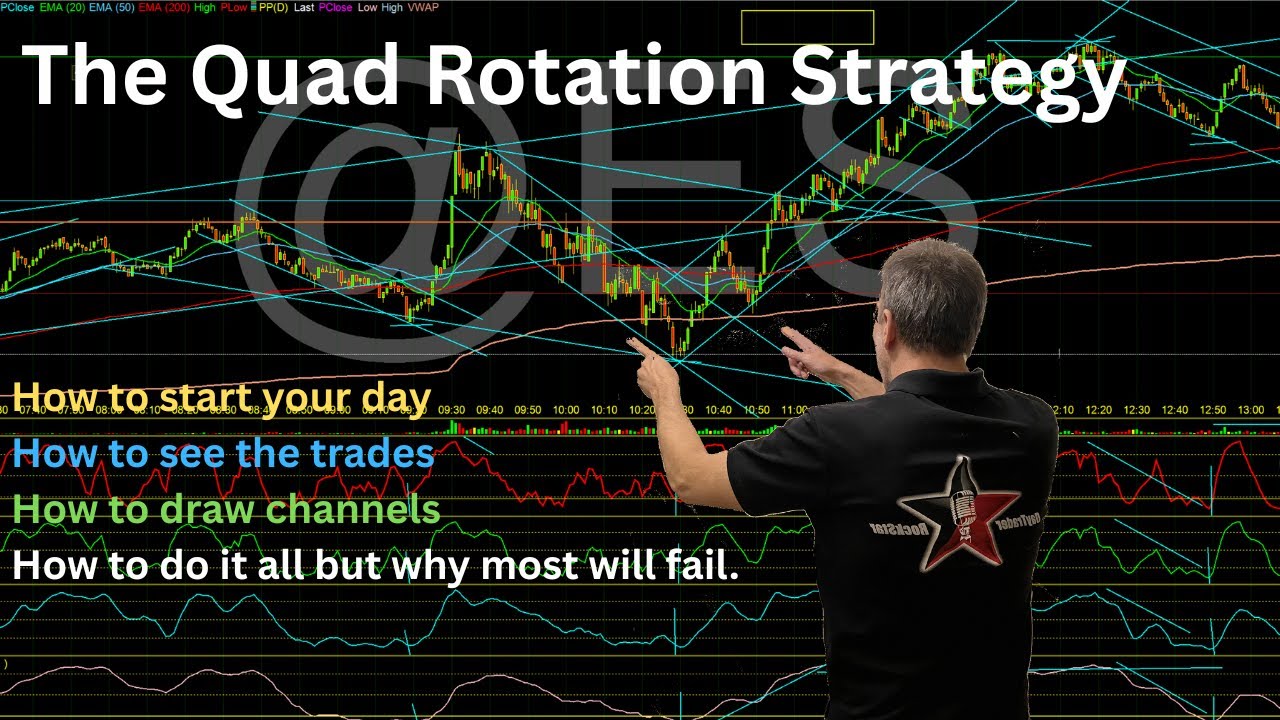
And I'll show you what happens when you venture off. So, these are the only trades I usually take. The rules of the trade, only trade the super signals. Super signal is a merger of a quad rotation and a HPS playbook trade setup. And a quad rotation is something I I invented and came up with over years of trading the stochastics. And I I measured them out so they would work together on different time frames. And each each stochastic um look back period. You know, when you have a percentage K and percentage D line, each one
of those mean something. And doing the calculation, you could kind of mirror some of the previous or bigger time frames on your one minute time frame using certain stochastic levels. So we become to see we get to see a very interesting you're gonna see it and if you're gonna see in a second but that's very important. So that quad rotation is a big portion of my my methodology. Uh and then the playbook trades a divergence a coil one two three channel falling wedge patterns or the VWAP. Any of these five right here that line up
with a quad rotation is considered a super signal. You know we call it quad rotation divergence. That's a divergence. Quad rotation coil. That's a coiled stochastic with a quad that ends at the end. A quad rotation trend line. That's a one, two, three pattern that comes down and hits four, five or six and you have a quad rotation. The VWAP in a quad rotation. Coil divergence is kind of a second that's a that's kind of a secondary because I still trade buy and sell divergences, but anything with a quad is considered a super signal. Now,
it's so super signal is such a good thing, but it it it's it requires us to um set up and it doesn't mean that it's we're going to set up like this every 5 10 minutes. You you might have one or two super signals a day. Now, these are great setups. These will give you tremendous moves. Um but you have to be in front of it at this at the uh the right time, right? So, um, and I got that figured out, too, because I have a I, you know, as a member of Day Trader
Radio, I'm just going to plug this. I think this is the greatest service ever. I do what's called the, um, futures trade alert network and all the members have a phone and they get the well, they have their own phone and they download the app and they get the alert over the phone. I speak into when we're taking that trade or when that trade is set up and what you should be preparing preparing yourself for. I'll give you an example for right now before we really get off here because this is this is key and
this is going to be helping a lot of traders because a lot of traders are not going to be able to do what I said. I hate to tell you this. All right, I'll go over that in just a second, but I'll give you a little taste. You see all these lines on my computer on my chart here. All right. Um these this is our our our environment that I'm looking for. I'm always looking for a directional trade. So, this is how my day goes. I get up in the morning. I get over to my
office. I do have an office outside my home. And I find that I can never trade in my home. Uh it's just would be too distracting and it's not professional for me for me. All right. Maybe if situations were different and I couldn't, you know, and I had to that would I would make it work. But I would try to isolate myself and try to have that, you know, that that that silence and that time that you could focus on the market and not always getting up and stuff. Um, so I'll come in and we'll
sit down. Now, there's a lot of things happening in the morning. A lot of news, as you know, recent events, you might see this, but recent events are always geopolitical events can be moving the markets. The futures will be trading overnight. So I when I get in and say it's about 8:30, 8:00, 8:30, 9:00, you know, I'll sit down at the computer and I'll just go back and overnight and I'll start to just fill in the channels. And the channels are not hard for me to fill in. I I know what they I know how
how we do channel channel work here. Actually, let's go back here. So we'll just we'll do do this together fast. I'm just showing you my process. So, what we're looking for, and this is part one of how to be successful, you're want to be able to identify a channel. A channel is a directional move in uh a in in a stock, index, future, whatever. Whatever you're trading, it has to be in a directional move. You could pretty much visualize a channel. It doesn't have to be exact, people. Important tip here. All right. Trading is not
an exact science. All right? Well, I might show you something here and you might say, "Well, that didn't work. You know, that quad, you know, quad rotation broke down." Yeah, it it, you know, this is not an exact science. This is a um a dangerous uh endeavor that you do the tighter the time frame because you don't get to you don't get to wait it out. You have to make decisions fast and the market knows that. And sometimes the market will test zones and it'll it'll take out stops and there's things that are going on
in this market that we can't we can't see on above the water, you know, and and maybe there's orders down there and maybe the algorithms will grab that order and that brings you past your stop and then it goes back down. But after years and years and years and decades of trading, decades, decades, two, couple decades of trading, we start to see how that plays out. And so we know know and we add that to the methodology. Everything here is based off of seeing this over and over and over again for 20 years over and
over. So when we see a channel, we know what, you know, we just have to put it in. It doesn't have to be exact. So many people ask me, John, how do you put your channel lines in? Where do I put them in for the bottom of the channel lines? Do I put them at the top of the trend lines? It's very important to let that market come to you and and let it tell you what it wants. All right? Lots of times you'll get a flush and then a reversal candle here. And if that
comes into play, then we cancel out those candles. So, we tend to kind of cancel out that candle if it's a good reversal. This case, it's not really. It's just a good just a test of the 200 here. We came back here, but we want to reverse all that candle in one candle. That's a reversal candle. This is not really, this is fine. So, you have, you know, basically you got to look at channels as once you have one, it the other ones will be easier to find. All right? So you have to establish one
channel in your in your viewpoint and then you can start connecting the dots because the dots are when a channel turns around or breaks out there's a high before that channel breaks out. Wherever that is that high tends to be the beginning of a new channel. All right. Um and that usually will be the top pivot area, the new pivot. So remember we there's a rule that I that I coined. It's called the one two three pattern. And you just don't need to have four points like a straight line here and straight line here to
make a a make a make a uh a channel. What you need is have a point here, a point here, and a point here. And with this one, two, three, the market came down, it popped back up. All right, I mean that's all. And then it started reacting down there. So we we have a this came in like this. So this is what we're looking at. It doesn't matter where it is, but long as there's a pivot here. So we have a pivot here, a pivot here. And most likely maybe it's it comes down here
and it's like this. But once we have one, two, three. All right. Just like that. We take that one and two and we just drop it on there. It's usually going to be at the closing prices. And typically, I would say 80% of the time when you have a good one, two, three channel, the two pivots that you're using as your your your first line, your third pivot will be between those. So you make a parallel line. You look for the low pivot in between these and that's why what you're doing. So now when the
market comes down, you're not you you already know where the channel is. And most most stocks channel out. As you look and you look back at your charts, you'll see this. You'll see this channeling that happens throughout the day, you know, and it might be on different time frames. The one minute works great because we've, you know, we know how to throw these. But now we're already setting up here for our trade. So we know where our next trade will come. Only if we have a quad rotation. So now we have a trend line and
if we have a quad rotation, then we're going to look for that bounce. So here we have actually a one, two, three, four, five, and here we come down to the trend line again right here. And guess what we have here? We have a quad rotation. Now, the quad rotation, it's a beast in its own. That's just one part of the super signal we need. And what is a quad rotation? A quad rotation, I'm not going to go into all this today because all this can be found on the site. I give away all this
information even for trial members, you know, just go up to the top in the playbook. Let me actually walk you through it because I know you guys are going to be like knocking down the doors now. Um, let's go to day training radio here fast. I want to just show you where to get this stuff. So, when you sign up, if you sign up, remember it's free. It's just a trial there. Um, you're going to you're going to I'll put the link in the uh the video. You just sign up on the video. You're going
to get this. You're going to be in in this room. You're going to be in this. Now, I turned off the show, so because I'm doing this video and stuff, but this is probably a um this is what our dashboard looks like. All right, this is a trade alert box. The trades go out. These are our news squawks, uh our live chat room, uh lot of stuff going on, the live chat. That's where all the action takes place. And and up here is all the things. We have our uh HPS video, the playbook. This is
very important. This is where I would recommend you going right when you sign up. Go up there. And up here you're going to see um how to set up your charts, all the business plan for the traders, triple uh trade plan for the quad divergence thing. I have all the cheat sheets here to help you understand these setups. Like here's our quad divergence. This is exactly a flowchart of actually what you're looking for. This is a quad divergence. This is one of our super signals. Beautiful flowchart. Makes it very easy to follow, you know, just
uh a lot of lot of stuff that I've done. And then we have the U quad super signal when to get out. All right, that's very important when to get in and when to get out. Um it's all it's all there. So that's where you would get it on the top of that the dashboard. I just wanted to show you that fast so I don't have to deal with the emails. Where is that stuff? That's where it is. Consider yourself. Um so so now I go back and we'll just go back and I'll just throw
these trend lines in. And again, I'm not like saying, "Oh, this needs to connect right to this and this is not that angle and I'm missing that and is this a par, you know, is that a wedge or a channel?" No, most all these consider everything a channel. If it's a wedge, let it be a wedge, but also understand that a wedge is half of a channel. You know that that could be a wedge very well. But the channel up here, if we end up breaking higher, would be your trigger area. Wedges are great. wedges
break down, but you also want that divergence right here. So, what you had here is a divergence. So, this is a signal right here. You have a you have a divergence. You have a little trend line top of the wedge pattern, but the important thing is the divergence. And that divergence with a quad rotation. That's all four stochastics oversold. And then after following up, what's called a quad divergence. quad divergences all four stoastics overbought or oversold little pullback and then a higher low or a lower high a lower low depending on buy or sell side
but a lower and again divergence with the stochastics again if this is Greek to you right now and you need to learn from basics then you know I would just go to those videos in the section of that ed the playbook section um and you know start studying more about that and I have tons tons of videos to catch you up. Uh but the best place to learn is in our chat room because we have constant education there. All right. So now I start to build out the channel. So I'm not really worried about that.
I'm just look eyeballing them. One, two, three, bang, bang, dra it down, you know. So these are all in the past, right? These are all in the past. You said, John, well, it's easy enough in the past to see them, right? Yeah, but you know, and I always I'm the first person to say that, you know, don't give me anything that is not you can't show me real time, you know. Don't do that. You know, I' I've been there. You know, I this stuff is the real deal. It's just that you have to know the
ins and outs, the little quirks of a uh you know, the relationship quirks that you have with channels and stuff. Sometimes they they they take care, but the the information we have down here is very very important. This is all tuned to tell us thing. This is the the echo cardiogram of the market. You know, this is the health and understanding of the bigger channel. Now, I divi designed this lower stochastic here to represent the fiveminute time frame. But the five-minute time frame is actually representative of the larger channel and the larger channel is this
coming down. See the see the channel and then this these are the small moves in and out. The nine threes in out in out. These are the smaller moves up down up down. And we look for the combination when they all line up and they're on the lower trend line right here. Boom. What do we have here? Trend line inside the channel line. That's when a breaks out. So these are the areas. Not to say you're going to be 2:40 in the morning trading, but for the European traders out there, this works great. You don't
have to deal with some of the craziness of the market during the, you know, the Fed speak and Trump being on the markets. You don't have to deal with some of that stuff. I find that the overnight markets are very easy to trade. Um, now the hardest part is I just showed you two great setups here, but can you survive being in the market from 2:00, 240 to about 422 hours without taking two trades? No, you cannot do that. You cannot. All right. It takes it takes discipline. It takes years of understanding and failure to
realize, you know what? Maybe he's on to something. Maybe he's right, you know? But like I was 1996, I had to figure out my own or my own way, you know. I I I even though someone said, "Oh, this is how to trade." I still had to try to figure out and, you know, blow up my stuff my own way before I realized, hey, certain people know you know. Excuse the language. I'm a little fired up. Um, and the experience means a lot. So, identifying these channels is number one. So, when you sit down at
the computer in the morning, go back and just identify it. Get you in the feel of it. The other thing this does is give you a visual conf a visual look at how the market is moving in in the stochastic rotation. The 93 is our fastest rotation. So typically that's our our channel ups and downs ups and downs in the 60s the big big channel be the big the bigger ones but you know here we have a channel down up down up you know and that's the 931 143 and then the bigger channel which is
going all the way from here all the way to down here represent our 60 and when they all line up what do we have right there it is you know we talked about that before all right Um now there's a lot of you know I always want a good channel to develop. Do you start um messing around after maybe one two and you know this could be a news you know remember if you trade this style into news the volatility that comes in at the market open could really be explosive or if there's some type
of um announcement being made by some type of market moving um you know Fed president anybody that could move the markets that could be a a serious thing not to mention missiles and everything else that goes on uh in everyday life here. But once you establish that those channels, you know, and work on your channels and you know, I try to work with people here training radio. I love love getting emails saying, "Is this channel correct? What am I missing here?" You know, but you'll you'll you'll see it and just put them together, you know,
get into habit. I used to see me everywhere I go, I just write down a channel out of habit now. do cuz I want to just, you know, then I want to go back, you know, and I said, "All right, we had these channels. What what here is telling me that this was going to break? What here is going to tell us going to break? What here was going to do? We know it was going to break and I'll go through that, you know, and it's almost like uh that we're gathering information. We're gathering what
works. We see our 93 and a rotation. Remember that 6010. Watch this. The 6010 doesn't You could almost cheat and just say, "I just want my 6010 and 93." K. The key is though, the 143 and the 44. The 44 is my secret weapon. For those that been with me a long time, you know that the 44 divergence has never failed. Actually, I think there was a diver I think there was a divergence just recently and it had a move and it didn't go as high as I expected, but it did move on it. I
think this was it. Let me see if I can find it cuz um probably a couple days ago, but that blue line is in there because it has a it it has a serious effect on the market and I know the signal that. But getting back to just saying you could really cheat treat this by keeping that 93 and 4 6010 that 6010 because it's so slow. It's slow. It's taking 60 periods of time added into the formula and then we're smoothing it out by a 10 period moving average. That right there, you know, you
kind of could feel where you're you want to be in the market right here. uh 12:30. We have a trend line and we have a quad rotation. What we have the 60. If your 60 is oversold, most likely everything else is going to be oversold because they're faster and already be down there. They're waiting for it. Half the time these things are waiting for the 60. And when the 60 gets there, then you get the move. And that's amazing. That's like here, look at this. I just anywhere I go on the chart 12:00. The important
thing is is it in a channel? That's another important thing about being in a channel. Once you're in a channel, channels break out for two reasons. All right, channels break out. And we say breakout, change direction. Couple basic stuff that you want to know. We talk about pivots. Pivots is basically a move from one direction to another. Pivot down to pivot up, you know, and those pivots are what we hunt. I'm a pivot hunter. I like that. I make a website for that. And that and those pivots we identify those by either quad rotations inside
the channel line inside the channel. If we have a quad rotation inside the channel there is a much better chance that channel is going to break out. So you could take those trades as long as you're inside the channel. Once we break out and you say, "Oh, it's we're breaking out." and you get in, you try to get in, you're going to get a bad fill and you're going to be chasing this and it might get a you might have a little profit. If you don't take it off, we're right back and you're like, "Oh,
I should have held on." You hold on a little bit more, then you're low again and then next thing you know, you're taking it off and then it rips higher and it starts it starts a avalanche of bad habits. All right? So, to be successful in this market, you have to be disciplined to identify the channel, then wait for the setup. When the setup comes, you have to have the guts to take the trade into that weakness. The great thing about divergence trading and stoastic trading is that we're buying in the weakness and we're selling
into strain. There is no way you could buy the low unless you buy the fear. All right? So, when you get that quad rotation and you're on that trend line, you got to pull the trigger. That's how you become successful. There's a great quote and I gotta play it for you, right? I gotta play it for you. They probably banned I think they banned me on YouTube today. I don't even know if this video you might find this video on Rumble because I was following the Israeli stuff, but anyway, I don't want to get off
track here. This is so so important. All right, this is u from the movie um Oceans 11. This is about trading, you know, and trading and gambling, you know, they f there's a fine line between the two, you know, it's a very gray area between that because there is nothing guaranteed about the markets, but you do have things that will help you define the levels you want to be in, you know, and we know that there's math involved, channels, uh, lines, um, geometry, uh, Fibonacci, There's a lot of different angles of the divergence. All these
things require a little little bit more scientific in nature, but they they work so well. So you have to if you do want to trade that way, the most important thing is you have to stick to that and you have to wait for it because it consider it a a formula and that formula works until you start to to dilute the formula with bad trades or contaminate it with some crap that you're trying to figure out. You know, not everyone's going to be successful. Uh, not every trade. Some trades maybe break down a little too
far and hit your stop. The majority will. And that's what trading is about. It's learning how to take not be upset that you get into a trade and not be afraid of taking a loss in that trade. You know, the odds are when you have that quad rotation and and you have a team behind you, you know, hopefully you're trading with a group like us, you know, then we're all we are analyzing it live and we know it, you know. So anyway, when these opportunities come around, that's how you become successful. It's not the other
stuff, you know, being in the market. I'm a trader and stuff. It's being successful. It's being in the big opportunities and and then taking the big shot. George Clooney did in Ocean 11 said something that's very same thing with from gambling to the markets especially for scalpers scalpers out there very you know you get hit with the commissions you're in and out one bad trade could put you back down you could start tilting what we call tilting going off the rails and overtrading um and things get really you have re revenge trading and stuff very
very tough to do that. Eventually, uh most of the traders because they don't have the discipline will be burnt out or eventually get caught because they're in the market too much. All right. Same thing here. George Clooney here and I myself believe that if you just take your certain shot in the market, let's listen to this. This is great. Let me see. Sorry YouTube if you kick me off here. I don't know. Maybe you will. Maybe you won't. I think I'm already gone. Because a house always wins because a house always wins. Play long enough,
you never change the stakes, the house takes you. Unless when that perfect hand comes along, you bet big and then you take the house. When that perfect hand comes along and you bet big and you take the house, these are the perfect hands. All right. The perfect hand is a 44 divergence. A perfect hand is a uh multiple divergence indicators. When they have multiple divergence, the quad rotation um I wouldn't say that's the ultimate um signal, you know, I don't that's part of this the super signal, but it it gives you much better chances. It's
like you're sitting down there at the, you know, this is for gamblers out there at the blackjack table and you're sitting around people and, you know, they're kind of upset because you don't know what you're doing and you're you're you're taking a hit when you shouldn't be taking a hit and stuff like that because there is a set of odds. You know, maybe it's still a random, but there is a a cheat sheet out there and says you don't take a hit when the dealer has a five or six. Um, and you know, there's certain
things that that you're supposed to do to increase your chances of success. Same thing with the markets. All right? Same thing with the markets here. We have our chances for success when the time comes around, putting it all together, building it out. So, as we build it out and we're live building it out, as we're, you know, you'll notice the channels continue to play out. And what every channel has something in common. It has a pivot. Pivot is where the channel goes from one direction to the next direction, from one direction down to the next
direction, down. And our job is to find this. And we know how to find that because look at this baby. Got another quad rotation right here. And it's a lower trend line inside the channel line. And there's other things here. We have this little 200 period moving average VWAP rising trend line. All right. So important. Now, most people cannot sit around and and trade that way. So, um and we could go right through the day here, you know, and the market opens up. Here we go. Same thing. We have our first quad trend line. We
could have a quad, but unless we have a trend line with it like here, we could have a quad here, but there's not really a trend line until I said right about remember we have one, two, and it really takes a while for that to identify these channels. I do them so fast like you hit one, two, three, you have two, you throw it up there, you just drag it down, it hit four, and it comes back to five and you have a quad rotation on five and that's your trade. All right. There's no other
excuses around um taking anything other other that you know. You know that's that's what I'm teaching right here. Right here. If you're going to do something else, do not contaminate your profits with your that from from this with something else. Um this is this is it. And the more you're disciplined and more you could be in front of this level. Now we have other trades that we take. We know when a trade gives us, you know, every so often these will break down. They might not give us a huge move. Maybe it gives us a
little bounce and then rolls over. How do you know that? Well, 26 years of trading told us exactly how to figure that out. All right. And we figure that out by watching our fast rotation 93 compared to our 60 uh 6010 which needs to be embedded underneath the 20 line. And we know when we have in this case it's a really strong trend. So we're going to use look at the opposite happening. And the opposite is when that 6010 is at 80 and you get these rotations back down. We know as this is pulling back
yet this is not pulling back that the big tra the big trend is intact that these pullbacks is if I mark this off right there. This is what we call this is what I call the 2020 bull flag. Now, remember earlier in the in the um in the cheat sheet section, let me see if I could find that again. Um here, here we have it. An anatomy of the bull flag. That's a super signal. Here it is right here. Start buy enter by signal enter when again this I make this pretty uh pretty easy. Price
has aggressively moved up off the 20 period moving average and it's steeper than average move. So you see this here, this move off the 20 period moving average off move to 20. That gives us the flag pole. The market is in an uptrend trading above the 50 EMA. All right, the blue line, the 50. Um the 93 stochastics has dropped back down towards the 20 line. Here we come. 93 is coming down towards the 20 line. The 6010 stocastic holds 85, preferably 90. This is very high here. As any as everything lines up, you take
the trade either when the price hits the 20 EMA right here. Right? You're buying into that weakness touches 20. Very important to buy into weakness and start taking profits on the candle coming out of the flag. So we usually that's usually about two or three candle trade to the upside. All right? And you might think that's too too, you know, tight. You you want to let it run and stuff. I'm telling you what works for me because lots of times the market comes right back down and, you know, I don't sometimes like that. I give
back those and it's, you know, we're all human and I find that I like the hit and run trade. I I you know, because I could I could find these setups very easily now. So, if I could wait for them and take them, that's the guarantee trade. holding on to them after I take profits and kind of hoping that a running a trailing stop goes higher. So, I tend to take my trades off faster, but there is there is a definite advantage of holding on to uh multiple contracts and I I do recommend that too.
So, there's always two sides of all those stories. You know, you can always look back saying, "Oh, I took it off, took it off, took it off and it was right, right, right." But then you could look at it another time and you'll be wrong, wrong, wrong, and the market went 50 points higher. You know it's not uh trading is not that easy. You have to develop your discipline, your patience to put everything in your favor. This is very important. These are six rules. I want to just throw this out to you right now. Six
rules. The running divergence must be taken if you get stopped out on the first signal. running divergence where you have it's usually three tops to three pops to a top or three drives to a bottom. The first two look like a divergence. So you take that but it actually pops a little and rolls over and goes down one more time and taking out the lows. Typically you want to have a stop underneath your divergence low. So that should take you out. But then what happens is the price moves back up. I have to show it
to you a signal. I'm just walking you through it. And you see the divergence still stands. that you need to get right back in that. All right. One, two, three channels and trend lines are perfect trades when broken and retraced to divergence are divided by bull and bare flags. This is kind of like the next level. This is like advanced 101. You have 101 basic entry stuff. This is a little bit more advanc not advanced but better tricks or tips I should say for this methodology to work really good. Um things to just uh that
I kind of look for divergences after quad rotations. Very good. And the nine, this is really a great one. The 93 divergence and the 14 divergence together happens a lot. But if there's ever a 143 divergence without a 93 divergence, it's rare and more powerful. It's a very powerful divergence when that happens. And you should always take that trade. All right. Couple couple tips there. So now we have, you know, everything here. So, we talked about that retrace when one of those rules was when you break down to a trend line and come back up
to it, that trend line tends to be a really good area of uh, you know, resistance. And now you have that you have another quad rotation here, double top, might have even been a little divergence. There's things that that I don't want to talk about yet on this video because they'll be over most people's most beginners heads. uh you know when we talk about the lip divergence and stuff but there is certain divergences you want to watch out for certain times. Um so then you start to roll over and you start to say all right
remember we said the breakdown well here we have a pivot here we have a pivot here we have a pivot once we have those three pivots one straight line all the way down drop that parallel line down to the closing price and then trade the lower trend line if you have a quad rotation. Here's the lower trend line. Here's the quad rotation. There's your move. All right. Now, you come back down really hard. Now, this is like 110. Now, we start to see that there's um this is not the best example because this day, this
just this video will be out there in internet land for a long time. Just let me explain that today um Israel and Iran were fighting back and forth, sending missiles back and forth. Around 2:00 Iran retaliated with a uh barrage of drones and stuff and the market, you know, caught wind of that and actually started to sell off. So when we have news like that, all bets are off. All bets are off. when you have news, we still follow it, but lots of times you could get ex like here we have the quad rotation uh
right here and you might have the lower I don't have a channel line here. I wouldn't say that's a channel line. Um you know there's not it was just too steep. Um but if there was something here you have to be super careful because things could get embedded down here. Um you know news is difficult if you could step step out of the news flow and just wait for your setup. It's again having that discipline. You might think, "Wow, these are big moves. This is where I want to make a lot of money." Uh, but
you could also lose a lot of money. So, wait for that pattern to come in to boom or boom, one, two, three. Put the four, five, and six together. At least you're starting to look at, you know, this level. If it got hit, no, maybe it doesn't get it. Maybe it just takes off. Whatever. That was the end of the day. That was the murder algo. Anyway, um but that's the that's a basic walkthrough of the day. Every move is probably going to be in some type of channel. Identifying that channel early on using a
one, two, three method. You could establish that and then wait for four, five, and six and wait for those quad rotations. That's the that's the the key to success in this market. Um there's other, you know, and divergences and position sizing. You know, these are things that we can talk about in the next video. I have a lot of that information in the playbook section there. So, we'll talk more about that. Here's a great divergence right here. So, that's our classic divergence. It's a it's a uh a low, a bounce, and a lower low, but
a much higher rotation here. All right. And you can see it was a good 93. 143 was a little one. Um, nothing really there, but that's a good divergence. And we talk about when we get out. If you happen to try to get in and you get a fast rotation, um, there's a lot of news here. I always take it off on that fast row 93 rotation. Even if you might get in a bad thing and it gives you two ticks or six ticks, gives you a point maybe, and you're like, and I hate hearing
this when I do coaching, you know, I want to make $300 a day, you know, I want to make $500 a day. Yeah. Well, that's that's the that is a sure way of overtrading and disaster. All right, you want to take the setups, you know, as they come, analyze them, get the alerts for them and then adjust your your size based off the type of setup. You know, you're going to learn that what what are the best setups. The quad rotation divergence, number one on the list. Quad rotation channel line up there very high. Those
are the ones you want to take a bigger position and a steady sta stable market when there's no news. Do you know what your news is? Do you look at the the news uh the forex factory or or financial juice or benzinger? Do you look at your news feeds and see if there's any any uh press conference that might move the market? You know, you don't want to be in front of that. These are all things that a professional will do or at least uh maybe they won't do it but you know that you should
be doing if you want to be the best at what you want to the best at what you could be. You perfect practice makes perfect. Not just going through just trading and then trying to figure it out as you go. But perfect practice knowing something works and waiting for it. Waiting for that fast ball if you're a fast ball hitter. Um, all right. One last thing. I hope that kind of motivate you. I wanted to motivate people because I know trading could be frustrating. Um, and not everyone want everyone wants to do this, but and
they see the dollar signs, but it's it's it's hard. It's it's hard and it's it's it's very um emotion. Not emotional, but you know, stressful maybe. You know, it could be. Don't be stressed out about it. If you once you start to not trade a lot, you know, and you you you if you're if you're trading 30 or 40 times, you know, most likely you're you're doing something wrong in my on my my feeling. Um but hey, you could be do sometimes people trade this style of trading and they trade a a tighter time frame.
They trade a tick chart or a range chart. Well, you never know. And it and some people might want to take a tick or two ticks. So you could get lots of trades. It really depends. But make sure the methodology you want that high. You want that higher high. You want that low. You want that lower that you want that high. You want that lower high right there inside of a channel. You have to be able to spot that. See that right there? High. High. Lower high. Inside the channel. Most likely you're going to break
out of the channel. Nine times out of ten, if you have a divergence inside of a channel, that channel will break break out and that will be a a new pivot area just like that. And then that new pivot area will eventually you you know you can almost guarantee by looking at this and this where this was going to go because of this up here. This is going to be a parallel line between this and everything perked, you know, came in perfect. If you had a 93 rotation, which normally I would take it off, but
you also had a one, two, three channel. One, two, three. Now, you could do a one, two, three like that, too. Remember the channel, the high of the channel that broke down is typically the first pivot. The channel when the channel breaks higher, the low of the ch previous downward channel is usually the first pivot. So up here, this is the first pivot. So we draw that line. We wait for that's number one. Now we come down here. We bounced once and we bounced twice. So we have two points down here. So I want to
make that parallel line at that point. This is where we make that parallel line right about here. I see that. Look at that. We have that. So what I'll do is I'll say all right we have and again that might not be the easiest one for anybody to see but you got to have your your mind has to be understanding of every part of a channel means something. If you had a channel breakdown, every these all these channels they show show up here and then you have these divergences. Look at this right here. High, higher
high, high, lower high underneath the 20 is very important. Breakdown high, higher high, high, lower high breakdown. Show me something else on the chart that's working like this. All right. Now, even here, and again, hit and run. We're snipers in this environment. You know, I'm not going to say that I'm going to capture this whole move down here and take it off perfect, reverse it, and go all the way back up. You can do that, then you're better than me. But what I want to do is I want to make sure that you get this
setup. And what am I going to do to make sure you get that setup is I want to get that set up and we do it live. And for those out there who are not live, here's an important announcement. And I should have put this first, but I send these setups out. All right, I set them out as alerts during the day to the members uh using the Voxer network or what I call the future trade alert network. And um I'll show you how that works. Let me just show you that fast. All right. All
right. This is the uh live audio futures alerts. This is a um an app I set up or a service I set up to identify or send out alerts when we have high probability setups. High probability setups is basically what this video was about and how important it is not not to miss these. Um, you know, so what I what I do is you you get about three to five alerts per day and basically I'll put this link in the room. It kind of you could you could sign up for it on it's it's you
could it comes with the day training radio membership with the with the paying membership or if you want to get it's only $20 a month and you can get it on the um Patreon site that's patreon.com daytrading radio and you'll see it there and it works on your phone. You download uh an app. Uh you send in your username. I attach you. It's the boxer walkie-talkie. Uh all the information is on the site. And what happens is I want to call out these trades as they approach. You know, the object here is to get people
in front of the computers before that. Quad divergences, quad VWAPs, quad rotations, uh coils. These are super signals, you know, the combinations. And that's what I really want. I mean, there'll be times when we have bull flags and bare flags, but sometimes they move so fast. Um, but these are things that I can see starting to set up to get you in front of this. This is such an important thing to do because again, you see basically if we have a one, two, three pattern, I'm I have a lot of actually nice charts on the
site. So, when you go to the site, scroll down to the bottom and you'll see just a lot of what you know, just some good shots of what I like to send out like a super signal, steep divergence, that will get sent out. If we have a one, two, three pattern, we have a quad rotation and a trend line. I'll tell you that's happening. Uh 44 the divergence if we're in front of that. Now, this is not automated. This is not going to send out, you know, 3:00 in the morning when I'm sleeping. This is
now I I am in the markets constantly. I'm I'm usually sitting at my table at 9:00 in the morning. We're here until 4 o'clock every day. And then I'm usually three times Sundays, um, Mondays, Wednesdays, sometimes Thursdays. We're trading the overnight markets, um, usually from 8:00 to 12:00 at night. And I send out the alerts, too. So, it's good for Australian European traders. Um, so these are the areas that we want. You know, whenever we have a coil stochastic, this is a great example of coil, you know, I'll send those out. Uh, coil stoastic a
great setup basically there's a lot of good trades that's just examples right there um today just to give you an example let's take a look at that chart again here today all right and let's take a look at we start off the morning now right at 9:30 the market took off remember we had some news this overnight that was the attack on Iran uh from Israel and then the counterattack today was clearly overhanging the markets, but still we still identify those channels. We still identify those those setups. So, let's see when I send it out.
This is how the process goes. All right, I'm going to play this for you. All right, so starting this morning, our first alert, this is what the alerts sound like when we go when I send them out. And they will show up. They come across your phone like a walkie-talkie. All right, the uh time is 10:20 a.m. here. Our market here is uh approaching the quad rotation. We also have a VWAP underneath us which we're looking down around that 5980 area. So it's about six points underneath us. We've had a series of bare flags in
this downward channel. Of course, the news. Now, just to let you know, at the time we were doing this, we were looking at the MEES. So the MEES and the ES had little different VWAPs on it. So that's why you're I have the ES up here. If we look at the VWAP, you'll see if I could see bring that over here. There we go. Let me bring this over here because basically um we trade a lot of the mees. So, as the you can see the VWAP down here a little bit lower and had that
lower trend line. Either case, uh we'll just continue on here. Let me get this show you this again. to putting some early pressure on the market. We're in a nice downward channel. Watch the uh lower trend lines. Again, our first quad rotation setting up right now, 59.85, but I think we could head a little lower to the VWAP, which is underneath us down underneath that 5980 level. So, that was our 5980 call right here. Um, but it also was a quad rotation. So, it's really about the quad rotation and the trend line. the areas around
there could be 78 to 80 85 it's you know again not an exact science u but the areas are very important and and the quad and having everything tied up I prefer to buy into that trend line that trend line is probably one of the better visual confirmations that we could have and again we typically use the typically use that where's my um um the closing price of those candles. All right. So that's that. Let's take a look at the next alert. Now these are happen every day. So So like All right. The uh time
is 11:34. S&P um has rallied strong off of the 10 1020 um quad rotation trade. Also was a lower trend line 123 pattern. Had everything going for it. Now we pushed up here to 6020 area and we're running into a little resistance here and we had a nice run. I mean this has been a nice uh 40 points 40 point run. Now just some thoughts going into the Friday you know the uh the Israel Iran conflict and the missiles flying around. a lot of things here that could uh shake up the market, but we are
still not at our main pivot area above us, which is uh I think a nice little target above us, which comes in around 60 pivot green line here. Now, we're pulling off at that 6020 level, which is, you know, we are extended here a bit. So, I'd watch for our first rotation. I think we'll have a great quad rotation once it sets up. It might set up down the road uh down, you know, a little bit further into our time um into the afternoon, but if we do get that first rotation or actually the second
rotation, it'll sure to be a nice bounce here. So, just waiting on that. So, at this point, this is where we're talking about the pivot or being our target. Um, and we got up to the pivot, we started coming back down. And what we're start talking about is this rotation, the 93, 143, the 44, all starting to sell off, all coming down um at the same time and getting oversold at the same time. Now, these bounced, the 93, bounced back up, came down, chopped, they all end up together. It really, we waited on that 60.
And when that 60 gets down there and we're on a lower trend line, 1 2 3 plus a lower trend line, that is a quad rotation. So I kind of put that out a little early saying buy the next quad rotation. Wasn't sure when it was going to be. It was going to be down in the early afternoon, but when it was, we ended up being at lunch at this point, but that alert went out. So people should be recognizing that setup because that that uh quad rotation after you've been embedded here. There's a lot
of rules that we use on quad rotations. as a whole. You know, there's just a lot of information to learn about the quad rotation, the little little things about when it gets embedded and how it works with the 93 thing. So, when we're embedded here, we're only buying the 93 rotations above the 20. These are all flags. Flag flag. And they're pretty easy flags to identify because we know that each one of these pullbacks, as long as this thing is going to be an opportunity, here's a flag. as long as the price is holding the
20. Here's your pull back to the 20 the 93 rotation and it's holding back. Again, we use 80 as our line, but you should be able to recognize the pullback and seeing the re the reaction on this. If this is not really losing any gap and we're almost there, but the price is on the 20, you buy it on the 20. First consideration is the price on the 20 uh and and the 93. So, that's why we called the 2020. the price is on the 20 and the 93 is down by the 20. That's called
a 2020 bull flag. The 1610 has to be up here above 85, preferably heading higher as this one's going lower. And these are our textbook flags. Um eventually a flag will start to get a little weaker. They'll extend out and then they'll eventually move over. Now, this is a divergence, but we know all this. We we've mapped this out earlier in the video. Um, so that was um, you know, that was our first rotation. That was the that was the last that was the the alert that went out with that rotation here. And then, um,
we actually had this last alert here. All right, it is 2:24 p.m. We have now come into another quad rotation, but this is starting to set up as a little quad divergence, but we have to also say that we have a missile attacks going into Israel that's caused a little more weakness in the market. So, there is uh there is a lot of volatility here. Be very safe. There is a quad rotation divergence setup here. We're at 5992 on ES 59.92. uh previous lows are right underneath us 59.90 and then lower lows are way underneath
that from the overnight lows. So just an just an update but be careful going into the last hour with the uh Israeli under Israel under attack. There could be more volatility here. So that's exactly what happened. This is exactly when the um so we had that little bounce on the divergence but it did roll over. Um and we're you know I was smart about it. I said I didn't want to be part of this trade because it's just when news comes out. I hear something in the background. I wonder why that was still on. It
must have recorded it. That's pretty funny. Um that that broke down and that was basically news. Then we moved back up. Once we get back into that that that rhythm again, um we just pick up identifying the channels again. But here you can kind of we kind of understood there were missiles were flying around. We kind of broke down through the we're just having a hard time rotating up. This was embedded and this is the key down here. When this gets embed this stays embedded and this starts to rotate up. That is our safety net.
That means that's moving up. This is not moving up. That means this is going to roll over and this is going to be a bare flag. And we already kind of put that bare flag out there. We were measuring but it did roll over pretty fast. Now that's just again every every situation in the market on these channels can be defined in the methodology by a rule. All right. And that rule is at 6010 embedded 93 rotation up price stays under the 20 or hangs around the 20 then um you know that's a bare flag
and you you either get out of your longs which you I did or you you execute a short and that was the and then the market sold off and then of course it was end of the end of the day we did start to get a little bit more choppy here going into Friday on the week there's certain things that you don't want to trade um at the end of the day today. Next week should be really good. But to get those alerts, I find those are the most uh important things to have, especially if
you're not familiar with the setups and you want to get alerted to a setup and get in front of those computers and so you know to trade it. This right there, I said if we look back at our 6010s and you say, "All right, there was one at 920, there was one at 10:30, there was one here at 12:40." Um there was one here at 1310 but there was also a breakdown so we didn't count that but that was a reversal candle right there. There's a lot of things to learn here. That candle that combination
of candles what's we call a cancelling candle and that kind of a little volume spike and that volume spike is bigger than the previous 20 volume bars and you have a reversal candle. We we cancelled that out. we cancel that previous candle and that's why we continue to just look at that trend line as a good hold. The market will do that sometimes. It will it'll shoot down. There might not be any orders there. It'll flush out, grab an order down there, come back, and then settle back in. Um, all right. Well, that's it. I
haven't named this video yet. I think I'm going to name it Here's the key to success. But you're you're not going to be successful unless you you establish that discipline and become that business uh you know write out that business plan, stick to it, be in front of the markets at the right time and take this stuff very serious. All right, if you need any help, any uh assistance, I'm always around day trading uh.com. You could become a member. You can reach out to me. I put out a lot of information. Um have a great
evening. Happy Father's to everyone. All the fathers.





![BEST MACD Trading Strategy [86% Win Rate]](https://img.youtube.com/vi/rf_EQvubKlk/mqdefault.jpg)