I love cave art. There's something raw and unfiltered about it. So simple yet so profound.
The lions of Chaveet look like they're mid pounce, frozen in motion. Others are strange and symbolic. Spirals, grids, abstract shapes we don't fully understand.
And then there are the handprints. Someone 30,000 years ago pressed their hand to the wall and left a mark. I was here.
I existed. These aren't just paintings. They're messages.
Direct links to the minds of people who lived and died in the Paleolithic. They show us how they saw the world, what they valued, what they ate, and sometimes what they feared. Because not all cave art is about animals or hunting.
Some of it's darker images of people speared, spled out, dying. Moments of violence captured in ochre and charcoal. So, what do these images mean?
Were they stories, warnings, memories? Today, we're digging into the oldest art on Earth and what it might reveal about the violence of the world that made us. Our story doesn't begin in the caves of France or Spain.
It begins much earlier and much further south. At a cave called Blombos near the southern tip of Africa, archaeologists have uncovered some of the earliest known examples of symbolic behavior by Homo sapiens. Pieces of ochre engraved with cross-hatch designs dating back more than 70,000 years.
Shell beads likely strung onto necklaces. Bone tools used to mix pigments. And even abalone shells used as paint containers.
Essentially prehistoric pallets. These aren't just curiosities. They're evidence of abstract thinking.
And here's where it gets more intriguing. Homo sapiens weren't the only ones doing it. In Spain, inside the caves of La Pasia, Mont Traviso, and Ard delays, researchers discovered symbols, red lines, dots, and shapes that are at least 64,000 years old.
That's more than 20,000 years before homo sapiens arrived in Europe. They were likely painted by Neanderls. So now we know the impulse to create wasn't uniquely ours.
It was something shared, a spark that flickered across species and continents. And as that spark spread, it lit up the world. Cave art appears in Sulawezi, Indonesia around 45,000 years ago.
Images of pigs and hand stencils on limestone walls. In Borneo, nearly as old, we find paintings of wild cattle. In Australia's Kimberly region, rock art dates back 40,000 years.
But wherever you go, one subject dominates the walls: animals. For tens of thousands of years, humans painted reindeer, lions, rhinos, bison, and mammoths in stunning lifelike detail. And yet, strangely, humans themselves are rarely shown.
Why? We're visual creatures. You know, children draw stick figures before they can even speak in full sentences.
So, why did Paleolithic artists avoid their own kind? And why, when they finally did paint humans, they were sometimes shown bleeding, broken, or dying? There's a long-standing myth in anthropology called the noble savage.
The idea that early humans lived in peaceful harmony with nature and each other. Free from the corruption of modern civilization. It's tempting to believe.
I have spent hours staring at Ice Age cave scenes. Cultures like the Oric Nation, Gravian, and Magdalenian left behind art that is shockingly vivid. Herds of horses, beautiful bison, and lions pacing together in groups.
The aesthetic is powerful. It invites a kind of prehistoric nostalgia. But if you linger long enough, that illusion starts to crack because among all the majestic animals, sometimes you see something else.
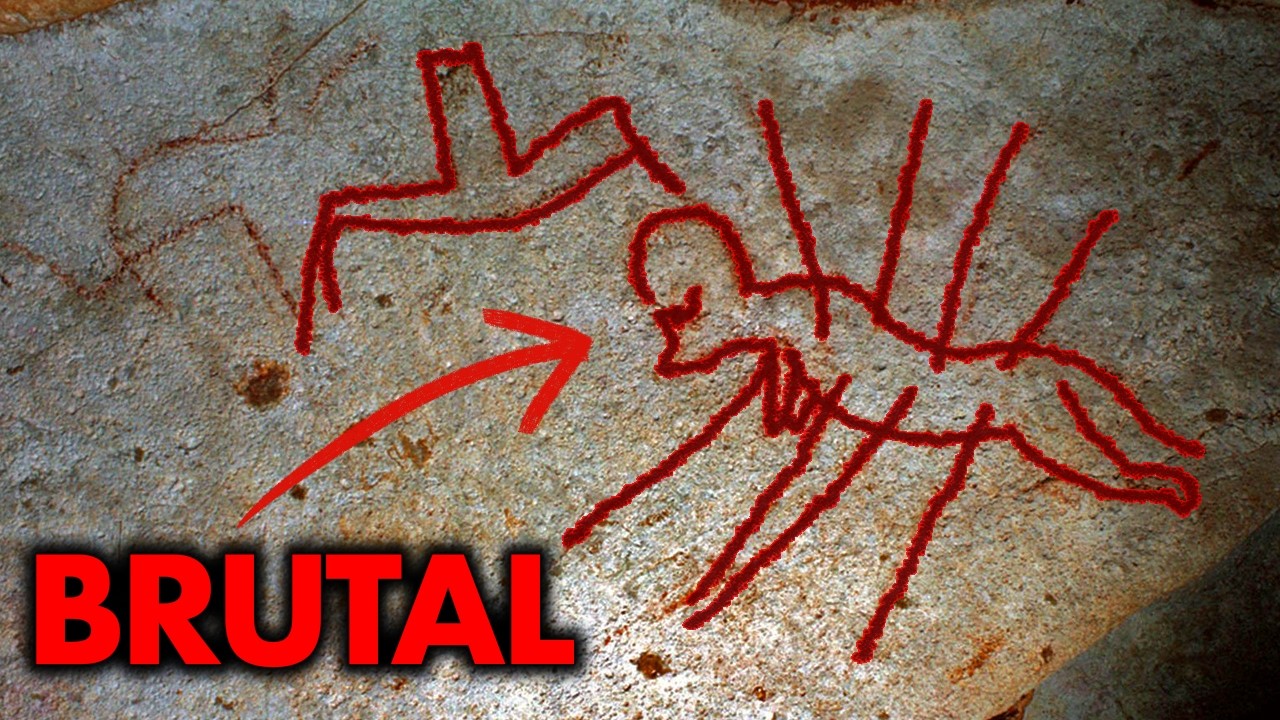
A person face down riddled with spears. Let's go to Peshme, a cave in southern France famous for its striking spotted horses. Ancient figures, according to recent DNA analysis, may reflect real coat patterns in Ice Age horses.
But just beyond the horses, amid the abstract symbols, you'll find something else. A human figure. It's stylized.
The lines are rough, but the meaning is unmistakable. A person lies prone, limbs stretched out with several spear-like objects impaling their body. Depending on the interpretation, there are between 5 to 10 weapons embedded in this figure.
Nearby is a placard sign, a wide symmetrical shape. Some archaeologists interpret it as a bird. Others think it's a symbol of identity or territory.
But to me, it resembles something more primal, a human posture of defiance. Arms out, legs wide, stance aggressive, dominant, and threatening. It reminds me of the footage from North Sentinel Island.
On one instance, when an attempt at contact was made, the Sentinel people didn't run. They spread their limbs wide and shook their weapons. an unmistakable sign of dominant aggression.
Could this Paleolithic sign be depicting a similar posture? Could it represent the killer? Or could it be a visual warning?
This is what happens when you cross us. We can't know for sure, but the same symbol has been found at nearby caves. Maybe the mark of a specific clan and maybe a violent one.
Just a short distance away lies Conac Cave, another French cave system adorned with ice age art. Among the many painted deer and ibecks, you'll find something far more disturbing. Two human figures.
One is tucked inside the shape of a giant servid, probably a megaloseris. But what draws the eye is the figure's pose and the three spears embedded in its back. He's fleeing, maybe caught in the moment of death.
And the second figure is even clearer. He lies with his arms and legs extended, his entire body pierced with spears. Not just once, but repeatedly.
The weapons strike his limbs, his torso, and his sides. This isn't accidental. It's methodical.
It's expressive. It's a depiction of murder. But why paint like this?
Why record it? What kind of world were these artists living in? It's easy to imagine the Ice Age as either brutal or idyllic, depending on your perspective.
But when you dig into the numbers, the picture becomes much more nuanced. At the height of the upper Paleolithic, say around 37,000 years ago, Europe likely had fewer than 4,000 Homo sapiens. That's less than the crowd at a high school football game, spread across an entire continent.
Their population density was about three people per 100 km. Now, compare that to Mongolia, which has around 200 people per 100 km. So yeah, there was not a lot of people in Paleolithic Europe.
Most Paleolithic humans lived in bands of 15 to 30 individuals. Often more than half were children. These groups are mobile, fluid, and dependent on close cooperation to survive.
So large scale wars or battles unlikely, but personal violence very possibly. Even with low population density, disputes could erupt over stolen resources, jealousy, betrayal, or revenge. And sometimes those disputes turn deadly.
To understand prehistoric violence, anthropologists often study modern hunter gatherers. One influential study looked at lethal violence across 21 mobile forager societies from around the world. Here's what they found.
55% of hominids were one-on-one, personal, emotional. 36 occurred within the same group, often between family or close kin. And only 15% involved separate communities.
And even then, most conflicts weren't over territory. They were over insults, wives, status, and shame. Another pattern emerged.
Very few of these killings were accidental. Most of them were planned, and many of them were remembered and retold for years. These modern foragers lived in denser populations than Paleolithic Europeans, with more competition for space and resources.
But the fact that violence was still personal and meaningful tells us something. In the Paleolithic, violence may have been rare, but when it happened, it mattered. And some of it was painted on stone.
So why even record violence? Why take the time in the depths of a cave to sketch out a dying man? There are a few possibilities.
Maybe these were real events, murders, or executions that the community wanted to remember. Or maybe they were a visual lesson. This is what happens to traitors, to cowards, and those who break the rules.
People forget that a lot of these societies were full of taboo and tradition. They have very strict rules. But maybe perhaps these figures weren't literal people, but characters from oral tradition, heroes or villains punished by spirits or fate.
And maybe the act of painting violence was part of a larger ceremonial or shamanistic practice. We will never know for sure, but one thing is certain, the artists didn't paint these scenes by accident. They painted them in careful detail and took the time to remember them.
Other examples of wounded humans do appear in Ice Age art. Though these aren't scenes of interpersonal violence. Instead, they show humans attacked or overwhelmed by animals.
And that opens up a new dimension in the story. A world where people weren't always the hunters, but sometimes the hunted. Deep in the boughels of the Lasco cave complex lies one of the most mysterious and debated panels in all of Upper Paleolithic art.
It's often called the shaft scene, and it stands apart from nearly everything else in the cave. A massive bison dominates the panel. Its stomach is torn open, intestines spilling out, painted in vivid detail that almost feels anatomical.
And in front of it, a human figure lies sprawled out on the ground. His limbs are outstretched. His posture is awkward, and his head appears bird-like, as if he's wearing a mask or has become something else entirely.
Nearby, a staff rises vertically from the ground, topped with a bird. It doesn't look like any of the other art. It almost feels like a story.
Interpretations vary widely. Some say it's a shamanistic trance, a symbolic journey to the spirit world where the human and animal blur. I believe it to be the image of a failed hunt.
The bird on the stick may be a spearthrower, and a spear seems to have disembowled the bison, but a shot to the intestines wouldn't have instantly killed the bison. So, the animal turned, gored the man, and left him for dead. This is my interpretation, but ice age art is often very abstract.
So, who knows what is being shown. Do you guys have any ideas what might be happening here? Leave a comment down below.
At another site called Hawkes, excuse my French, we find a very unusual image, this time sculpted rather than painted. Along the carved freeze, a human figure appears to be in motion, possibly fleeing from a large charging animal. The beast, likely a bison or orox, leans forward aggressively, its body low and fast, frozen mid strike.
The human figure is caught in a dynamic pose, arms raised and body recoiling. There's a sense of energy in the stone, an implied moment just before impact or just after escape. Some scholars believe that this might reflect a symbolic chase.
And others see it as literal danger remembered in stone, the moment when a hunter misjudged their prey and now they're facing the consequences. It's one of the few surviving moments in which Ice Age artists show the cost of failure. There also may be a comedic element.
Something about how the man is depicted is just kind of hilarious. His little crouch posture and nonchal hunt facial expressions could make it on a meme. At Galibu Cave is found one of the more unsettling human animal hybrids in Ice Age art.
A creature is carved or scratched into the wall. Its body unmistakably bisonlike, but its torso and limbs human hood. The head is ambiguous.
It might be wearing horns or maybe a mask. or it might be something in between. Neither man nor beast.
But the figure also seems wounded. Insized line suggests injury or pain. Its posture is twisted as if it's writhing.
It may represent a shaman in mid transformation. Someone channeling the spirit of an animal during a ritual or it might be a symbolic merging of hunter and the hunted, a reminder of the circle of life. I have always simply thought if the figure is just a bison shaman, but in the context of the other figures, it very well may be wounded.
If ice age European shamans dressed up in bison costumes, this is also very fascinating because various indigenous cultures of the North American plains would wear bison costumes during ceremonial practices. Though there is probably not a direct connection, it is just so fascinating to me that both cultures, separated by time and continent, could come up with such a similar concept. The scenes from Lasco, Rock Desair, and Calibu aren't just records of violence.
They don't seem literal in the way Peshmerly or Cognac might be. Instead, they feel symbolic, something between memory and myth. We don't know who these figures were meant to be.
Maybe they're not people at all, but characters in long-lost stories. These ice age cultures were certainly very complex, rich with belief, ritual, and imagination. Their myths were probably as strange and vibrant as anything from ancient Greece or Mesopotamia.
We just don't know their stories. We can only see their images. So when we see a man with a bird head or a bison with human arms, maybe it's not a memory of what happened, but something that was believed.
And somewhere in those beliefs, violence played a role. Not just as a danger, but as some kind of meaning. When we think of cave art, we often imagine beauty.
But hidden among those masterpieces is something more uncomfortable. Death, violence, vulnerability. These weren't just artists.
They were hunters, shamans, survivors, people with stories, fears, and beliefs as rich as any culture that came after. This is what makes their art so impactful. Even after 30,000 years, their art still makes us feel something.
It reminds us that behind every mark on the cave wall was a person, not so different from us, trying to make sense of their world. If you made it this far, you're officially part of the tribe. So, subscribe, comment what you want to see next, leave a comment telling me which piece of cave art you found the most haunting, or if you think these scenes were myth or memory or something else entirely.
All right, thanks for watching and I'll see you in the next one.