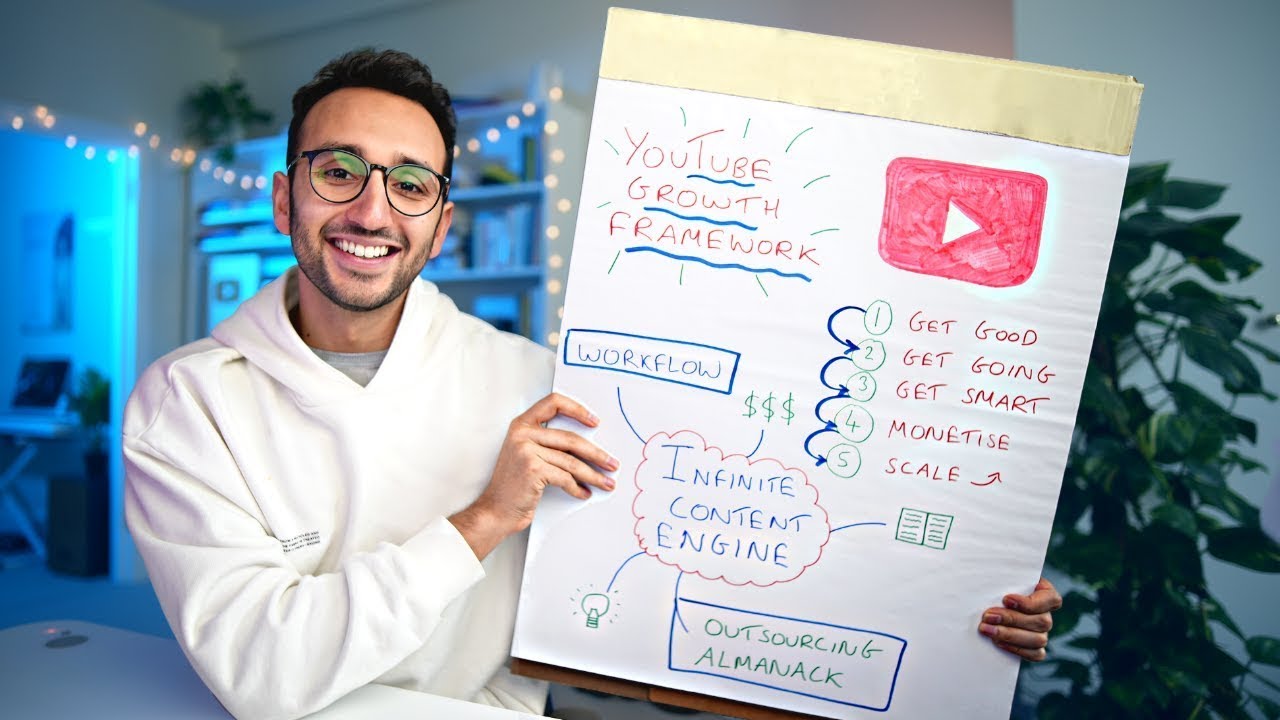
If you can get these three things right, then you're completely off to the races and your channel will explode and you'll become a millionaire. So, in this video, I'm going to take my last 6 years of experience on YouTube and I'm going to try and condense it into a three-part framework that I would follow if I was starting a [music] YouTube channel completely from scratch today. So, I call this framework the part-time YouTuber blueprint because my course is called the part-time YouTuber Academy.
And I've taught this system to more than 2,300 students over the last 3 years. Now, there's three levels to this framework. If you're new to making videos, and in this context, I'm starting a YouTube channel with zero experience, completely from scratch, we're going to start with level one.
Level one is get going. And this is like your first three videos. Now, if you're starting completely from scratch and you have zero experience, then a huge hurdle that holds people up from starting a YouTube channel is actually just not getting started with the thing in the first place.
So, what I'd be doing is I'd just be making three videos. Maybe they're shorts, maybe they're videos I don't even edit, maybe I'm just making them on my phone and speaking to the camera, and uploading them to a new YouTube channel. I would create a channel, create maybe some channel art on Canva or something like that.
And this is kind of like the first [music] three dates that you go on someone if you're in the dating world. You know, you're kind of getting to know them. You're seeing if you vibe.
And in those three videos, I get some pretty good insight into how I feel about making videos. I'm going to be absolutely terrible at it because like with any skill, it takes ages to get [music] good at the thing. But at least at the start, I've made some kind of effort in doing it.
Like for example, if you're watching this right now and you haven't yet started a YouTube channel, I suspect the thing that's holding you back is probably overthinking. I suspect it's probably overthinking about your niche. What the hell do I make videos about?
Why would anyone watch my content? Will people at my job respond poorly to the fact I have a YouTube channel? All of that overthinking just gets in the way of people.
That's why level one is to get going and just make those first three videos. Because to be honest, YouTube is a lifestyle choice. What you're trying to do, what you're signing up for if you're going to take this seriously is making videos every week for the next like several years of your life.
And so it's worth flirting with it for these first three videos and just seeing how you feel. If you don't know anything at all about literally how to hold a camera, how to hold a phone, how to edit a video, how to make a thumbnail, how to start a YouTube channel, then there's loads of free content available on YouTube. Anyway, once you've gone on these first three dates, once you've made these first three videos, at that point, you have a choice.
And this is choice number one. This is, do you want to be in a casual relationship with YouTube or do you want to be in a serious relationship [music] with YouTube? Now, casual is like, I'll make a video whenever I feel like it.
Maybe I'll film a video on a holiday here and there. serious is I am committed to this and that would be obviously the position that I would be in if I was starting YouTube completely from scratch [music] today. I would actively decide consciously commit to being in a serious relationship [music] with YouTube.
That means just like if you're in a serious relationship with a person in real life, you want to try and see them at least once a week. I would want to be committing to making at least one video a week because that to me is taking it seriously. You know, a YouTube channel does not grow if you if you treat it [music] casually.
You cannot accidentally lock into just having a big profitable YouTube channel and [music] that kind of stuff. you have to actively take it seriously. And then once I've committed to taking YouTube seriously, I'm now ready to go on to level two.
Now level two is what I call get good. Um, but I would say in brackets get good enough because in level two we're going to be making our next seven videos. And the point of these seven videos is to get better at the craft of making videos.
Now the thing with YouTube is that there are a lot of skills wound up in being a good YouTuber or being a successful YouTuber. There's titles and thumbnails and filming and talking to a camera and like structuring your stuff and storytelling and being reasonable at public speaking if you're going to show your face. And then being reasonable at research and writing and animation if you're not going to show your face and then actually editing which takes absolutely ages and understanding analytics.
There are so many skills around what it takes to be an effective YouTuber. Again, in this model, we're starting completely from scratch. I don't know any of these skills.
I don't know how to talk to a camera. Don't know how to edit a video. So, I need to spend these next seven videos actively trying to improve the craft of making videos.
Crucially, at this point, I'm still not worrying about my niche. I don't give a toss what my niche is at this point because all I'm trying to do is get better at the craft of making videos. [music] So, my next seven videos in this get good enough stage are going to be I'm just making videos on whatever I feel like.
Maybe I just absolutely freaking love these Stabilo pastel colored highlighters, so I might make a video about my favorite highlighter pens. Maybe I absolutely love this Dbrand Ali Abdal palettes collaboration phone [music] case and I can make a video reviewing that. Maybe I absolutely love this book that I have on my desk at all times, Show Your Work by Austin Cleon, so I can make a video reviewing the book.
It does not matter what the video is about. What matters is that we're getting better at the craft of making videos. And we're not trying to overthink our niche at this point.
And again, to use the relationship analogy, this is where you get to know each other a little bit better. You're learning more about the other person. They're learning more about you.
And across these seven videos, and 3 + 7 equals 10, so 10 videos in level 1 and level two. Across these 10 videos, you're getting to know the craft of making YouTube videos, but you're also learning a little bit about yourself. Maybe at this point you're even having to confront your own emotions around like fear of what other people will think and judgment and self-doubt and all of these other emotional hurdles that can get in the way of us building a life that we love.
And so I'd be making these seven videos on top of my other three and I would just be uploading them to my YouTube channel. At this point you might also want to learn how to get better at editing if you happen to use Final Cut. I have another course about this.
It's completely free on Skillshare or it's included for free as part of my part-time YouTuber academy if you want. That'll be linked down below as well. By the way, if you're enjoying this video so far, I would love it if you could give us a thumbs up.
Apparently it really helps for the YouTube algorithm. Anyway, once you've gotten beyond level two, at that point you have to make the ultimate choice. And the ultimate choice is, do you want to treat YouTube like a hobby, having made 10 videos, or do you want to treat YouTube like a business?
[music] And on the hobby to business spectrum, let's say hobby is zero and business is 10, where do you land on that spectrum? You're not allowed to pick five. And if you do decide at this point that you actually want to treat YouTube as a hobby, that's totally fine.
But if you decide that you want to lean towards the business end of the spectrum, if you decide like I would if I were in your position that I want to treat YouTube very seriously and I want to treat it like a business and I want to be a professional rather than an amateur when it comes to YouTube, that takes us on to level three. And level three is get smart. Now, at this point, we need to actually understand the game of YouTube.
So far, in these first 10 videos, we've just been trying to make videos that we enjoy. But to really grow a YouTube channel that can potentially change our life, we need to understand what is the game that we are trying to play. And there's basically three things.
There's only three things that YouTube cares about when it comes to growing a YouTube channel. And if you can get these three things right, [music] then you're completely off to the races and your channel will explode and you'll become a millionaire. And those three things are number one, click, number two, watch time, and number three, satisfaction.
So firstly, the click. This is the importance of titles and thumbnails and idea generation and concept. No one is ever going to watch your video unless they click on your video.
And so the first step to success on YouTube is earning the click. Your titles and thumbnails and concepts need to be sufficiently intriguing that someone actually clicks on the video. Secondly, we have watch time.
Now, the YouTube algorithm cares a lot about how much of your video someone has watched because the YouTube algorithm is ultimately trying to serve the right video to the right viewer at the right time. And so, if a viewer is watching a lot of your video, it means they're getting continuous value from that video. And so, watch time is a great signal for the algorithm to then promote your video to more people that are similar to that viewer that watched it for a long time.
So, we've gotten people to click with our title and thumbnail. We've gotten people to watch the video with [music] everything about the video actually being good. And then we want to leave people satisfied.
Now increasingly the algorithm is talking a lot more about satisfaction. It's looking at signals according to my YouTube partner manager who I speak to fairly regularly. Signals like you know likes and comments and things.
But also YouTube has started putting these surveys for a percentage of their users that you might have seen when you're browsing YouTube. And they've got tons of other signals for viewer satisfaction. So it's not necessarily that you need to get people to watch 100% of your hourong video, but YouTube has good ways of knowing were people satisfied as a result of the video that they watched.
So, having understood the game, we now need to talk about strategy. And this is where we're allowed to start thinking about our niche. But at this point, we have to think, okay, there are zillions of videos uploaded to YouTube every single day.
And so, your video needs to add enough value for the person on the other end to think that it's justified as an investment of time and attention on their part. You're not just competing with the other stuff that's on the side of YouTube in the suggested videos and watch this next. You're competing with their phone.
You're competing with things happening in their real life. You're competing with every other distraction in this person's life. So this is where strategy comes in and this is where it's really important to figure out what is our niche.
Now the way that I've been teaching this for the last 3 years on my YouTuber academy I think makes a lot of sense and that's you know the question of niche gets people focused on the wrong things. I think a niche is actually two things. It's a target and it's a value.
So in the start of my YouTube journey in 2017 the target for my YouTube videos was people applying to medical school in the UK. And the value I was giving them was helping them get into medical school in the [music] UK. And that is a very clear target and a very clear value proposition which is how my channel grew in those initial days.
Now in our YouTuber academy we have a whole like 2-hour long session where we talk about how to figure out your target and your value proposition. But kind of long story short, basically what you want to do is you want to figure out what are your own interests and what are your [music] own strengths and what are your own unfair or competitive advantages and who are the people that you could potentially help or serve with your content. And then you kind of combine all those things and you make a few hypotheses about, okay, I could potentially be helping small business owners manage their accounts or I could be potentially helping [music] dentists run better ads on Facebook or I could potentially be helping students in Indonesia get better at studying for their exams.
Like whatever that target and value is, those are different niches that you could potentially enter with your YouTube channel. And so that answers the question of why should someone watch my videos? It's like I'm the videos are targeted to that person and I'm giving value to that person and therefore people are watching my videos for the value that they get.
Whether it's entertainment or education or inspiration, there's always value that people want to get from your videos otherwise they wouldn't watch them. And then the next question we have to answer in the strategy piece is why would someone watch my videos rather than the other videos on this topic? Now most niches that you might want to go into on YouTube are kind of crowded these days.
Productivity, personal development, all this this kind of stuff ridiculously crowded. And so you need a way of standing out in a crowded market. So again, the method that we teach for this, there's like two things to understand here.
There's number one, the market, and number two, your edge. So firstly, we've got understanding the market. And here we want to apply the principles that a business would use, which is why we're treating YouTube as a business.
Let's say you wanted to start a new business. Let's say you decided, I want to open an Italian restaurant on my local high street. You wouldn't just decide to open an Italian restaurant on your local high street.
You would do some market analysis. You would see, what other Italian restaurants are there in my local area? What are the restaurants that there are in my local area?
What are the coffee shops? What's the clientele like? What are the what's the sort of income of people walking through the area?
You'd be doing a lot of analysis before you pull the trigger and just randomly decide to open up an Italian restaurant. And so, we'd analyze the market and then we'd figure out our competitive or authentic edge. And this isn't necessarily about being better.
In fact, I think being better is like the worst way of doing this. Firstly, cuz better is in the eye of the beholder and also just takes way more work. But there are loads of other domains in which you could stand out.
For example, in terms of the depth of research you go into your videos, in terms of storytelling, in terms of editing, in terms of relatability and authenticity, maybe you're a male in a female dominated industry or female in a male dominated industry. Maybe you're the only person of color who's making that kind of content. And so, you're appealing to other people of color just like you.
And so, there's loads of these different ways that you could stand out in the market. And you just need to figure out what is that like what is the market and what is my edge. Now, once I figured out the strategy, the next problem I'm going to run into is that it takes a large amount of time to do all of this stuff.
Well, especially if I've got a full-time job, especially if I've got a family and friends and I want to maintain my health and social life, it's actually really hard to make make the time to do YouTube. Well, unless of course you quit your job from day one and that kind of like again, I'm assuming if I start YouTube completely from scratch, I don't have the ability to quit my day job. And this is quite a lot to do.
There's a lot of stuff you have to do to be good at YouTube. And it's really, really, really hard to do it in, you know, 5 to 10 hours a week. But what I've learned over the last six years, and I'd incorporate this kind of knowledge into my starting YouTube from scratch, is that if I build systems, systems and leverage, then I actually can do YouTube in somewhere between 5 and 10 hours a week.
And again, this is thinking like a business. It's like if you go into any McDonald's anywhere in the world, you'll get basically an identical experience because the systems and processes that McDonald's have built are absolutely incredible. You can put any 16-year-old into any of the positions at McDonald's basically, and they'd give you the same result because the systems are so good.
So, what I'd be thinking is, how do I build systems for my YouTube channel so that I can create valuable content that my audience finds interesting and useful within my niche that's strategically aligned to what I want to do, but do it in a way that doesn't take up large amounts of time. Now, if you've gotten to the end of this video and you're interested in potentially building systems for your YouTube channel and saving a lot of time, that's exactly what we teach on my part-time YouTuber Academy. And we're going to be doing our final live cohort of the course in April and May of 2023.
So, that this is the last time we're doing a live cohort. I've done seven life cohorts for over 2,300 students in the last like 2 and a half years. But now it's kind of getting a bit boring.
Firstly, because I've been saying the same stuff repeatedly for the last 3 years, but also now that this channel has grown and about to publish my book and all this other stuff's happening. My life is going in a direction where running live online courses is no longer compatible with other cool stuff that's happening. But basically, the whole course is about how do you build systems and processes and tools and templates to operationalize and scale a YouTube channel just as if you were treating it like a business.
And I've been building these systems and tools for my channel for the last 6 years. I've taught it to 2,000 plus other students and so we'll teach that to you on this live course as well. And we've got some really cool looking graphs and testimonials as well from people who have taken the course in the last like 2 and a half years and whose channels have exploded and it's just super interesting to see.
And the course has a 60-day 100% satisfaction money back guarantee. Also, I get that the course is pretty expensive because it's live and it takes a lot of effort from like me and like 10 other people in my team to make this happen. But for the last 3 years, we have been offering scholarships to people who are in financial difficulty who can't afford the price of the course.
And this time again because it's the final life cohort that we're going to do. We have doubled the amount of scholarship places that are available. So if you want to take YouTube seriously, but if you're in a financial situation that means you can't afford the price of the course, then you should absolutely apply for a scholarship.
We spend a lot of time looking at these applications. The team spends ages reviewing them and so if your application is good, you'll get a scholarship to the course and then you can join this community of 2,000 plus part-time YouTubers. It's absolutely sick.
Anyway, that'll be linked down in the video description so you can check it out. And if you enjoyed this video, you might like to check out this video over here, which is my top 10 tips for beginner YouTubers. So that might be interesting [music] for you.
Thank you so much for watching. Have a great day, and I'll see you in the next video.