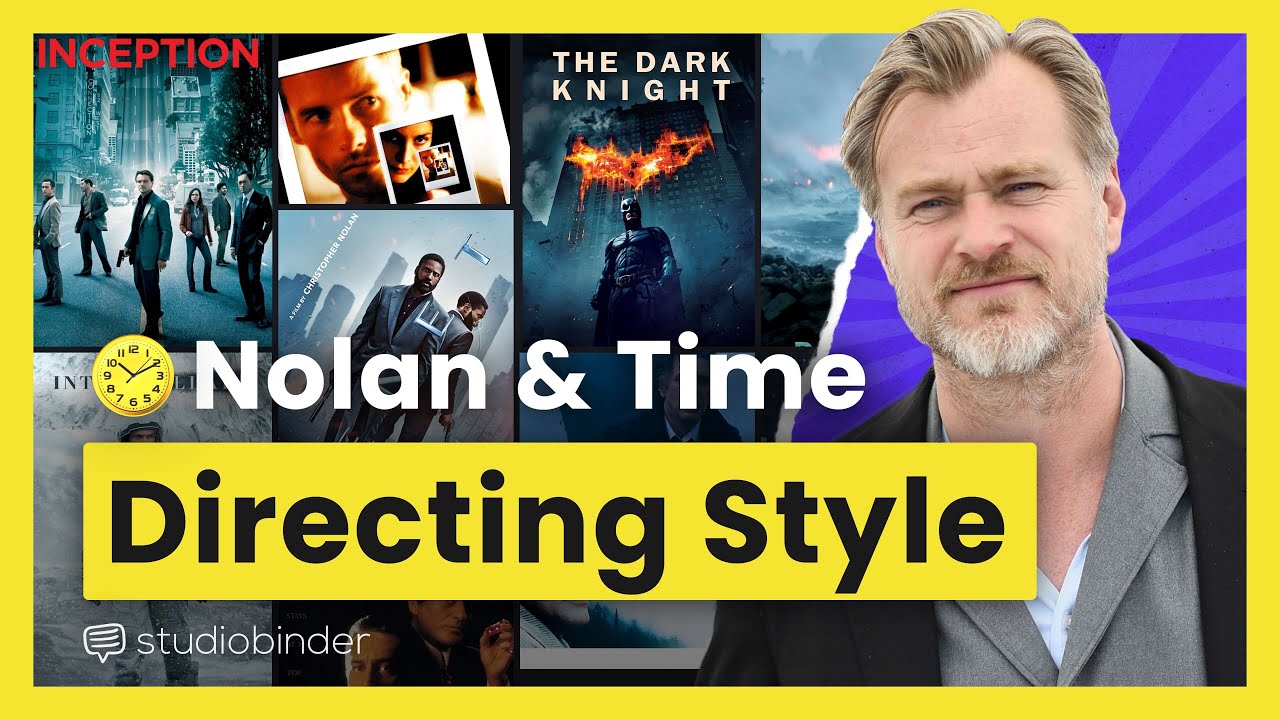
What's one thing that binds all of Christopher Nolan's films together? It's not just mind vending plots or special effects. Or Michael Kane.
"- Some men just want to watch the world burn. " - It's his fascination with time. So how deep does this motif go?
And why is time such an effective tool in Nolan storytelling? Because with Nolan, the clock never stops ticking. This is "Motifs & Motives - Nolan & Time".
"- One of these bullets is like us trolling forwards through time. The other ones going backwards. Can you tell which is which?
How about now? It's inverted. Its entropy runs backwards.
So to our eyes, its movement is reversed. " - For this investigation, we need to examine the evidence. Nolan screenplays.
When we imported them into StudioBinder, we found that this time motif is no accident. The most immediate and obvious way Nolan deals with time is in his plots. "- He can communicate with the future.
- We all do, don't we? " - In many ways, Nolan tells stories as puzzles. One of his favorite storytelling devices is to play with past, present, and future.
And often presents them out of chronological order forcing the audience to piece them together. "Dunkirk" has three plots told in three different timelines. "Inception" ends up operating in five different story levels.
"Memento" is told backwards. And forwards. "- Yeah, it was not amnesia.
I remember everything up until my injury. I just can't make new memories. " - This allows Nolan to deploy information strategically.
"- Okay. What do you have? You have the beginning of the film here.
That's basically the end of the movie. This stuff is the black and white stuff. This is color.
And this is running backwards as a series of jumps. And what we do is we cut between the two, the whole way through. So we alternate scene here, scene there, scene there, and then meet towards the end of the film.
" - Nolan isn't subtle with this motif. "- I have to believe in a world outside my own mind. I have to believe that my actions still have meaning.
Even if I can't remember them. " - What's the most obvious way he uses time? He shows it.
Whether it's how a character is aged. A spaceship that looks like a clock. Or waiting for a bomb to explode.
Beyond the basic plot structures, characters discuss time and how it affects the plot. "- I've waited years. - How many years?
- By now it must be. . .
- It's 23 years. . .
. . .
four months, eight days. " - Or their internal struggle with the past. Because time is universal.
"- Can't remember to forget you. " - We're all dealing with time in some way. So no matter how fantastical the concepts in Nolan's films they're still grounded in something we all share.
"- Because I gave it to her. " - Nolan doesn't stop with dialogue and props. He edits time into his films.
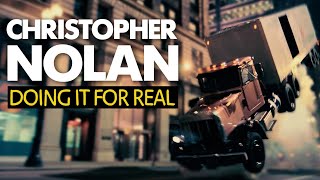
Remember this? Well, that was shot at 360 to 700 frames per second. Certain sections, 2000 frames a second.
The vehicle is essentially a ticking clock slowed-down so much, it's painful. You feel the time. And how valuable each second is.
But he doesn't stop there. Just like "Inception", we have to go a level deeper. "- Cobb, do you hear that?
- Now I hear it. It's music. " - Nolan brings this motif of time into his soundtracks as well.
With "Inception", Nolan plan to use Edith Piaf's "Non, Je Ne Regrette Rien. " as a leitmotif from the beginning. He even wrote it into the script.
♪ Edith Piaf's - Non, Je Ne Regrette Rien ♪ The song acts as the anchor to keep the characters synchronized within different dream levels. "- No, it's too soon. " - And that brings us to Nolan secret weapon - Hans Zimmer.
Zimmer built his score around the slowed down version of this track. ♪ Edith Piaf's - Non, Je Ne Regrette Rien ♪ The speed and timing of the music just like the van is dramatically slowed down for intensity. ♪ Hans Zimmer - Destabilization ♪ Nolan gives us a multisensory experience.
♪ Hans Zimmer - Destabilization ♪ Zimmer Nolan taught themselves again in "Dunkirk". Hear that? The relentless ticking.
That's based on a recording from Chris Nolan's stopwatch. Time running out is a major motif in "Dunkirk". So time is of the essence.
Zimmer also uses an audio illusion called the Shepard tone in his score. With its seemingly endless rise and pitch, the tension has compounded as the three storylines converge. "- He said to me, "This is going to be a short movie.
It's going to be 90 minutes long". I basically demoed up a hundred-minute piece, which sort of became like a grid of tension. Chris has talked about the Shepard Tone.
It's like, you know, when you want to barber pole things keep going up endlessly, right? - So you will continually going up the scale, going up the scale, but you never seem to go out of reach if you like. And I wanted to try and apply that to screenwriting, to a narrative.
And say, okay, well this story, can you braid together the three storylines in such a way that you create the idea of a continuing rise in intensity? It's the combination of time represented in sound and image that amplifies the pressure. Nolan puts time on the forefront of the viewing experience.
Much like the characters, we feel the time. And when you feel the time you feel the pressure. Nolan's use of time in his films is cohesive.
It's a great example of unified storytelling. In which each element perpetually reinforces the others. The fragmented narratives pull us in.
The sensory input of time from the sounds and images, make us feel the time. And aligns us with characters who are also dealing with the effects of time. Nolan keeps us aware that for the time, time does not stop.
He's everywhere. He's inescapable. "- That's who he is.
That's what it takes. He lives his acts. Don't you see?
" - So when workshopping your next project, think about what it is that fascinates you. Nolan found a universal connective tissue we can all relate to. And made it into a motif.
The guiding principle. Maybe that's why his films are so timeless. What is your favorite use of time in movies?
Does anyone rival Nolan? Should we have talked more about "Interstellar"? Cause we did a whole beat sheet on it.
Tell us in the comments. "- The magician takes the ordinary something and makes it do something extraordinary.