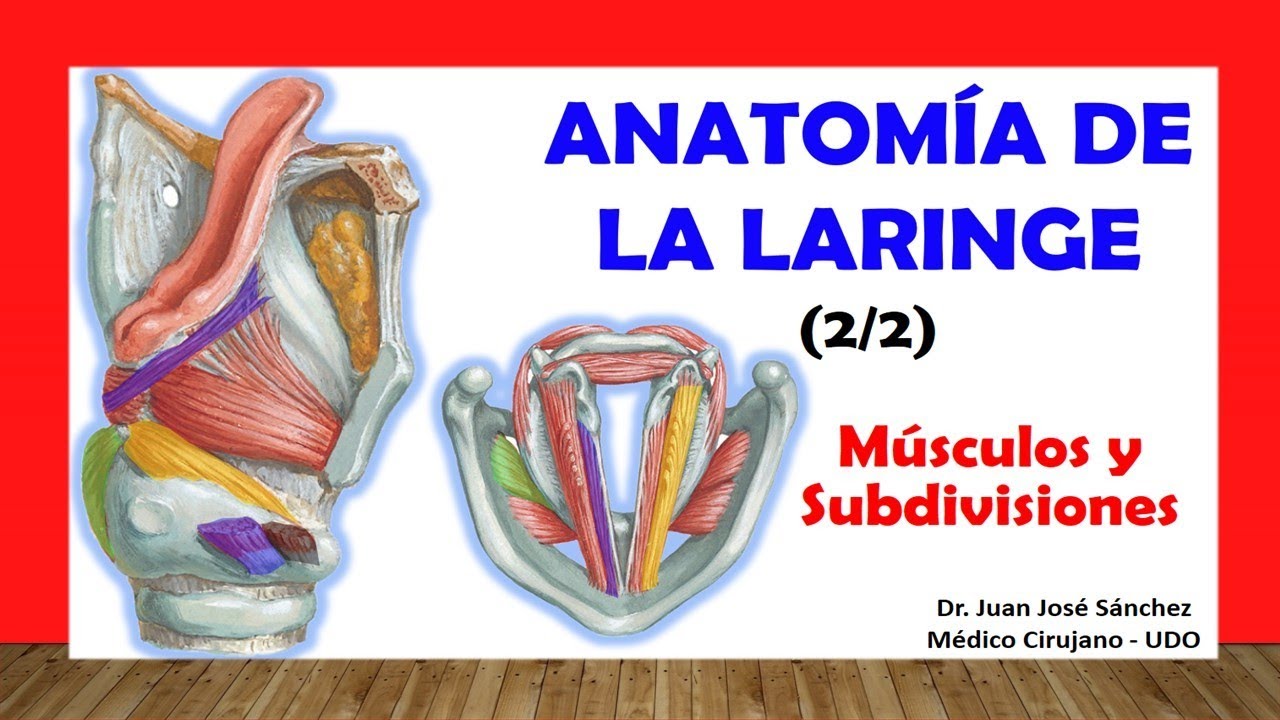
Well friends, then we continue with the second part of the larynx, in the previous video of larynx 1 I explained the cartilaginous part of the larynx as well as the generalities of the larynx, in this installment we will talk about the subdivisions of the mucosa as well as the muscular part and its innervation, then the larynx I remind you that it was a structure that served me for human formation, because within it were the famous vocal cords and that it was going to be the entrance to the respiratory system as such, ok? It continued backwards with the lower part of the pharynx, which is the larynx, pharynx or hypopharynx, and downwards with what is the trachea, that is why it would go from the upper edge of the thyroid cartilage, sorry for the epiglottic cartilage. to the lower edge of the cricoid cartilage, which corresponded to the C6 vertebral level, then it will be composed of two large parts, one is the entrance orifice and the other is the subdivisions that I will explain to you right now, the entrance orifice is the orifice that will communicate to the laryngopharynx with what is the larynx itself, then this orifice will be the famous aditus that the Greeks called aditus larynx or simply entrance orifice to the larynx, then it will be limited from above along the upper edge of the epiglottic cartilage, on the sides by some mucosal folds that will be folds that will go from the cartilage that is at this level, obviously here it is covered by mucosa, it seems to be in the arytenoid cartilages to the epiglottic cartilage .
So this mucosal ridge is called aryepiglottic folds or tubercles, then in the first two tubercles, which are more medial and more inferior, more posterior in this vision, they will be the corniculate tubercles, which are then formed by the corniculate cartilage that is underlying, and then we have more lateral and anterior ones, which are the cuneiform or wedge-shaped tubercles caused by the wedge-shaped cartilage and they are going to be immersed within that aryeteenoepiglottic fold, see that in the most inferior part at what is the union of the corniculate tubercles there is a fold that the inter-artenoid fold because it is going to be between both arytenoid cartilages that are here resting on the back of this cartilage which is the cricoid, you have to watch the previous video so that you understand this anatomy well, some books like this have the shape of a neckline they simply call it inter arytenoid notch or simply fold inter arytenoid, so that will be the limits of the entrance orifice to the larynx or simply the laryngeal aditus, okay? This is a lateral view, there we see above then the laryngeal aditus, we see the upper edge of the epiglottis, we see the aryepiglottic fold, this tubercle that is seen to be the cuneiform tubercle in the background and this more medial one the corniculate tubercle, remember resting on the back the cricoid cartilage. So then we are going to talk now about the laryngeal cavity as such, that laryngeal cavity well this image is then so you can see how the aditus is arranged, the upper edge of the epiglottic cartilage, here it touches the cuneiforms and here it reaches the corniculates , so that this part here you see that it is the notch that is between the arytenoids, which is the inter-artitenoid notch or inter-arytenoid fold.
So now yes, we are talking about the laryngeal cavity , it is divided into three portions, the first portion is the entrance to the vestibule, which the Greeks called every entrance vestibule, then the second portion is the portion of the ventricles and then the portion of the infraglottic cavity, okay? So this is going to be more or less like the subdivisions of the mucosa of the pharynx, nasopharyngeal, oropharynx, laryngopharynx here they are going to be called the vestibule, ventricle and infraglottic cavity. We are going to start first with the vestibule, which is the entrance to the larynx, that vestibule will go from the laryngeal aditus, very important until this fold or this edge that we call the vestibular fold, which is called a fold because it is covered with mucosa but is formed by the vestibular ligament, so you know, from the vestibular ligament below to the aditus above, it is the famous vestibule.
, it will have as its upper limit the epiglottic cartilage and the upper and anterior limit and in the lateral walls we find this fold in mucosa that we already know is the same quadrangular cartilage that we see in the previous video, more laterally, remember that this In a lateral view we find a fossa of the laryngopharynx which is the piriformis fossa or recesses, that would be the lateral limit of what is the vestibule, see in this image then how this ligament, the quadrangular ligament will then be the lateral part from this entire area that would be the laryngeal vestibule to this fold or fold that is the vestibular fold; Now the second area is the area of the ventricle, it is a very deep area, what happens in this image is in 2D and it does not allow us to see the depth of the ventricle but later we will see it, from where to where does it go? go the ventricle? The ventricle or sinus is what the Greeks call the ventricle or cavity, it goes from the edge of the vestibular fold above and below the vocal fold, so this area will be from the vestibular fold and the vocal fold, it is the part let's say most important for the larynx from the phonatory point of view because that is where the voice is given in the ventricle, so you already know the upper limit of the vestibule or vestibular ligament and the lower limit of the vocal ligament, but you already know that as we talk about mucosa it is the vestibular fold.
above and vocal fold below, then in that ventricle there are very important structures towards the anterior part although we do not see it in this image there is a deep structure that I want you to know exists that is called sacculus, in that sacculus there are some very important glands that secrete an oily substance that keeps the vocal cords lubricated so that they can perform their function, then we know that inside the ventricle there is then the vestibular fold above and the vocal fold below, now, there is a space, here we see the vestibular fold above and the vocal fold below, this black shadow that you see here is the depth that is the ventricle itself, okay? So there we see between both vestibular folds, which are the upper ones, there is a space when you put the complete larynx here because it is open but we put it in a circular way, we are going to see that there is a space left in a shape due to that space that exists between both vestibular folds what is called cleft which is what I tried to point out with this red arrow, vestibular cleft to see it we have to see the larynx from above or from below which in this image we have to imagine, then that is between both vestibular folds and then down Between both vocal folds we are going to have a space that is going to be called the glottal cleft, okay? So that we understand it better, we are going to see this image, this is the vocal ligament, if it were covered by mucosa, it would be called the vocal fold, so this space that is between both vocal folds, that is the cleft, as I say, we have to see it Like this image that is from above, it is the glottic cleft, anatomists say that the narrowest part of the larynx is the narrowest point of the larynx when we see it from above when we do a laryngoscopy , okay?
indirectly what we see directly there in the glottis that closes in the larynx, that is the glottic cleft, it is the space between both folds or vocal cords, that glottic cleft has a posterior part that you see is between the arytenoid cartilages, That is the portion that is then inter cartilaginous and has an anterior part that is between the vocal ligaments, which is the part that is then inter ligamentous or inter membranous; So those are the two portions of the glottal cleft. Above the vocal ligament there will be the vestibular ligament, which happens that this image does not allow it to be seen, so the equal space in the glottic cleft but it is above this one between both vestibular ligaments is what is called vestibular cleft in a space wider than the glottic cleft that is why the narrowest space of the larynx will always be the glottic cleft, ok ? .
Now there is a term that you will see that is used very commonly, which is the term vocal cord, people believe that the vocal cord is the vocal ligament and that is not the case, the vocal cord is both the vocal ligament and this muscle that is next to it. What we are going to see right now is the vocal muscle, so the sum of the vocal ligament plus the vocal muscle is what makes up the vocal cord and there is another very common term used in medicine which is the term glottis, when we talk By glottis we are referring to the vocal cord, which you already know is the vocal ligament and the vocal muscle, to the vocal process of the arytenoid cartilage and to the glottic cleft, the sum of these structures, glottic cleft, I repeat, vocal ligament, muscle. vocal and vocal process of the arytenoid cartilage, the sum of these four structures is what makes up the famous glottis, okay?
then below the ventricle then we have the vestibule we are going to have the infraglottic cavity, see that it goes from the vocal fold above to the lower edge of the cricoid cartilage because from there the infraglottic cavity continues with the trachea, see this frontal cut Here the trachea begins, this is the cricoid cartilage, see that it has a dome shape, okay? then this would be the vocal ligament here it is covered in mucosa it would be the vocal fold and see that this would be the upper limit of the entire infraglottic cavity, the lateral limits are going to be in addition to the cricoid cartilage, it is going to be this membrane that is here that goes from the cricoid cartilage to the vocal ligament which is the famous elastic cone or cricovocal membrane, see this deep hole here that would be the ventricle that goes from the vestibular fold that would be covering this ligament which is the vestibular ligament to the vocal fold that covers the vocal ligament , this from here to here is the ventricle and above this vestibular fold we then have the entrance or vestibule of the larynx, okay? See that the lateral limits of the vestibule then of this membrane, which is the famous quadrangular membrane I named them at first.
So we are going to talk now about the intrinsic muscles of the larynx, why? because they are extrinsic that move the larynx but are not part of it, such as the suprahyoid and infrahyoid muscles that descend and ascend the hyoid bone and since it is attached to the larynx, it will also access the larynx, those are the extrinsic that are already studied in another part of the neck, now we will talk about the muscles of the larynx, which are the intrinsic ones, we are going to divide them into three large groups, first the muscles that regulate the entrance orifice, open it and They close it, which is why we call the sphincter muscles of the entrance opening, then we will talk about the muscles that regulate this space, which is a muscle that regulates the glottic cleft and finally the muscles that regulate these ligaments, which are the vocal ligaments. as such; Let's talk about first the three muscles that are the ones that control the sphincter of the entrance orifice, first here in it is very easy in the larynx because the muscles have the mnemonics that at the beginning tell you the origin and at the end they tell you the insertion, So the first muscle I will talk to you about is the transverse arytenoid, why is it called that?
because it goes from the arytenoid cartilage on one side to the arytenoid cartilage on the other side, which is why it is called transverse arytenoid, in some books they only give it the name arytenoid but you already know that it is the same muscle, so this muscle is in charge of Close to the glottis, to the glottis and also close to the larynx, okay? Then let's see that there are some fibers that cross that are behind the transverse ariarytenoid, that is the oblique ariarytenoid. Where does it go from?
he will go from the muscular process of the arytenoid cartilage on one side to the vertex of the arytenoid cartilage on the other side, that is the famous oblique ariarytenoid, it helps close the epiglottis, now look carefully at this posterior view here we see the transverse aryarytenoid this cross that you see here is that intersect with the oblique aryenoid cartilage but continue towards the epiglottis as such, then that will be the arietenoepiglottic muscle because it goes from the arytenoid cartilage that is above the cricoid here to the epiglottis, which opens and closes the epiglottis. It opens and closes my entrance orifice together with or assisted by the oblique ariarytenoid because its fibers intermingle, so that the three muscles that begin with ari are the ones that regulate the sphincter of the entrance orifice. This function is very important; Then we talk, look at this lateral view, there you can see the transverse ariarytenoid, here you can see the oblique and here you can see the fibers of the arietenoepiglottic that surround the entire epiglottis and that is where it closes.
Now let's go with the muscles that regulate the glottic cleft, which you already know was the space between both vocal ligaments, there are just two of them, first we talk about the posterior cricoarytenoid muscle, see that it goes from the lamina or the back of the sheet of the cricoid cartilage that is why it is called crico and then to what is the muscular process of the arytenoid cartilage that is why it is called the posterior cricoarytenoid, if it contracts it causes the arytenoid to rotate on the cricoid that they articulate, for That's what I invite you, I continue to invite you or I urged you to watch my my previous video where he explained these joints of larynx 1, then this posterior cricoarytenoid to contract is going to pull the muscular process towards it and is going to open the glottis, okay? ? It is the only muscle that is an abductor of the glottis, it opens it, unlike the lateral cricoarytenoid muscle, which is the other one that regulates the glottic cleft because it also inserts into the muscular process of the arytenoid but originates the sheet of the cricoid cartilage, So when the hala contracts more towards the side, which is the arytenoid cartilage, so that the glottic cleft, which is this space here, closes, then it is an adductor of the glottic cleft, okay?
So you already know the only abductor, the posterior cricoarytenoid, you see in this image then this would be the lateral cricoarytenoid and this the posterior cricoarytenoid, here in situ we see the lateral cricoarytenoid and the posterior cricoarytenoid, so those are the only two that regulate me this space than the glottal cleft. We are talking now or we will talk about the muscles that regulate the vocal ligaments, which are three, so the following three muscles are only responsible for lengthening or shortening the vocal ligament, which then means that we can give the different tones of the voice, or It's like the strings of a guitar, if I stretch everything to make deeper sounds and if I shorten them, I make those vocal cords not so tense, they come out a little higher pitched, then the first muscle I'll talk to you about is the thyroarytenoid muscle, easy , it goes from the inner surface of the thyroid cartilage very close to the midline to the arytenoid cartilage, which is why they are called thyroarytenoid. If it contracts, it shortens the vocal cords and relaxes them, the muscle next to it that its fibers fuse at its origin is the vocal muscle, it also goes from the dorsum of the thyroid cartilage but it goes specifically to the vocal process of the arytenoid cartilage, it then together with the thyroarytenoid, when contracted are the ones that shorten and relax in those cords vowels okay?
It has no function of opening and closing anything, it only shortens the vocal cords to relax them, they are contracted but they will be relaxed and the cords are and finally, the last muscle that has to do with these vocal guidelines, one of the most important is the criticalthyroid muscle. See that it descends from the cricoid cartilage to the thyroid cartilage, which is why it is called the cricothyroid, see that it has two portions, I will explain those portions to you, it has a lateral view of the crico muscle, see where the cricoid is located. to the cricothyroid thyroid, it has an anterior portion, a posterior portion that is oblique and an anterior portion that is longitudinal.
The anterior or longitudinal portion easily reaches the cicothyroid cartilage to the lower edge but in the oblique portion it reaches the lower horn of the thyroid cartilage. When it contracts, the thyroid cartilage descends, makes it rotate on its axis of the cricothyroid joint and that causes the vocal cord to lengthen, it becomes more tense, so the only tensor of the vocal cords is the cricothyroid, while the thyroarytenoid and the vocal They are rather relaxing of the vocal cords, so here we have a summary table, see that the three arytenoids, which were the three arytenes, aryepiglottic, oblique arytenoid and the transverse arytenoid are adductors but of the entrance orifice, now the ones that regulated the cleft glottic, the lateral cricoarytenoid was an adductor, I closed it and the only abductor, as I told you, is the posterior cricoarytenoid, while what the vocal ligaments regulated in the vocal muscle and the thyroarytenoid, they cut, that is, they pulled the vocal cords while the criticalthyroid muscle lengthened That is to say, I rather tense those vocal cords, so the innervation is very important, all the muscles of the larynx that are innervated by the vagus nerve, what changes is the branch of the vagus that it innervates, all of them will be innervated by the recurrent laryngeal nerve. branch of the vagus, except for one, the only one that is not innervated by the recurrent laryngeal nerve is the cricothyroid , which is the only muscle of the larynx that is innervated by the external laryngeal nerve, okay?
which is a branch of the superior laryngeal nerve that is also a branch of the vagus but it is not the same branch of the vagus that innervates the other muscles of the larynx, so in this image I will explain the sensory innervation I already explained the motor innervation of the larynx by the vagus the branches of the vagus the sensitive is also provided by the vagus but pay close attention to the internal branch of the superior laryngeal nerve today also the internal branch the superior laryngeal nerve is a branch of the vagus minerva to the entire mucosa of the larynx from the vocal cords That is, from the vocal fold to the root of the tongue, okay? That is, both the mucosa and the ventricle are innervated by the sensitivity of both the vestibule and the ventricle, but from the vocal ligament downwards, including the mucosa of the trachea, they are innervated by the recurrent laryngeal nerve, which is also a branch of the vagus, so that the innervation changes. and the cutting point is that vocal ligament, although from here up there is the larynx or superiorly its internal branch and from there down there is the recurrent larynx, so see here how the recurrent laryngeal innervates all the muscles of the larynx, all except the cricothyroid that you see that it goes down the external branch that is of the superior laryngeal nerve, while the internal branch is sensitive, this is the one that you see here innervates my mucosa from the vocal cords up and the mucosa of the vocal cords down It is also secured by this muscle and nerve which is the recurrent laryngeal nerve.








![Neck Dissection Surgical Anatomy: OR FAQs & Answers [201] Didactic](https://img.youtube.com/vi/oSQLNfo4rXs/mqdefault.jpg)