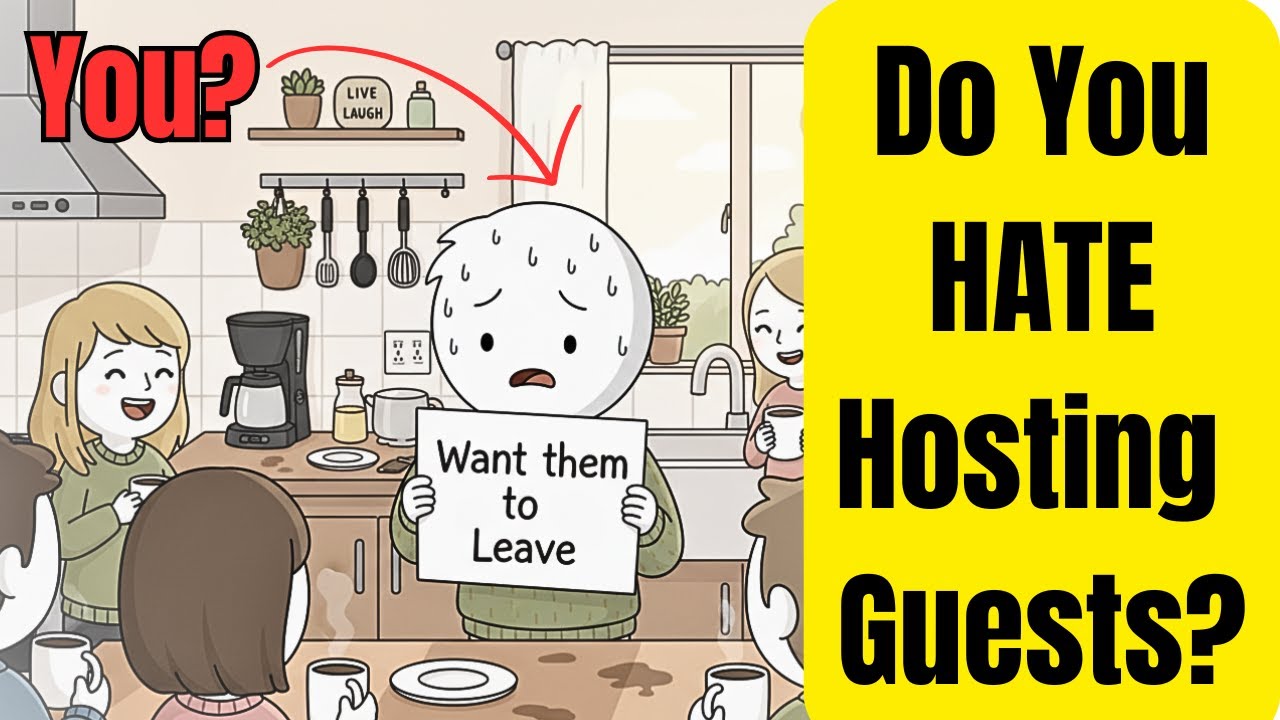
You know what's wild? There are people who invite others over and don't immediately feel their sanctuary being threatened, like they're actually looking forward to it. I am not one of those people.
And if you're watching this, neither are you. So, let's talk about why some of us would literally rather meet anywhere else, a coffee shop, a park, a random parking lot, than have people in our carefully curated space. Because, spoiler alert, it's not about being antisocial.
It's so much deeper than that. Here's the thing. Your home isn't just a place.
It's your place. You spent months, maybe years, getting everything exactly right. The lighting, the temperature, your favorite mug in its spot, your blanket at precisely the right angle.
Everything has a rhythm that's distinctly yours. And then you invite people over. Suddenly, someone's going to sit in your spot, use your bathroom, touch your things, exist in the space you've calibrated for your own comfort.
Psychologists call this environmental comfort, being perfectly attuned to your surroundings. And for some people, that comfort is incredibly specific. It's not mess that bothers you, it's disruption.
Hosting isn't one task. It's 7,000 microtasks disguised as having people over. You've got to clean, but not regular clean.
Guest clean. Which means you're suddenly aware that your bathroom grout has opinions. That there's dust on door frames.
Door frames. Who even looks there? You do now because guests might.
Then there's food. Not just do you want pizza? More like dietary restrictions.
Preferences. That one person who doesn't do carbs after 6 p. m.
You're googling gluten-free vegan appetizers that don't taste like sadness at midnight. and drinks. Multiple options.
Tea. What kind? Herbal, green, Earl Gray.
You're running a beverage hotel. This is cognitive load. The mental effort your brain uses.
Hosting is cognitive load on steroids. Your brain is running dozens of calculations. Timing, coordination, social dynamics, problem solving.
When does conversation naturally end? How do I politely move people from the living room to the dining area? What if someone needs the bathroom while someone else is in there?
It's like playing 4D chess with social etiquette and you're exhausted before anyone rings the doorbell. When you host, your home becomes a stage. You're the lead actor, director, and audience manager rolled into one anxious burrito.
There's this concept called impression management, controlling how others perceive you. Hosting cranks it to 11. You're not just managing impressions of yourself.
You're managing impressions of your entire carefully crafted space. Every choice is on display. Your minimalist aesthetic.
They're judging it. Your book collection reading the spines. Your art forming opinions.
Hit subscribe if you've ever felt visitors do this. Even if guests would never actually judge you, and they probably won't, your brain doesn't care. Your brain is convinced they're conducting forensic analysis of your throw pillow selection.
Here's the kicker. Introverts feel this more intensely. If you recharge through alone time, hosting is running a marathon while someone drains your phone battery.
Social energy plus protecting your sacred space simultaneously. It's multitasking nobody asked for. Let's get primal.
Humans are territorial. Always have been. Your home is your sanctuary, your fortress, your kingdom where you make the rules and everything exists exactly as you want it.
Then you invite people in. Environmental psychologists talk about personal space and territorial behavior. Your home is the ultimate expression of both.
It's where you exist authentically. Pants optional. Complete silence for an hour valid.
Dinner at 9:00 p. m. while reading your call.
But when guests arrive, that sanctuary becomes shared space. You can't just exist. You have to host.
The rules change. The vibe shifts. You're maintaining the atmosphere you've worked to create while accommodating other people's energy in it.
This isn't about mess. It's about someone else's presence fundamentally altering your carefully cultivated environment. Their voice changes the acoustics.
Their movements disrupt stillness. Their being there transforms your recharge station into a performance venue. And if you have anxiety or sensory sensitivities, multiply that by a thousand.
Other people in your space feels like someone rearranging your internal furniture without permission. Your home isn't just comfortable, it's precisely comfortable. You've spent time creating an environment that supports your nervous system.
The lighting isn't too bright. Sounds are familiar. Smells are yours.
Temperature is calibrated. Everything from furniture arrangement to ambient noise has been optimized for your specific needs. Psychologists call this environmental mastery.
Controlling your surroundings in a way that supports well-being, not Instagram worthy perfection, just a space that works for you. Then guests arrive and you're managing their comfort while yours evaporates. Someone's cold, so you adjust temperature.
Now you're uncomfortable. Someone opens a window. Your controlled environment disrupts.
Someone talks loudly. Your peaceful acoustics shatter. You're not worried about mess.
You're grieving the temporary loss of your comfort. Baseline. Hosting requires vulnerability.
You're opening your private world to others, letting them see how you live, what you value, what you've chosen to surround yourself with. It's intimate in a way meeting at a bar just isn't. Researcher Bnee Brown talks about vulnerability as uncertainty, risk, and emotional exposure.
Hosting hits all three. You're uncertain if people will understand your space. You're risking judgment.
You're emotionally exposed because your sanctuary is exposed. Your home is an extension of you. When someone enters it, they're not just seeing furniture.
They're seeing your inner world externalized. That's a lot. Social media has absolutely ruined us on this one.
Everyone's posting their perfect hosting moments, aesthetically arranged shakuderie boards, Pinterestw worthy table settings, candid laughter that definitely wasn't staged three times. And suddenly having someone over for coffee feels like it requires a production budget and a creative director. This is social comparison, measuring yourself against others.
And this is a recipe for hosting hatred because you're comparing your behind-the-scenes chaos to everyone else's highlight reel. Real talk, your guests probably just want to hang out. They don't need themed cocktails with colorcoordinated napkins.
But try telling your anxiety brain that at 2 a. m. when you're spiraling.
When you meet someone at a neutral location, you can leave whenever you want. Bad conversation? Fake an emergency.
Feeling overstimulated? Irish goodbye. You maintain exit strategy autonomy.
But when people are in your home, you're trapped. You can't leave your own sanctuary. You're managing the situation until the socially acceptable departure time.
Anywhere from 30 minutes to 5 hours, depending on how oblivious your guests are. Worse, you're no longer in control of your space. You can't go lie down, can't retreat to usual comfort activities.
You have to stay present, engaged, hosting in the place where you should be able to fully let your guard down. For people who value automate hosting, this lack of exit strategy in your own home is genuinely distressing. If you hate hosting, you're not antisocial, not broken, not a bad friend.
You're someone whose comfort, peace, and control are deeply tied to your personal environment. Inviting people into that environment feels like voluntarily disrupting your own well-being. That's completely valid.
Maybe you meet friends at cafes instead, do outdoor activities, bring wine to other people's houses, and never return the invitation. Whatever works for you works. Because here's the secret.
Protecting your sanctuary doesn't make you selfish. It makes you self-aware. In this next video, I break down why people who love organizing aren't controlling.
They're regulating their nervous system.