If you have thinning hair around the temples, around the hairline, you may have been told how to make it look thicker. But stop now because if you get this wrong, it won't make it look better. And in fact, it'll actually make it look worse.
So today, I'm going to walk you through the most common mistakes that I see as a stylist. And trust me, you're going to want to get this one right. Okay.
So, I'm going to walk through some very common concerns. I'm going to explain what the concern is or the mistake is, why that mistake actually matters, and then the pro tip on how you can address it. And at the very end of the video, I'll share my favorite way to hide this thinning concern because I have the same issue.
And well, I hide mine. Usually only when I do videos, but that's beside the point. We'll talk about that in a second.
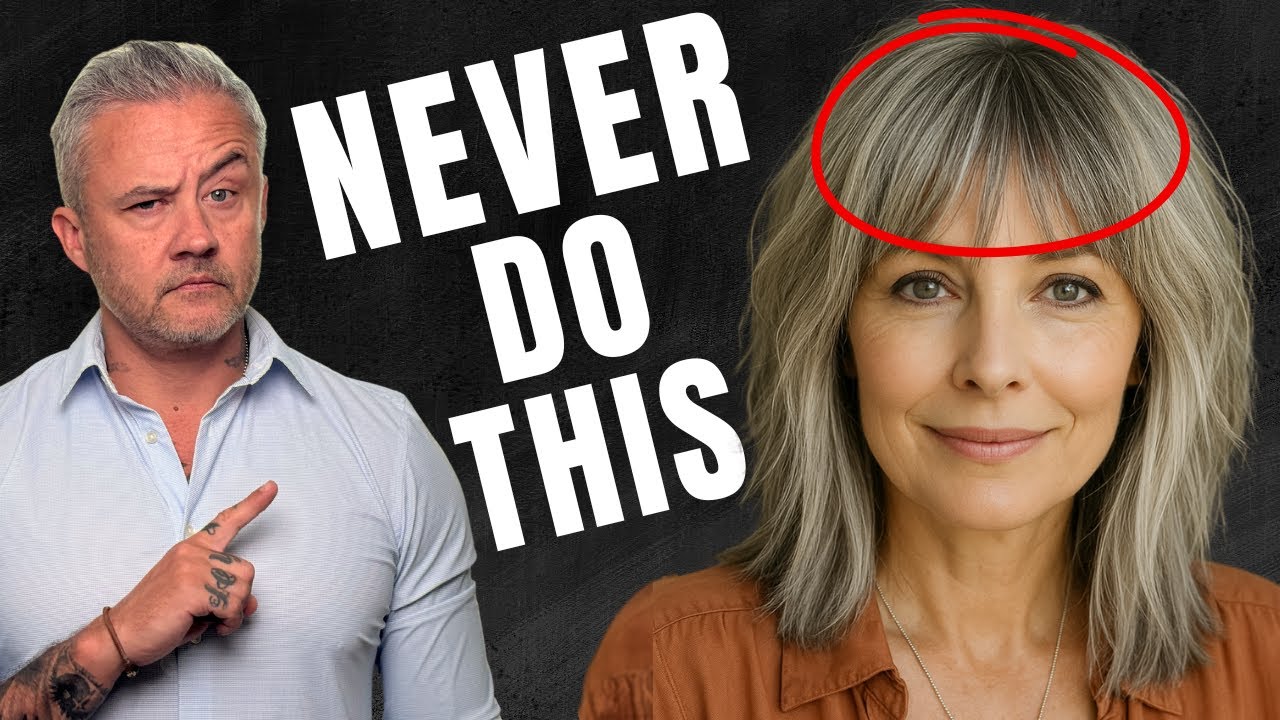
Anyway, now we have our model here. And if you see, she's got a little bit of thinning right here in her forehead. Now, stop.
I know some of you might be saying, "But I have way thinner hair. " That's not thin at all. I promise you the points that I'm going to make today are going to help regardless if you've got much more severe thinning or much less severe thinning.
The way we approach this is the same regardless. You can see that she's got some thinning right in this area in that temple area as well. This is a very common area for people to start going thin, especially when hormonal changes happen when we get a little bit older.
You know, all of those things will start to actually make this more pronounced. So, the first thing you don't want to do is just go get bangs. I know you've probably heard that bangs will do a really good job of hiding this, and they absolutely do.
I'm not against bangs at all. In fact, you'll understand in a second why I think they're a really good option. You just have to make sure that you do them right.
See, the problem is if you do bangs incorrectly, it actually brings more attention to the lack of hair there and it can actually make it look thinner. If you notice here, we've got bangs. Now, this actually looks pretty good.
Good. And you might be saying, "But wait a minute, that doesn't look thin at all. " That's great.
And in some cases, this won't be a problem for you. You've got enough density there that it does look thick like this or thicker like this. But with that said, there might be a problem where you don't have the density to create this much bang.
Now, I'm going to explain exactly how you can know, you can be sure whether or not you have the right amount of density for bangs. We'll talk about that in just a second because you want to know that before you decide to get bangs. when they're not, they might look a little bit more like this or even thinner.
And the problem with this is it's a bit like it might be like a guy with a comb over that's never hidden anything, right? We all know what's happening there. So, how do we actually take bangs cuz you might want bangs and make them actually make your hair look denser?
Well, the pro tip here is to go into a sides sweep bang like this. If we can do a side sweep bang or a curtain bang, something where we're not completely covering the forehead, the side sweep bang will not only give you coverage on the forehead if that's what you're looking for, but also it helps to actually make that area look denser because it's giving you the illusion of the bangs, but because all of that hair like in that area is clumped together, it tends to look a lot denser. Now, in this photo, I purposely made this so that it looked like there was some hair that was coming down like this, too, in case you wanted a little bit of softness in the forehead.
And you absolutely can wear it like that. And something like this because of how dense that side area looks that's being swept off. The little pieces that are coming down like bangs don't look as thin.
Not like they did before in the thinner photo. Here they just look like a little bit of softness. So you can get away with having some softness down there.
But you just want to make sure that you have some of it swept off to the side so that it looks a little bit denser and that'll create the illusion that everything is the more dense. Maybe you don't even want to have a bang section. You just want to have shorter pieces.
If you've ever experienced your hair splitting on the side, and I know this is super common, especially when the hair is receding or thinning right here, you might get this little bald section. All of a sudden, your hair splits back and forth and you can never get it to kind of stay together. And then the worst part about that is you see this split and therefore you see the roots or the thinness right through it.
So, it's kind of two problems all in one. Part of the reason that that happens is because of that area that's thinning and it starts to split right there. If you take the layers in the front or the piece in the front shorter, they're going to get more control, which means that it's going to be easier for them to kind of clump together when you style it and if they clump together, they're not splitting as much.
Now, this is going to vary depending on how short you take this, right? So, if your hair is quite long and the front is also quite long, and you take them up to here, for instance, that's maybe 6 in off, they're going to react a little bit better. It's going to be a little bit easier, but if I'm honest, they're still going to probably split.
It isn't until you really get up into about the cheekbone length where you really start to get some pieces that are short enough and therefore light enough, airy enough to be able to be easily clumped together and get control out of. So even though it's not a bang, shorter layers that are swept off that start in that area are going to help that split a ton. And I get it, you might not want to go that short.
I'm just sharing how you can get more control out of it. the shorter you go, the more control you're going to get. That's not an opinion.
That's just the way hair works. Now, with that said, do not cut those pieces shorter, unless you're willing to use a little bit of product in your hair as well, because simply cutting them shorter is not going to solve the issue. It also needs a foundational product to actually give it the foundation to clump together.
So, just something to be aware of. I I would never want you to go and cut your hair shorter and be like, "Oh my gosh, it's still splitting. " and then I'd feel terrible because you know that's not going to work.
Even with that said, I still don't want to say that that's going to fix it 100%. It's just going to make it better. Again, all of these tips are really a work them together to create a better result individually.
They all aren't going to just 100% fix the problem. We need to bring these together to get you all the way there. Now, the next most important thing that I need you to do is uh go ahead and subscribe.
It's totally free. Just go ahead and do it. Helps the channel.
Or share this with a friend. Did I slide that one right in there? You didn't even know it was coming, did you?
The next biggest kind of mistake or concern I see is people ignoring the power of color. Many times as we age, we're going to notice more of that thinning around the hairline. But at the same time, many stylists and many people will say to lighten your hair because it's less harsh.
They're so concerned about it being so dark and that being too harsh that they say go to the lighter side. But the problem with that is light hair reflects light differently than dark hair does. And so many times that light hair actually looks a little bit more transparent and it's like you can see the forehead through it.
So for instance, here we have the same kind of bangs, but now these are a little bit lighter. And you can see not only does this not do a great job of adding dimension or definition to the skin tone here, but also you just kind of blend the bangs into the skin and because of that it ends up actually not looking quite as dense. So, what if you are already blonde?
Or maybe you just don't want to go really dark or maybe you don't want to go dark all over. You still want to feel blonde. There's nothing wrong with that.
What I say is a pro tip is add a little bit of dimension back in to your entire hair really, but especially in the bang area. The way you do that is just through low lightss. This is not a dramatic version of this.
Now, we've got a little bit of dimension in those bangs. It is very slight, but I've always said that it's not always a big difference that makes a difference. Sometimes a lot of little things add up.
So, when you add some dimension to your hairs with some subtle, even low lightss, it's going to create the illusion that you've got more density within that hair. You couple that with the other tips we're going to be talking about in the video, and all of those things will work together to create a much denser overall feel. Now, if your hair is already dark, you can still do low lightss on dark hair.
As we can see right here, here we have a lighter version of dark with some bangs. And on this one, I'm purposely actually using a bang photo of her with less bang so that this is a little bit more severe in the illusion of thinness right now. And we add even a subtle amount of low lightss to it.
We can see there's a bit more dimension and it feels a little bit thicker. This is a really really big deal even though it's not a dramatic overall feel. Again, this is one of those things where we're going to add all this together to create a much more dramatic overall result.
Now, you might be concerned about growout. Well, I don't want to have a bunch of maintenance. As long as you keep these away from the part line, so they're not coming directly onto the part, you won't notice nearly as dramatically as you might think, especially if they aren't a dramatic contrast to the color that you have already.
So, if you're not doing white and black, you're not really going to see them. And even if you do white and black, as long as you keep it away from right on the hairline, you pull them back a little ways and not right on the part line, it actually doesn't grow out nearly as dramatically as you might expect. And realistically, you may be in a situation where you could even just let them grow out completely before you ever have to get them redone again.
So, it's not as dramatic as you think. And the payout that you get from that, huge payoff. Now, one thing that I constantly get asked in comments are very specific questions about this kind of stuff.
I'll be honest, when it gets into like the comments, especially on YouTube, I can't see enough of you. and the the questions are really hard to answer when it's something a little bit more specific where I actually need to see you and what's going on with your hair to really give you a good recommendation. This is rare, but every once in a while I open up one-on-one consultations, which I'll do actually over Zoom.
If you want to be a part of that, I'll go ahead and throw a link in the description below so that you can get signed up. And then the next time that we release some of those appointments, we'll make sure that you get an email to let you know you can have the opportunity to sign up. If you've got very specific questions you want to know, that's how you're going to find out.
Now, the next biggest concern that I see is the assumption that because you're thinning around the hairline that it's hereditary and you just have to deal with it. That that very well may be true, but also there's a whole other group of reasoning behind why you might be experiencing thinness around your hairline. And some of those things absolutely can be addressed.
So, pro tip here is don't assume that it's hereditary. If you're starting to see thinness, go get your hormones checked. Go get your blood levels checked.
Make sure that there's not something going on that can be addressed through either a lifestyle change or maybe it's medication or whatever. So, make sure that it is something that we can't address another way before we just settle on it. Now, the next biggest mistake that I see is people asking for bangs without first making sure that their hair will actually support not just bangs, but the bangs that they want.
You need to make sure that your hairline will actually have enough hair once it's cut to actually look the way you want it to look. Hey, Diana, do you want to come here real quick? I actually have to take your hair down.
Can you do that or not? I can't. I don't look like a hot mess express.
Well, you're just going to take a comb. Okay. You can do this in the mirror.
Sit on your head. Where that comb leaves your scalp, that's the round of the front of your head. So for Diana, where it leaves her scalp is right about in here.
That means that everything in front of that point is going to fall forward like a bang. Everything at this point is going to fall to the side. And everything behind this, even if you comb that forward and cut it like a bang, it's going to end up as you go like this and shake your head, falling backwards, more like a very short layer.
Take a section from your on your head from that point to each recession. So here on the other side. So you're creating this little triangle.
You pull all your hair back just like Jana's hair is now. Comb that stuff straight down. That's the amount of bangs you're going to have.
Period. So it's either going to look dense or it's not going to look dense, but at least you'll know exactly how much or how much density you're going to see if you wear bangs. And then you can decide if it actually makes sense to have them come straight down or if you need to sweep them off to get them to look as thick as you want them to look.
Did that make sense? I wasn't listening. Oh my gosh.
So, that's a very simple trick that you can do today. What I would recommend doing is you do that, pin everything back, comb that section down, comb it straight forward, and then look at it. And then you can talk to your stylist about what makes sense.
Does it make sense to do bangs or a strong bang or a stripped off bang because you want to maximize that amount of hair, however much that is? Okay, bonus tip. I promised you I would give you my favorite trick to hiding any sort of thinness.
If you've been around the channel at all for any period of time, you've probably already heard me talk about these, but they are fibers. I talk about these things all the time because they're great. But I want to answer a couple questions that I've gotten in the comments regarding these so that you know how to get the best results with them.
But aren't these just going to clog my hair and make that more of it fall out? I'll be honest, I can't say for sure, but I would be really, really, really surprised if they could? From my 30 years of doing hair and working around hair products, it usually requires something to build up on your scalp enough to actually cause a thinning concern.
But these are going to rinse out the minute you rinse them out. So, I don't see these sitting on your scalp for long enough to cause that problem. Now, if you've got other insight that's more technical or clinical that you can give me on that, great.
Comment below. Okay, with that said, the best way to apply these, and I've been using them for a long time. I always use one of these little spray pumps because it's so much easier.
Now, these do come with a little salt and pepper shaker style top. D I hate those things. They drive me nuts.
Honestly, I would say don't even bother using them if you're not going to grab one of these. It's going to be a billion times better. After I style my hair, it's dried.
It's completely done. This is like a hairspray scenario. This is the last thing you do.
I usually just put my hand here just to kind of block it from my scalp. And all you do is just hold it back about 5 in 6 in from your head. And I just spray them in like this.
Okay? So, like right in here. Maybe I want some right there.
I have no idea how that looks because I'm looking at a little tiny monitor like this big. You can get these in basically any color. If you're thinking that you don't know what color to choose, it's surprising how dark you can go or how much off your color you can be and still make it all blend and not even realize that it's an issue at all that they don't blend or that they don't technically match.
A little bit darker is going to look a little bit thicker. The lighter it goes, it's going to match the scalp in many cases more and therefore have a tendency to look a little bit less dense. Okay, so those are the main concerns that I see behind the chair when it comes to making a thinning hairline look more dense.
So, I hope that helped. I'd love to know. If you've got any questions, comment below.
Otherwise, if you like this video, check out this video because uh I'll be there and I'll see you there. Take care now. We'll see you next time.
That's my dance. I'm so hot right now. That's my dance.
That's my dance is obnoxious.