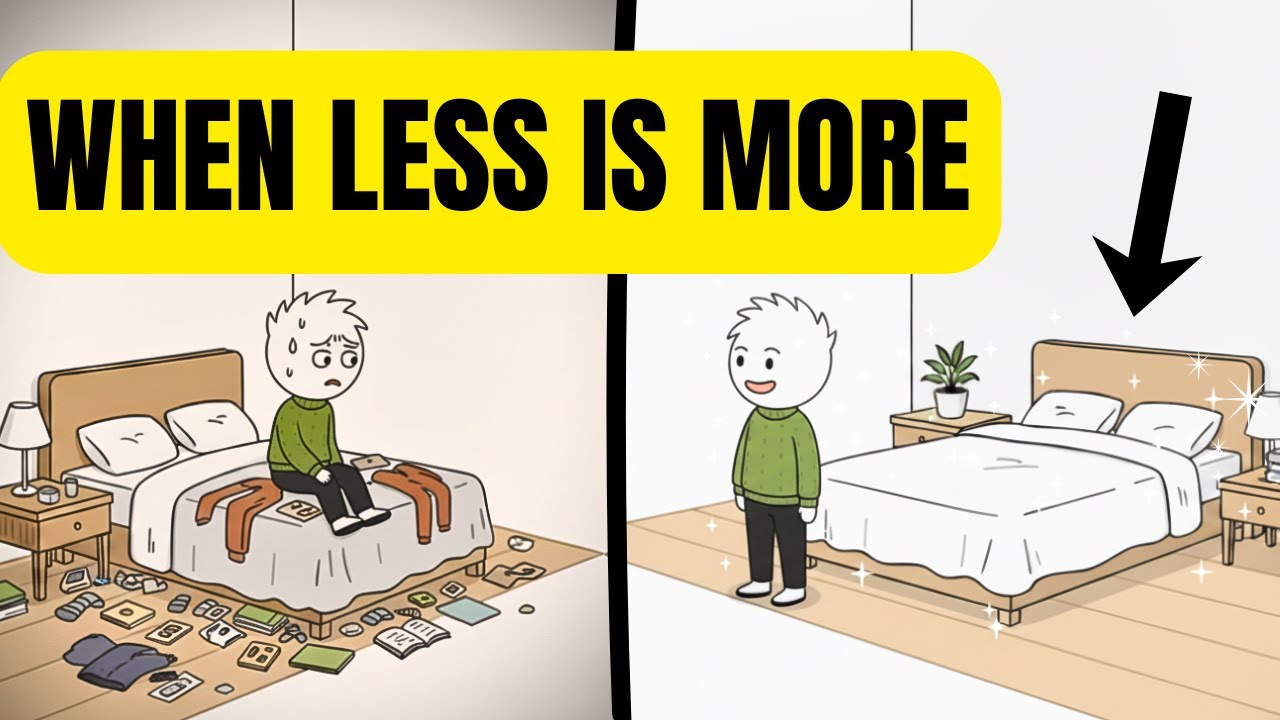
Minimalists aren't getting rid of things because they hate stuff. They're running from something far more terrifying. And once you understand what it is, you'll never look at your own clutter the same way again.
Here's what nobody tells you about minimalism. It's not about the objects. A minimalist doesn't wake up one morning and think, "I hate my couch.
" That's not how it works. They wake up feeling suffocated by choice itself. Psychologists call this decision fatigue.
Your brain makes tens of thousands of micro decisions every single day. And each one drains your mental energy like a phone battery dying in the background. Now imagine every object you own is asking you a question.
Should I wear this? Do I still need this? Where does this belong?
Minimalists figured out the cheat code. Fewer objects equals fewer questions. But here's where it gets interesting.
Research from Princeton found that physical clutter literally competes for your attention. It's not psychological, it's neurological. Your visual cortex gets overwhelmed processing all those inputs and your cognitive performance actually drops.
Minimalists are essentially debugging their environment. And here's the bridge nobody talks about. The more overwhelmed your brain becomes, the more you crave a sense of control.
In a world where you can't control pandemics, politics, or whether your Wi-Fi decides to work, minimalism offers something intoxicating. Agency. You might not control the chaos outside, but you can control what's in your closet.
This is the hidden psychology. It's control masquerading as simplicity. But wait, because this is where minimalism reveals its shadow side.
Psychologists have identified something called destination addiction. the belief that happiness exists in the next place, the next achievement, the next version of yourself. For some people, minimalism becomes exactly that.
They're not removing clutter. They're removing themselves from the discomfort of being human. Because here's the uncomfortable truth.
Sometimes your mess is evidence of a life being lived. Your kids toys scattered everywhere, that's presents. Your overflowing bookshelf, that's curiosity.
your collection of random coffee mugs, that's memory. The healthiest minimalists understand this paradox. They're not seeking emptiness.
They're seeking intentionality. Every object that remains is a deliberate choice, not a default. So maybe minimalists aren't running from stuff after all.
Maybe they're running towards something, a life where their environment reflects their values instead of their impulses, where space isn't wasted storage, but room to breathe. And maybe that's what makes minimalism so compelling. It's not really about owning less.
It's about being owned by less. Now look around your room. What's competing for your attention right now?
What object is speaking the loudest? And what is it saying? Drp a comment and don't forget to subscribe.
Make sure to check out this video next. It's going to change how you view reality itself.