Operating Model Design in Successful Digital Transformation
40.32k views1799 WordsCopy TextShare
Jesper Lowgren
The operating model is often overlooked when organisations transform, resulting in new technology ru...
Video Transcript:
uh VCS for dynamic videos on YouTube for those who like to challenge mindset and make a difference in the workplace most transformation projects fail the failure differed depending upon who conducts the research yet if we take an average of What McKinsey Bain BCG and other heavy heater States the failure rate is around 75 percent put inversely only one in four succeed these are not very good odds especially as companies invest Millions sometimes billions in transformation programs there are several reasons but one more common is the inability to Define new ways of working and operating often
business transformation gives way to digital transformation where a business keeps operating similarly but with new technology put simply that transform the technology but not the business itself there are benefits in this approach it decommissions Legacy systems reduces technical debt and reduces overall technology risk but it's also a lost opportunity to transform how a business operates that is to reimagine its structure and roles capabilities and processes to meet future requirements and here is a kicker digitizing sub-optimal ways of operating can highlight inefficiencies and make business perform worse I repeat it digitizing sub-optimal ways of operating can
highlighting efficiencies and make a business perform worse ouch the ants are nice in defining and developing a future State operating model but what is an operating model to create the context for understanding we can look towards it closed cousins this strategy and the business model the strategy outlines and organizations Ambitions and its competitive markets it sets an intention of what an organization wants to achieve and where it wants to achieve it the business model outlines how it generates value that is how it makes money it identifies the customers and defines the value proposition a value
proposition is a simple statement summarizing why a customer would choose the product or service over a competitor a business that competes in multiple markets has multiple business models the operating model defines how business operates and structures itself to generate value it describes how to deliver the value proposition each business model typically has its own operating Model A business model can also be transformed but the operating model does the heavy lifting that example is Amazon it has an overall strategy covering multiple markets One Market is a corporate sector where it offers cloud services through its AWS
brand another Market is a consumer Market where it offers the Amazon Marketplace selling consumer products each of these markets targets different customers presents different value propositions and has its own business model which has its own operating model if you want to know more about the business model I've created a video about the business model canvas a popular approach for defining business models and I put a link in the video description there are different ways of defining an operating model but the most common approach I probably heard of is people process and Technology the people Dimension
can be divided into sub-components like organizational structure culture and capacity the process Dimension can also be divided into sub-components like value streams capabilities governance space and facilities and a technology Dimension can be divided into operational management and Reporting systems if you Google operating models you would receive many different approaches and models but most are too high level to be meaningful to a transformation program for example the Deloitte industrial transformation framework takes a holistic approach and describes a linear process for developing an operating model it begins with defining a strategy and from the strategy a business
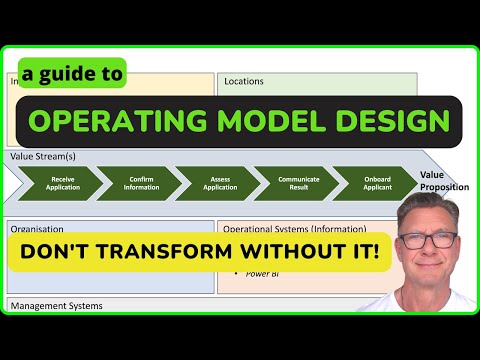
model it then identifies the capability uplifts a new capabilities required and use these to determine the operating model and its impact on people process and Technology it explains a potential process and the context of the operating model versus strategy versus the business model but it's not detailed enough to make transformation decisions I prefer the operating model canvas by Andrea Campbell it is more granular focuses on defining an operating model assumes an existing strategy and business model and identifies six specific areas to deliver a value proposition it begins with defining what needs to be done to
deliver the value proposition what needs to be done can be called by different names such as value chain value stream or a high level process regardless of name it describes the steps to create and deliver value to a customer the concept of value streams will be familiar to anyone interested in business architecture next it defines the inputs into the value stream in the canvas it's called supplies which are found a little bit misleading as it makes you think of something external when it defines any input internal or external it then defines the locations or where
the work is performed depending on the organization's size it can go as wide as countries or as narrow as specific work locations within the building next it defines the organizational structure that creates and delivers the valid proposition the structure is about the relationships between the roles and the roles themselves in my experience especially for smaller organizations it may not change that much but the rules do so to be meaningful individual roles in this structure need to be defined next it identifies the required operational systems such as technology applications in the real canvas this is called
information the final step is management and Reporting systems which contain the metrics and key performance indicators to ensure that the operating model runs smoothly there are several templates available or the internet for download in case you'd like my template I've included a link to the part 1 presentation in the video description let's unpike a case study to understand how the operating model Canvas Works and how to use it the Mental Health Association mha is a not-for-profit member-based organizations for mental health practitioners it has 50 000 members and covid has put a lot of strain on
the organization this year has decided that MHS need to transform to assess an onboard new mental health practitioners to meet an increasing need for mental health services currently mha receives thousand applications from mental health practitioners per month creating a huge backlog the CEO wants to use the operating model canvas to transform the application to onboarding Value stream which is mainly manual the assessment team consists of four full-time employees who can assess around 500 applications per month mha began by mapping the application to onboarding Value stream and defined five stages first it receives the application second
it confirmed that application contains the required basic information third it assesses the application by checking the applicant's qualifications fourth it communicates the outcome of the assessment Fifth and final it on boards approved applicants mha then created current and Target State views of the value stream and the processes within each stage NHA currently receive applications via email or fax application date that is manually entered into an application spreadsheet which takes 15 minutes on average the target state is to use an online form with built-in data validation to store the application data in a database mha tends
to make it a fully automated process confirming applications is tough consuming and often requires a team member to contact the applicant the confirmation takes on average 15 minutes in the Target State the information is checked as part of the application form submission once application data is confirmed the application's qualifications are assessed it is currently a manual process and consists of first checking that the qualification entitles the applicant of practice in second to check the applicant has achieved the qualification stated the qualification is checked against a natural database maintained by regulator if it is an overseas
qualification additional assessment time is needed the assessment takes on average 15 minutes in the Target State mha wants to use the newly developed API better regulator that enables a direct connection to the National Database overseas qualifications still did Manual checking estimated to take an average of 3 minutes once application is assessed the result is communicated to the applicant it is a manual process by the team member either write an email or calls the applicant which takes five minutes on average in the Target state it will be an automated email the final step is onboarding it
is the most time consuming process which takes 30 minutes where a team member makes several phone calls and write several emails mha intends to implement email Automation in a Target State and call the applicant once during the onboarding process it is estimated to Take 5 minutes on average mha believes they will be able to run the future State assessment process with two part-time employees and it tends to redeploy the remaining employees to other parts of its business NHA is now ready to start populating the operating model canvas the input into the value stream is the
regulator who provides the National Education database I have seen some canvases that include internal supplies such as it I don't usually include these unless they add necessary context for example if we model a finance process it might be important at least in total audit as an input the locations include the head office and remote working the organization includes a part-time assessment manager and two part-time assessment officers operational systems include Salesforce sales Cloud to store and manage application and application details and sales Source marketing Cloud to develop and capture application and application details and to automate
email communication power bi will be used for reporting Management Systems include a weekly assessment review and a quarterly assessment performance review the operating mode of canvas clarified mhas understanding of how it wants to operate its most important process application to onboarding and nature then used it as a template for examining other processes NHA also used it as a communication tool internally and externally to explain its transformation program from here on I believe the best step is to develop business and the capability models and Link capabilities to the value streams and value stream stages to gain
insight into the full organizational impact and changes required to successfully operate in the future mfj knew that most of its changes were technology related and had previously developed an information technology capability model which I described in a previous video I have put a link in the video description please share any questions feedback or insights in the comment section I hope you found this video helpful and if you liked it please like it and subscribe to my channel thank you for watching and I hope to see you in my next video take care until then
Related Videos
10:25
Speak Like A Consultant - 8 Technology Ter...
Jesper Lowgren
10,099 views
10:54
How to Define a Future State Operating Mod...
Digital Transformation with Eric Kimberling
5,408 views
11:24
Simplification Framework for Digital Trans...
Jesper Lowgren
12,546 views
11:24
Is Capability Mapping the Secret Sauce for...
Jesper Lowgren
40,133 views

13:48
How To Learn Any Skill So Fast It Feels Il...
Justin Sung
1,332,584 views

15:07
Solution vs Enterprise Architecture POV
Jesper Lowgren
86,421 views

15:32
Capability Mapping Mastery in less than 15...
Jesper Lowgren
94,978 views
30:51
Crafting a Better IT Operating Model for t...
The Open Group
12,928 views

28:47
Digital Transformation Strategy in the Era...
Ionology
6,435 views
11:39
How To Build an IT Capability Model - Fram...
Jesper Lowgren
35,720 views
9:32
A Plan Is Not a Strategy
Harvard Business Review
5,286,376 views

8:29
What Is Digital Transformation - A Brief I...
LeanVlog
88,531 views

52:18
Agile Management | Google Project Manageme...
Google Career Certificates
348,333 views

22:29
2017-20 Designing for Digital
MIT Sloan CIO Symposium Videos
59,407 views

13:39
How to Build Systems (so your business run...
Layla at ProcessDriven
153,059 views

50:42
Feeling Good Mix - Emma Péters, Carla Morr...
Nonstop Music
50,976,099 views

45:48
Digital Transformation Strategy: Become an...
CXOTalk
38,593 views
1:01:48
Enterprise Architecture = Architecting the...
GOTO Conferences
57,144 views
43:47
Digital Transformation Strategy
Ionology
101,359 views

29:44
Risk Management Basics | Google Project Ma...
Google Career Certificates
100,129 views