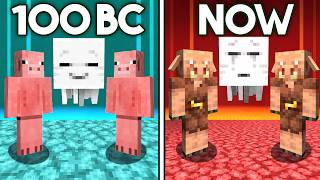
Why is the Minecraft ghast always crying? Since we've been able to wander into the fiery depths of the Nether, so too have the ghasts had tears streaming down their face. But today, we uncover the reason.
Hello, internet. Welcome to Game Theory, the show that reminds you to stay hydrated. Unless you're in the Nether, that is.
But we aren't the only ones suffering down here. In the most recent Minecraft Live event, Mojang revealed to us some upcoming features, namely a new variant of the Nether's iconic ghast. For those of you who are unfamiliar with the ghast or you've just been too afraid to get up close to one, gas are these balloon jellyfishy ghostlike creatures that roam the Nether.
If they catch sight of you, you'd better get ready to run as they'll launch exploding fireballs that could destroy everything around you. These guys are just so strange. And for so long, I have wondered about what their law is.
Sadly, we've just never really had enough to make a theory on it. That is until today, because now we're being given a new kind of gasp. Only this time, it's smiling.
Immediately, my theorist senses began to tingle. Why are the ghasts behaving so differently living in the overworld? Why are ghasts so darn sad in the first place?
Did they watch The Notebook again? Gets me every time. And of course, where do they fit into the everexpanding lore of this game?
Well, fear not theorists, because this new update gives us everything we need to understand their history. So, grab those new fangled harnesses because we're about to discover the origins of the Minecraft Ghast. First, let's take a look at where we're starting from.
What do we already know about the ghast? Or at least, what do we think we know about them? Considering these guys live in Minecraft's version of H double hockey sticks, the most obvious initial idea was that these guys are ghosts haunting the Nether, angry at those who took their lives.
And while that could be an explanation, if this was the overworld, that's not how souls work in the Nether. We've talked about this in a number of past theories, but the reason we have things like soul sand in the Nether is because the souls of those who die end up being absorbed into the ground and work like an energy source for the environment. So that means no souls are flying around to try to haunt you.
Then the Minecraft movie trailer came out and showed us that they don't even look that ghostly in reality. They're more like these fleshy hot air balloons, which is truly cursed, although not that much more cursed than the general art style. Hey, the only other thing we really had to go off of was one of the achievements you can collect in the game.
It's called uneasy alliance, and it requires you to rescue a ghast from the Nether, bring it safely home to the overworld, and then kill it. This is not an easy task, but the key detail is the phrase, "Bring it safely home. " These four words sent the fan base and myself into a theory frenzy for years because it implies that the ghast's real home is the overworld.
It's a really fascinating idea. It's just that outside of this one quote, there wasn't really any evidence to back it up. There have been no signs in the overworld that gas ever existed there, like bone structures or item drops hidden in chests like we've seen with previous mobs.
It also shoots fireballs, which feels much more at home in the fiery hex space of the Nether than in the somewhat peaceful and natural overworld. But the big reason I don't think the ghast can come from the overworld is the main thing we worry about with any franchise, the timeline. Minecraft Legends is the earliest part of the Minecraft timeline as we know it.
At the very start of the game, there are no ancient builders and there are no piglin or nether portals. Those all come about during the events of Legends. But did you catch it right in the background of this shot?
A regular sad ghast floating around in the Nether only just as the ancient builders arrived and just as the piglins were first crossing into the overworld. meaning that the ghasts had to exist in the Nether before any kind of cross-dimensional travel existed and therefore they would have had no way of traveling between the overworld and the Nether prior to this moment. The phrase bring them safely home isn't referring to them being brought safely to their home, but to us, the traveler who has ventured into a dangerous land keeping ourselves safe as we bring the ghasts back to our home.
Although that doesn't mean that the achievement can't be used for our law purposes. I believe we've just been looking at the wrong part of it. What we should have been focusing on is the word rescue.
And the reason why becomes more clear thanks to what we're seeing in the teasers for this new update. There's a new block called a dried ghast. It's small, it's grumpy, and it looks just like the baby ghast that you could have as a companion in Minecraft Dungeons, which were so cute.
Oh, I like adorable little guys. Suit me. Anyway, these guys can be found in the soul sand valleys of the Nether.
If you grab one of them, take them back to the overworld, and then put it in water for 5 days, their frown turns upside down, and they come to life as a new mob, a little ghastling. These ghastlings start roaming around the overworld. And to help them grow into full-size ghasts, you can feed them something I didn't expect, snowballs.
Clearly, water, and especially cold water, is essential to this mob's survival. So much so that the ghastling will imprint on the player who revives them. So, it's going to somewhat imprint over players or mobs and just follow them around a bit.
But surely that contradicts what I've just been saying about the ghast not being from the overworld, but instead being a Nether native. The Nether has no water whatsoever. In fact, it's so hot that the water completely evaporates.
And this typically would be a theory breaking contradiction if it weren't for another theory we made a few years ago about how the Nether wasn't always the fiery landscape we know today. It once had an ice age. Hey you, you're not using a VPN.
And I know you're not because if you were truly protected online by our sponsor, NordVPN, I wouldn't be able to just barge into this video. Thankfully, I'm not a hacker trying to get your data. I'm here with a great deal to help make your online experience so much better.
Don't want to be tracked online? Boom. NordVPN.
Don't want annoying ads while you're just looking up a crafting recipe? Boom. NordVPN.
Don't want to accidentally download a malware ridden Minecraft mod? Boom. Boom.
Boom. NordVPN. That's five big booms thanks to NordVPN's threat protection feature.
And when you're done mining and crafting with boys, NordVPN also allows you to watch content from all over the world. Want to watch Drgon Ball Z but only have Netflix? Just set your location to Japan and bam, there it is.
Want to catch up on the Spider-Verse movies before Beyond the Spider-Verse releases in 2027? Well, set your location to the UK and there they are. Oh, and that great deal I promised you.
Well, if you use the link in the description, nordvpn. com/game theory, you'll get all of these features and more for just a few dollars a month because you'll be getting a massive savings on a 2-year plan, plus four bonus months for free. And if you don't like it, NordVPN has a 30-day money back guarantee.
So, it's completely risk-free. So, protect yourself online and open up your content horizons by going to nordvpn. com/game theory or click the link in the description.
Thanks again to NordVPN for sponsoring this video. Now, I'm just going to let PNG Tom explain this Nether ice age business. This idea stemmed from the presence of basalt in the Nether, a block that can only be created when a lava source meets both soul soil and blue ice.
Therefore, ice must have existed at some point in the Nether in order for the Basalt deltas to form. Not only that, but the streaky texture of salt soil looks remarkably similar to the texture we see on rocks and soil in our world after glaciers have passed over them. Once again, implying that there was an ice and or water source at some point in the Nether's soul sand valleys.
And would you like to take a guess as to where the ghasts spawn in the Nether? Yep, the basalt deltas and the soul sand valleys. The ghasts live in areas where there used to be water, keeping them hydrated.
And thanks to the Nether's previously colder climate, there was plenty of snow and ice to keep them cool and refreshed. But sadly, as we see in Legends, the Piglins industrialized, creating weapons, armor, and bastions in order to conquer more worlds, heating up the atmosphere through greenhouse gases and turning the Nether into the torched, barren land it is now. The ice melted, the water dried up, leaving the ghasts without a water supply and a much hotter environment than they're used to.
The ghast we see in that one shot from legends isn't sad because it's been taken from its home. It's sad because its home has been taken away from it. That's why the achievement calls for us to rescue the ghast.
We may joke about how this place is hell. But for the ghast, it literally is. By bringing it to the overworld, we have rescued it from its suffering and brought it to a more forgiving climate where it can thrive.
Wait, what's the matter, little guy? It's okay. You're in the overworld now.
You're safe. Oh, him. That's just Larry the sniffer.
He's not going to hurt you. At least not anymore. Yeah, sorry friends.
I was really hoping for a happy ending to this Minecraft theory, but as I looked more into the dried gas block, I realized something truly horrifying about where we find them. You see, dried gas blocks can be found in the soul sand valleys, which makes a lot of sense with everything else we've looked at so far. The soul sand valleys are where ghasts spawn, and it's where they used to be a water supply.
But in this teaser, we are being shown that the dried ghasts appear in a far more specific location than just the biome. They are shown to be found inside fossil structures. I actually theorized about these fossils in my very first Minecraft theory as host by combining these fossils from the Nether with the fossils from the overworld.
We discovered that the fossil structures were a perfect match for giant prehistoric sniffers that existed years before the ancient builders came to the Nether and took them back to the overworld. If the dried gas blocks are being found inside the bones of these giant ancient sniffers, that can only really mean one thing. These adorable baby ghasts were inside the sniffers when their bodies decayed because they were food for the ancient sniffer.
In our sniffer video, we actually theorized that the sniffer originally lived in the soul sand valleys where there was plenty of seeds for them to dig up and eat. But as the land dried up, they moved to the warped forest to find another food source. We see this kind of behavior in most herbivores in real life.
If their food source disappears in their natural habitat, they will move to find a new environment that contains the same or a similar food source. However, this isn't the only approach a species can take. There have been some cases in prehistoric times where rather than finding a new habitat with the same food source, herbivores would change their diet in order to survive and begin feeding on other animals instead.
Thyloalio, also known as the marsupial lion, was believed to originally be a herbivore. But as the land of Australia became more deserted, vegetation grew scarce. Additionally, large carnivores were dying out.
This left room for the marsupial lion to become an apex predator and start feeding off of smaller animals in the area. Similarly, while some of our giant ancient herbivore sniffers may have gone on to the greener pastures of the warped forest to give them that teal and red color scheme we know today, others chose to stay in their natural habitat and instead find a new food source, one that was weaker and also struggling with the recent change in its environment. The baby ghasts were constantly in pain, trying desperately to survive the harsh climate, and eventually they would become nothing more than a dehydrated block.
Easy pickings. But while picking off weakened ghastlings may have been an easier food supply, it clearly wasn't enough. Eventually, the carnivorous sniffer would die out.
Their bodies decayed, leaving nothing but bone and whatever remnants they had left inside their digestive tract. A small, very weak, and dehydrated ghast who now wait patiently for someone to come along and save them. That, my friends, is the story of the ghast.
A once docsile creature who lived peacefully in the frozen lands of the nether ice age, now desperately trying to survive in a barren wasteland, where the water is gone, their mere existence is pain, and even the herbivores are trying to eat them. All thanks to the piglin and their selfish ambition to go to war. Now, after all these years of suffering, all the ghasts have to show for it are the remnant tear tracks on their faces because they ran out of tears to cry.
The water is far too valuable to waste. Instead, they attack anyone who they see as a threat to their already challenging survival, only giving up their final tier when we forcibly take it from them and put an end to their existence. Those tiers can then be used to create potions of regeneration.
Because for the ghasts, even that small amount of water is the difference between life and death. But hey, that's just a theory. A game theory.
Thanks for watching. World premiere on Game Theory. I figured out what the ancient mysteries this dump truck of a mob is hiding.