These are the most popular types of mulch for any garden. And today I will tell you which ones will work great [music] and which ones you should avoid. But I can't do it alone.
So I went to my friend Eddie the lazy landscaper to show you around his garden. And at the end I'll reveal the most common mulch [music] mistakes that everyone should avoid. Mulch is one of the easiest ways to level up your garden and improve plant health.
Let's break down exactly what good mulch does and why it matters. So, Ed, you recently updated the mulch in your garden. What do you find are the key benefits to that?
>> Well, I'll tell you what, it it certainly helps with weed suppression. >> It's fantastic with weed suppression, but I think underappreciated for that because a lot of times what happens is people have a weed problem and they put mulch on and the weeds come right through it and they say, "Well, it didn't work. " Well, it's not quite that simple, right?
But you have to keep working with it. Keep applying mulch as some sprout here and there. We get rid of them.
So, it's kind of working with your landscape and training it. I like to say training it to not have weeds. And that mulch can be an important part of the training process.
You want to maintain that layer of mulch, you know, between one and two inches thick all the time. With that method, I think you can create a landscape like you have where you just almost don't get weeds. >> I like to use two to three inches of mulch.
Of course, the real question is how mulch is too mulch? >> That is an important question. >> I can run that by you again if you need me to, Johnny.
I just it was a bad it was a bad pun. It helps during the winter now as we're getting into the colder weather with, you know, just keeping the soil a little warmer and reasonable temperature, especially for tropical and subtropical plants. The other thing about the mulch in the summer gets up in a 100 degree weather.
By having that mulch, it helps to keep the soil a little cooler and it also stops the water from evaporating. So, we don't have to water as much, which in a drought area, that's very beneficial. >> You are absolutely right, Eddie the lazy landscaper.
My [laughter] >> my goodness. I I haven't heard that since well before I was married. [laughter] So, it is great at retaining moisture and making it so you have to water a lot less.
The other thing it does related to moisture that's a little underappreciated is when you have bare soil and you just leave it open to the elements like rain pounding on it and maybe even hail pounding on it. It's not good for the soil. If you protect it with a mulch, when that rain hits it, it's protecting the soil physically.
And uh one of the reasons that most landscape professionals and homeowners use it is because of its appearance. It's it's beautiful and it looks way better than your soil usually. From fine dark mulch to coarse shredded cedar.
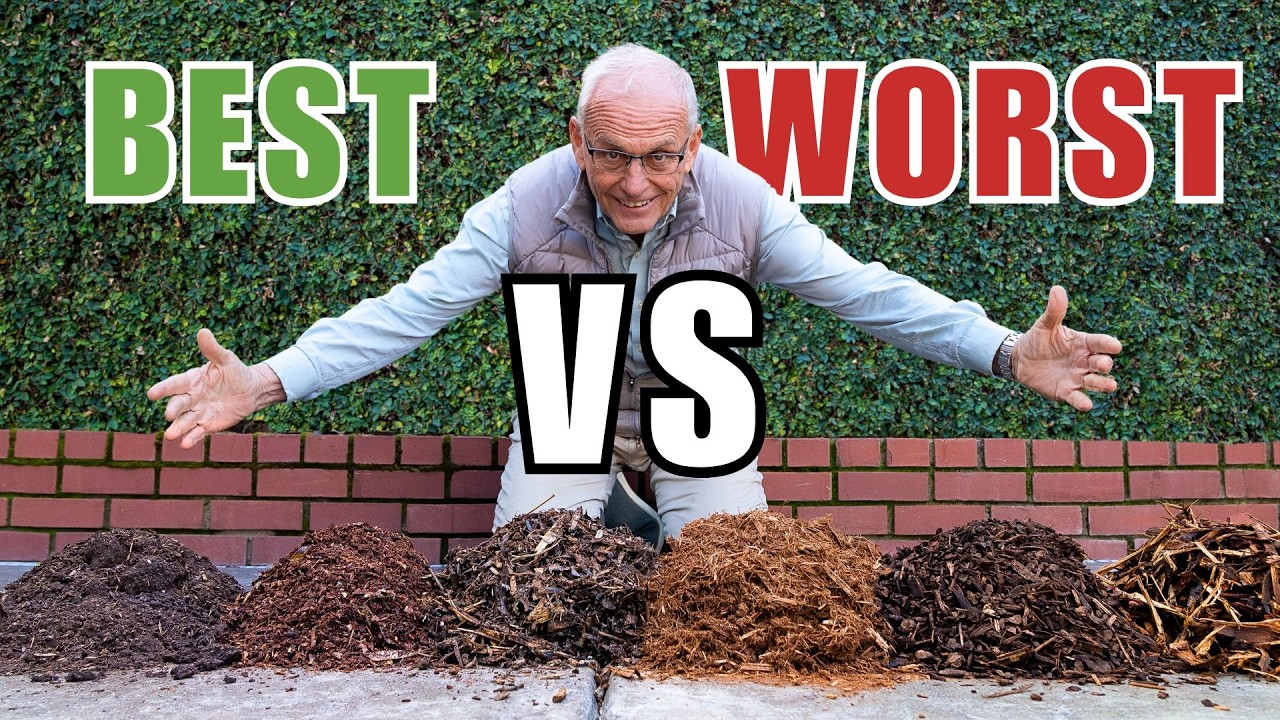
Let's compare [music] how the different mulch options stack up against each other. So on my far right is black forest humus. And this is very popular.
It's what Eddie the lazy landscaper was using before we put coarser mulch on top. It makes a really attractive top dress mulch, but the problem with it is it doesn't stay put and we stopped using it because of that. Essentially the same thing but a dark brownish red humus.
They're both made from similar products. They're the bark of Douglas fur. And this one has the same problems in that some people use it as a top dress mulch, but it just doesn't stay put.
Then next to that is a really good product in terms of cost. It's the least expensive of all six of these. It's called arbor mulch.
We have it in this area because it tends to be agricultural trees that have been removed and cut up. And so it's really inexpensive. Works good as a mulch.
It does stay put pretty well, but it's just not as attractive. So, right next to the arbor mulch is cedar mulch. Now, I order a special cedar mulch that is fine cedar mulch, and they get that by grinding it more than one time.
You can get cedar mulch that's really coarse, even coarser than this one on the end. When you have this cedar mulch that's finely ground, it's really nice looking and it has this kind of fibrous nature to it and it it knits together and stays put really well. After uh this arbor mulch, it's the second least expensive.
And then next to the fine cedar mulch is the one we used in Eddie the lazy landscaper yard, dark walk-on supreme, and it comes out of Long View, Washington. It's the bark of Douglas fur and pine. He wanted something that was coarse but kind of looked like the dark humus which he already had because he likes that color.
This is our best one for that and it's still pretty coarse. Next to the dark walk-on supreme is regular walk-on bark which has kind of been a staple of the landscape industry made from Douglas fur and pine also. And you can see it's pretty coarse.
Obviously, it stays put very well. From that standpoint, it's good. I think the only thing I don't like about it is its appearance.
It's not one of the more attractive ones. So, I use dark walk-on supreme or fine shredded cedar. Those two are my first choices.
And then third, I'll use the arbor mulch. And then fourth, I'd use the Wagon bark. And then fifth and sixth, the very fine forcehumus products which are beautiful to look at but transient in that they move around right off of your yard almost as soon as you put them on.
Maybe you've heard that mulch can steal nutrients from your plants. But is that really true or just another garden myth? Let's dig in to what's really happening in your soil when you use mulch.
There's a lot of garden myths and all you got to do is listen to your neighbors and you'll hear all kinds of garden myths. I I think it's hidden myth. I really do.
I This current garden myth that I'd like to dispel today is that when you use mulch, it takes away from the nutrients for your plants. Although there is a little bit of truth to it, which is why I think it hangs around. This organic matter that we use as top dressing mulch starts to break down, it does need and use some nitrogen and microbes as part of the process.
So, some people say, "Well, it's taking nitrogen from the soil, nitrogen that your plants need. " But the truth is that it's only using nitrogen on the very surface, and your plants have roots that are way deeper than the surface. It doesn't impact the nutrients in the soil where your roots are.
If you're using good gardening techniques, you're probably replenishing nitrogen to some degree. If you're using our products, there is a little bit of organic nitrogen in it. There's not a problem at all when you use it as a top dress mulch, as a surface mulch.
>> And by protecting the living organisms below down where the roots are and the microisa, for instance, is helping absorb nutrients. I mean, it's not like the plant's going to use every bit of nitrogen anyway. >> And so, this idea that we're depleting soil of nitrogen just isn't valid.
Where it could be a concern is if you took say a coarse top dress mulch and you tilled it in. Now you have all of this wood with some bulk to it and some substance to it kind of tilled in and that does need nitrogen to decompose. Then it might take an amount of nitrogen that makes a little bit of a problem.
>> I mean I was in favor of using that dark mulch that just blows away. I don't I don't remember that. >> No.
I've been a believer for a long time and and I like the looks of it even though it can be blown away by the gardeners, but the dark fine dark forest humus. Then again, my memor is failing me. So, it could be >> I really had some problems with the dark fine forest humus I was using for all these years.
It looked great for about the first oh 30 minutes. Still had the weed problems. So, I really wasn't satisfying anything that I wanted to.
Let's go take a look at what John's crew has done. It's really fantastic. So, I had some problems here before John's crew came in.
One of them was I'd already had these rocks put down and they were starting to scatter into the hedge there, the fatini hedge, and I really wanted some separation so that I could put down some quality mulch that John had told me about. Previous to that, I had some dark forest humus in there, but it was scattered and blown away. I was still having weed problems.
I had the scattered rocks. It just didn't look clean. His crew came in and they did a beautiful edging along the way there.
So, while the crew was doing a great job with this straight edge, I didn't realize they could do this. But with this flexible edging, they were able to actually make a perfect circle around here with my tree lights being outside of it and just high enough that it still kept all the rocks out and allowed for this uh mulch to really really do a great job here around the tree and look good. It really has achieved a lot of things that I'm so pleased with.
Instead of the humus blowing away with this mulch, I'm blown away. Now you know why mulch matters and which types are best. But there are still some classic mistakes that can cause all kinds of trouble in your garden.
Here are the mulching mistakes to avoid at all costs. One of the biggest mistakes in my opinion is that ugly, stupid, toxic dyed mulch that you see people use, sometimes reddish, sometimes black, where they take a plain brown wood product that they think doesn't have enough coloring and they dye it. It's not a good idea.
It's not good for your plants. It's not good for your soil. And in my opinion, apparently not everyone agrees, but in my opinion, it looks ugly.
>> Well, yeah. I mean, that's why I don't dye my hair as often anymore. I still a little bit.
Another mistake is to not pile it around the base of the plants. If you you were saying you like to put it thick in your yard, which nothing wrong with that. I I like to just do it one to two inches, but I don't want two inches right up against the trunk of the shrubs and the trees.
We [snorts] want as we get into the area where the actual uh stems and trunks are, then we kind of go down to just a quarter of an inch or something. Another thing that you need to do is you have to reapply every year or two. Depends on the style of your garden, too.
You might have a style of garden with a lot of ground cover and a lot of plants where you you hardly need any mulch over time because it's covered with plants. But if you can see bare soil, then you need to reapply mulch. If you had this terrible soil and you said you had three or four years to improve it, but you could only do one thing, I would say cover it with two to three inches of mulch and do nothing else.
If you could do two things, I'd say put our products under the mulch. But if you could only do one thing, put mulch over the top of lousy soil and that will improve tilt and soil structure in kind of miraculous ways over time. >> Did I tell you how Sandy Lom broke up with me?
>> No. She sent me a John Deere letter. It [laughter] was just it was terrible.
I I just I I Mulch is just one piece of the puzzle. If you want your garden to thrive and not just survive, check out this video where we teach you the importance of healthy soil and how to infuse your soil with life the lazy way.