Making money has nothing to do with being talented or blown up. Everyone thinks they need millions of streams, a label deal, or luck. But that's exactly why most music artists are broke.
So, in this video, I'm going to show you how normal artists are quietly making over 100K a year without anyone knowing their names. See, most artists chase fans, fame, and streams. They drop songs.
They pray for Spotify playlists. They wait for someone to discover them. But this is not a business.
It's a lottery ticket. I've seen artists with over 200k monthly listeners still working a day job. And I've seen talented musicians with over a million followers still struggling to pay rent.
On the other hand, there are producers and artists with less than 5,000 followers, barely any streams on Spotify that are making a full-time income from their music skills and knowledge online from their own bedroom. The difference is not talent. It's this.
Stop trying to be famous. Start trying to be useful. In the next 10 minutes, you are going to build a music business plan with one offer that can realistically take you to over 100 grand next year in 2026.
So, let's get into it with step number one, the music business plan. So, first things first, the math needs the math. So, before we talk about content, offers, platforms, you need to know two numbers.
Your monthly income target, aka how much money do you need to make per month to be able to quit your job. So, usually this is where I recommend you to calculate all your bills, you know, rent, mortgage, bills, food, transportation, car, insuranceances, and then on top of that add 25% for security and taxes. That final number is your monthly income target.
Second number is the units sold per month, aka how many units of the thing you sell do you need to sell per [music] month to make that monthly target income. So, for example, if you sell a $500 ghost production service and your goal is to make $3,000 per month, then you need six clients. If you sell a $50 sample pack, then you need 60 clients.
And if you sell $1,000 services, then you only need three clients. Now, don't worry if you don't know exactly what you want to sell yet or how much you're going to price it. We'll talk about this in a later on step.
For now, just put whatever comes to your mind first. Once you know your monthly income targets and your required sales, [music] then everything becomes more clearer and we can move on to step number two. Pick your dream client.
One of the most basic rules in business is that if you are trying to help everyone, you will end up helping no one and you will stay broke. The fastest way to make money with your music is to solve one painful problem for a specific person. Not music fans, not every artist, not producers, not sound engineers, a specific kind of client.
Think of the last time you posted DM me for collabs and nothing ever happened, right? This is because you're being too vague and people do not buy vague. So, I need you to pick one client that is ultra specific.
Emotional female singer songwriters who write sad piano songs but hate producing and struggle to finish them. Producers who make great beats but cannot turn them into paid collaborations. YouTubers who need custom background music to avoid copyright strikes and sound more professional.
small brands running ads who needs short catchy music without agency prices. Indie filmmakers who need original music for short films but cannot afford a composer or licensing fees or indie game developers who needs immersive background music but do not have an audio team or budget for a studio. At this point, the list goes on and on and on.
Now, to help you find your dream client, I'm going to give you one of my tools for free, a custom GPT tool called the Dram Client Finder. This is something that is normally reserved for my music creator students, but today I felt generous and I'm giving it to you. After using it, it will tell you who you should target based on your skills, expertise, and market demand.
If you want access to it, just click the link below in the description or scan the cure code right here. Now, the important thing to remember is that your dream perfect client is not who you like. It's who already spends money on a problem they need fixed.
Which brings us to step number three, your perfect offer. Your offer is not a sample pack, a ghost production course, a mixing and mastering service, a vocal pack. Your offer is the [music] transformation your customer or clients will experience and the problem you are solving for them.
Most of your music offers right now are weak because they sound like chores. I do mixing. I do beats.
Who cares? That is not a transformation. And they also blend in a sea of thousand other offers and producers and artists saying the same thing on social media.
So there is only one sentence that you need to stand out. Okay? So copy this formula.
I help insert your dream client achieve insert your dream outcome without insert your biggest obstacle that they go through even if insert their biggest objection and then optional in insert a certain amount of time. If we take the example of me and my own coaching mentorship program, Music Creator, here's the formula. I help aspiring music creators make a full-time income from their music online without relying on labels, paid ads, or going viral, even if they are still working a 9 to-ive job, in less than 12 months.
Let me give you more example. I help independent rappers release a pro sounding song without spending months stuck in revisions, even if they hate their own voice, in just 7 days. Or I help YouTubers get custom background music without copyright stress even if they do not know any music terms in just 72 hours.
Or I help singers turn rough iPhone demos into finished records without a label budget even if they have never recorded properly in 14 days. If you cannot say your whole sentence in one breath, it's too complicated. Make it easier.
So again, your offer is not what you do or how you do it. It's what they get like the transformation they experience, [music] the results they get. Now, another thing that you can add to lower the risk on their end is to add a guarantee.
For example, I will mix your song to a clean, loud, streaming ready level in 5 days or I keep working until you love it. People do not pay for your talent. In fact, that's probably the least thing they care about.
They pay for a transformation and results. So, now that you have your offer, let's move on to step number four. Validate your offer with the market.
Do not build in silence. I repeat, do not build in silence. The fastest way to waste money and [music] time is to spend months creating something that no one will want to buy once it's ready for them to buy.
If you don't check with the audience and the market what they want, you're doomed. And validation does not mean building a website or a portfolio or perfecting your branding. No, validation means answering one question.
Will someone buy this? You do not need a huge audience for this step, but you do need the courage to have real conversations [music] with people. So, here are two ways that you can do so.
Option number one, ask your network. Reach out to past clients, artists you already worked with or collaborated with, music creators that you interact with online, and send this message. Hey, quick question.
If I offered insert dream outcome in your time frame, [music] is that something you would pay for? If people say yes or ask follow-up questions, then it's validated. If not, go back to the drawing board.
Option number two, offer it for free. Post content on social media to offer your product or service for free for the first five people. So, for example, you could say something like, "I'm opening five free spots to help singers turn rough iPhone demos into finished records in 7 days in exchange for a testimonial.
[music] Just DM me or send me an email at your email to book it. " Then, watch what happens. If you get DMs, emails, comments, likes, questions, all of that is great signs.
If you get no answer, no bookings whatsoever, then it's a bad sign. Go back to the drawing board. But if you get booked, great.
The idea here is that if you can't even sell something for free, you'll never be able to sell something for a paid amount of money. So, make sure to validate before jumping in. One of the best things as well here with this technique is that while you validate, you will gather social proof, you will gather feedback from your first clients, you will get the courage as well to ask for money later on.
It's a win-win for everyone. So test one offer for at least two weeks. Have at least 10 conversations and then you can make a decision.
And with that done, it's time to move on to step number five. Market on two platforms maximum. Once you have your offer validated and ready to go, it is time to put it in front of your dream client's eyes [music] by doing some sales and marketing.
For this, my favorite way is to use social media and post free content there because it is free advertisement. Now, you have two choices. You can go for depth, aka you maximize one platform before you move on to all the other ones.
Or you can go for width, when you first go onto all of the platforms for exposure, and then you maximize them, aka you make more quality content with time. From what I've seen with my own experience and my students, option number one, depth is the best. It's already so freaking hard to maximize one platform.
Believe me, make your life easier and just focus on one two maximum as we're going to talk about, but don't go on like five. It's useless. So, as I was saying, the max you need is two platforms for two different jobs.
You need one platform for discovery, aka where new people find you, like YouTube, Instagram, Tik Tok, [music] threads, Twitter, LinkedIn, whatever it is you want, and one for nurturing, aka where you're going to build trust with your audience and buyers are going to come back. Here you can have email list, Discord, SMS, Telegram, WhatsApp. But once you pick your platforms, just stick to them for a minimum of 90 days before deciding it's not working.
Again, if you cannot be consistent for 90 days on two platforms, you're not ready for more than that. So, now that you have your offer and we're bringing traffic to it, let's move to step number six. Ask for the sale.
This might sound dumb, but it's true. If you want to make money, you have to ask for money. And this is where most of you, most creatives fall short.
I [music] get it. It feels awkward at the beginning. I get it.
Believe me. You post, you teach, you help, you show results, then you stop. No offer, no price, no next step.
Hope that people buy from you or just ask and come to you and find your services on their own. It's just hope. It's not a strategy.
Most artists are scared of being salesy or annoying, so they don't sell. But here's the best piece of advice I've ever received about selling. If you can help someone, you are doing them a disservice by not telling them how you can help them.
Selling is just helping. But in exchange of money, that's what selling is anything in life. It's an it's just an exchange of value.
Now, how you do this? By doing CTAs, aka call to actions. And I mean it in every single piece of content.
So, here's the rule. Every piece of content needs a clear action step. It needs to answer, "What do you want them to do once they're done consuming your content?
" If a client has to [music] ask, "How do I pay you? " Dude, you already lost. Instead, say something like, "DM me this word.
Comment this word. Link in the description, link in bio. " Even if it's not the best, at least it's one.
Even follow or like or comment would be a call to actions here. Preferably, it's to your offer. But whatever it is, tell them.
You can say it's on the video. You can write it as a text. You can put it at the end of the caption.
There are lots of ways to include your CTAs in your content. But whatever you do, only have one CTA per piece of content, not more than that. The error of like like, subscribe, and comment.
Done. No one does this. A confused mind is a confused buyer, and so they will never buy.
So, all this to say that if you're serious about monetizing and going full-time with your music, you need to be comfortable. You need to get comfortable with the selling [music] and marketing and promoting yourself and your services and your product. And the only way that you do this is by practicing.
I [music] swear at some point you just don't care anymore. You just need to put in the reps. Look at me for example.
Right now I'm about to tell you that if you got some value in this video and that you would like more personal support and personal guidance and working [music] with me to help you monetize your skills, your music skills online, then you should check out the link in the description to check out my mentorship program, Music Creator. And if you've been eyeing that program, I would highly recommend that you jump in before January 1st because the price is going to triple. See a simple call to action.
Click the link in the description. And I'm also telling the viewer, you why you should [music] do it. What is the outcome?
Aka monetizing and going full-time with your music online. Anyway, back to the video with step number seven. Client acquisition flywheel.
Most artists think that the job is over once the song, the service, the product is delivered. This is why they always start again from zero. If you want this plan to get easier over time, you need a flywheel.
A flywheel that keeps getting customers in over and over and over again. The flywheel that I recommend is social proof and referrals. Every time you deliver a result, capture proof, not later, right after the delivery.
Proof can be a before and after audio clip, a short text message from the client, a quick screen recording reaction, a DM screenshot. You do not need perfect testimonials. You just need raw, honest reactions.
So, right after delivery, send this message. Hey, if you liked product service, can you send me one sentence on how this helped you? How do you feel afterwards?
That's it. This is going to give you content to post, trust referred to your clients, and faster [music] yeses. Now, for referrals, after you ask for testimonials, a couple days later or a couple weeks later, you could ask something like this.
Hey, I loved working with you and would love working with more people like you. Do you know any other artist or creator who needs insert whatever [music] you sell? Referrals work heavily, but most people are too shy to ask for it.
Don't be that person. And referral clients are the best because they close faster. They respect your price and they require less convincing.
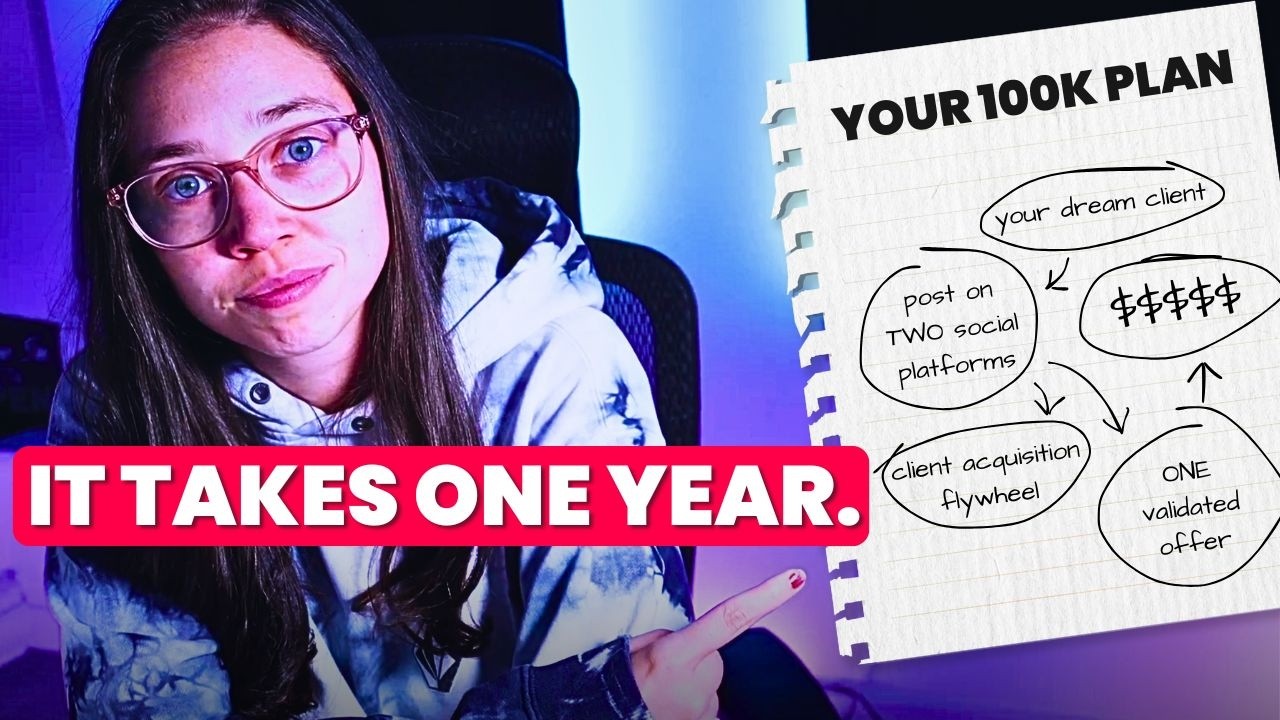
So the idea of the client wheel acquisition is this. Deliver, capture proof, ask for a referral, where more leads are coming in, you close those leads and then you repeat. That is the client acquisition flywheel, which then moves us to step number eight, productize.
At some point, if selling your services takes off, you are going to get in a time bottleneck. [music] Selling services is the best way to get started in my opinion. But if you only sell your services, at some point it is going to get you stuck because at some point your calendar fills up and you hit a ceiling because there are only so many hours you can work.
[music] If every dollar requires your direct time, your income stops growing. This is where productizing come in. Productizing isn't about passive income.
There's no such thing. It's about leverage. The idea is that [music] you help more people without putting in more hours.
Now, that being said, do not build products too early. First, get booked with your services. prove that people will pay for your service.
But once clients come in with the same question over and over again, then build a product. That's how I came up with the music creator program. In my one-1 coaching sessions, 80% of the students were coming in asking me the exact same questions.
And I had to repeat myself over and over and over and over until I got tired of it. So I built the program and a course for it. So for example, if 10 clients ask you about your vocal chain, this is a product.
Or if you are booked out on ghost production services and you can't take anymore, then this is your sign to create some pre-made beats or instrumentals. And this is how you stack income without working any more hours. Now, before we wrap up, here's the math that makes hitting 100K feel more real and sustainable and realistic.
Option A, you have a $500 offer. 17 clients per month for 12 months equals 204 clients. 204 * 500 equals just over 100 grand.
Option B, $1,000 offer. If you have nine clients per month for 12 months, that's 108 clients over the year equal 108 grand. And option C, $2,000 offer.
At five clients, now you can only have five clients per month for 12 months equals 60 clients * 2, 120K. So with this, pick the offer price that matches your skill and expertise. Set your monthly client income target and track it.
100K is not a mystery. It is just a combination of systems that leads to consistent sales. Every artist I know who quit music quit too early.
They thought success had only one path like streams, labels. It doesn't. The music industry may be broken for stars, but it is wide open for creators and music entrepreneurs.
If you want to succeed in 2026, take this plan, [music] implement it, adapt it, go with it. Just don't ignore it. Again, if you want my dream client finder tool, it's linked below in the description or on this QR code.
But in the meantime, keep learning and I'll see you in the next one.