Welcome to the Bible quiz. It is a special month. Christmas is here.
As we celebrate the birth of the Savior in the manger, we invite you to go deeper. How well do you really know the man he became? Today, we are exploring the unknown Jesus.
We are looking at his raw human emotions, the specific Aramaic words he spoke, and the surprising ways he interacted with people. These 25 questions will reveal details that many Christians often miss. A special holiday shout out to our faithful community members: Esmerald Denell, Wilson Santos, Kevin Paul, Anna Ao, Loretta Peron, Amond Deep, Roberts, Carol T.
Hunter. Are you ready to meet the Messiah in a whole new way? Hit that subscribe button, get comfortable, and let's get started.
Question one: Besides the tomb of Lazarus, when else is Jesus recorded as weeping? A: on the cross. B: in the garden.
C: at his baptism. D: over Jerusalem. You get 10 seconds.
That's D: over Jerusalem. While many know Jesus wept for his friend, Luke 19:41 captures a different kind of grief. As Jesus approached Jerusalem during the triumphal entry, he saw the city and wept over it.
He wasn't crying for himself, but for the coming destruction of the city because they did not recognize the time of God's coming to them. Question two: In which miracle did Jesus heal a man in two specific stages? A: The 10 lepers, B: The blind man at Bethida, C: the paralytic, D: The woman with bleeding.
You get 10 seconds. That's B, the blind man at Bethsida. Uniquely, this healing wasn't instant.
In Mark 8:23-2, Jesus touched the man's eyes and the man saw people looking like trees walking around. Jesus touched him again and his sight was fully restored. This miracle serves as a powerful metaphor for spiritual understanding which often comes gradually rather than all at once.
Question three: During the great storm on the lake, where exactly was Jesus sleeping? A: on the deck, B: in the bow, C: on a cushion in the stern, D: under a bench. You get 10 seconds.
That's C: on a cushion in the stern. The disciples were terrified, but Jesus was at total peace. Mark 4:38 provides the specific detail that he was in the stern, the back of the boat, sleeping on a cushion.
This image contrasts the chaotic fear of humanity with the sovereign rest of God, showing that peace is possible even when the waves are breaking over the boat. Question four: What is the only recorded instance of Jesus writing something? A: On the ground.
B: A letter to Peter. C: On a scroll in the temple. D: the Ten Commandments.
You get 10 seconds. That's a: on the ground. When the Pharisees brought a woman caught in adultery to trap him, Jesus bent down.
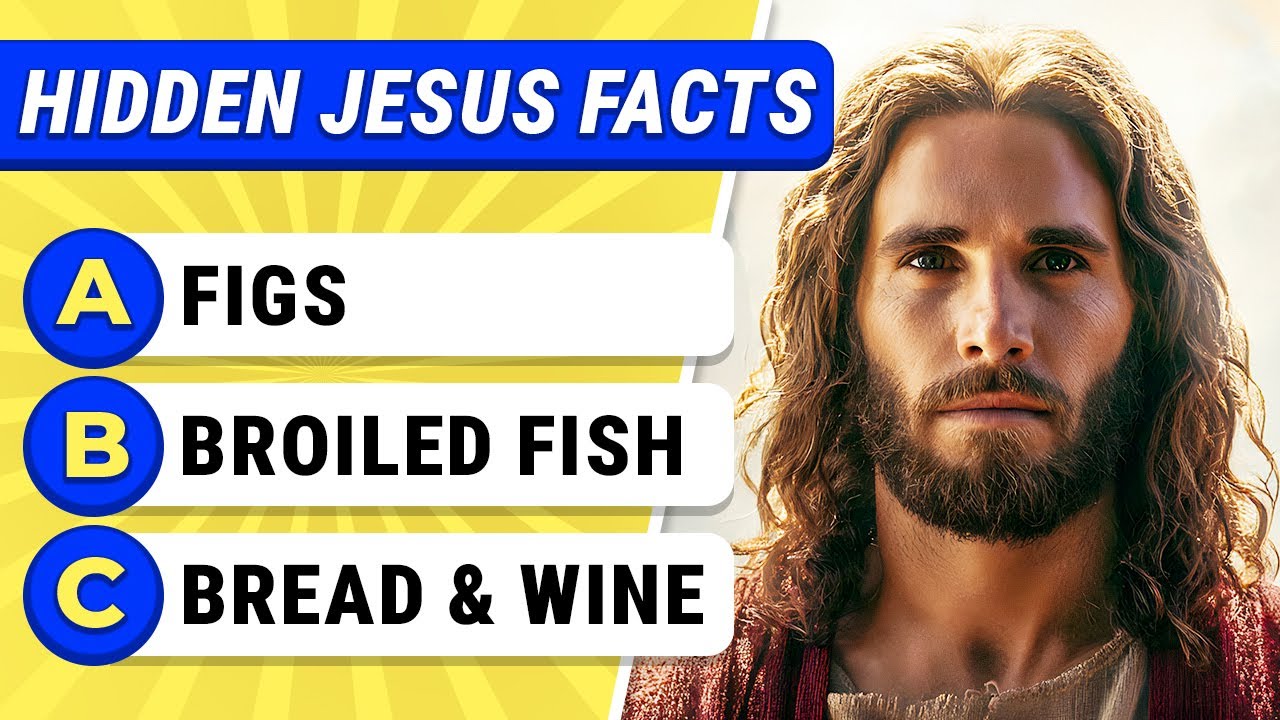
John 8:6 states he started writing on the ground with his finger. The Bible never reveals what he wrote, but his action diffused the mob's anger, leading to his famous challenge, "Let any one of you who is without sin be the first to throw a stone? " Question five: What did the resurrected Jesus eat to prove he had a physical body?
A: Figs. B: Broiled fish. C: Bread and wine.
D: A honeycomb. You get 10 seconds. That's B: Broiled fish.
To dispel the disciples' fear that they were seeing a ghost, Jesus asked for food. Luke 24:41-43 records that they gave him a piece of broiled fish and he took it and ate it in their presence. This act was crucial theology.
The resurrection wasn't just spiritual. It was a physical victory over death, reclaiming the physical body. We'd love to see you again.
Hit subscribe and stay close through more Bible quizzes. Question six: To whom did Jesus say the Aramaic phrase "talakum? " A: Gyrus's daughter.
B: The widow's son. C: Mary Magdalene. D: Peter's mother-in-law.
You get 10 seconds. That's a: Gyrus's daughter. Jesus entered the room where the 12-year-old girl lay dead.
Mark 5:41 preserves the original Aramaic words. He spoke "talithakum," which translates to, "little girl, I say to you, get up. " By using her native tongue, Jesus showed deep personal tenderness even as he displayed the divine power to reverse death itself.
Question seven: Which intimate Aramaic word did Jesus use for God in Gethsemane? A: Abba. B: Elohim C: Adoni D: Yahweh.
You get 10 seconds. That's a: abba. In his moment of greatest agony, Jesus did not use a formal title.
Mark 14:36 records him praying, "Aba, father, everything is possible for you. " Aba represents the close, affectionate relationship of a child to a father, similar to daddy or papa. It invites believers into this same intimate relationship with the creator.
Question eight: Jesus said "fatha" to a man suffering from what? A: Leprosy. B: Paralysis.
C: Blindness. D: Deafness and speech impediment. You get 10 seconds.
That's D: Deafness and speech impediment. Jesus took the man aside, put his fingers into the man's ears, spat, and touched the man's tongue. Looking to heaven, he said, "Ephatha.
" Mark 7:34 explains this means "be opened. " Immediately the man's ears were opened and his tongue was loosened, showing Jesus as the Messiah who fulfills the prophecy of making the deaf hear. Question nine: What nickname did Jesus give to the brothers James and John?
A: The Rock. B: The Zealots. C: Sons of thunder.
D: Sons of encouragement. You get 10 seconds. That's C, sons of thunder.
Jesus saw the fiery, intense personalities of these two fishermen. Mark 3:17 lists their new name as Boneres, which means "sons of thunder. " This nickname fits their later request to call down fire from heaven on a Samaritan village, reflecting the raw zeal that Jesus would eventually channel into bold love for the gospel.
Question 10: In the sermon on the mount, Jesus warned against using which insult? A liar. B: Raka, c: fool, d: traitor.
You get 10 seconds. That's B. Raqqa.
Jesus taught that anger is the root of murder. Matthew 5 verse 22 warns that anyone who says to a brother or sister, Raqqa, is answerable to the court. This Aramaic term roughly means empty-headed or worthless.
Jesus emphasizes that contemptuous words that dehumanize others are a serious spiritual offense in the eyes of God. Question 11: Who is the only person Jesus refused to answer during his trial? A: Annis.
B: Pontius Pilate. C: Caiaphas. D: Herod Antipas.
You get 10 seconds. That's D. Herod Antipas.
When Pilate sent Jesus to Herod, Herod was excited, hoping to see a magic trick. He pied Jesus with many questions, but Luke 23:9 states Jesus gave him no answer. Herod had silenced the voice of God by beheading John the Baptist.
Now the word of God had nothing left to say to him. Question 12: Who did Mary Magdalene initially mistake the risen Jesus for? A: A gardener.
B: An angel. C: A soldier. D: Peter's mother-in-law.
You get 10 seconds. That's a: a gardener. Blinded by tears and not expecting a resurrection, Mary saw Jesus standing there but didn't recognize him.
John 20:15 says she thought he was the gardener and asked where the body had been moved. It wasn't until he spoke her name, Mary, that her eyes were open to see the risen Lord. Question 13: At what specific moment did the disciples at Emmas recognize Jesus?
A: He prayed. B: He vanished. C: He broke bread.
D: He explained scripture. You get 10 seconds. That sea he broke bread.
They had walked seven miles with him without knowing who he was. Luke 24:30-31 describes the moment as he took bread, gave thanks, broke it, and began to give it to them. Their eyes were opened.
The familiar action of the last supper revealed his identity, showing he is known in communion with his people. Question 14: To whom did Jesus say, "Get behind me, Satan? " A: The Pharisees B: Legion C: Judas's Scariot.
D: Peter. You get 10 seconds. That's D.
Peter. When Peter tried to rebuke Jesus for talking about his coming death, Jesus responded sharply. Matthew 16:23 records this rebuke.
Jesus wasn't calling Peter a demon, but pointing out that Peter's mindset, seeking to avoid the cross, aligned with Satan's will, not God's. It was a stark reminder that the mission was suffering, not earthly glory. Question 15: What specific emotion did Jesus feel when looking at the rich young ruler?
A pity, B: Loved him. C anger, D: Disappointment. You get 10 seconds.
That's B: Loved him. Before delivering the hard truth that the man needed to sell everything, Mark 10:21 notes a beautiful detail. Jesus looked at him and loved him.
The command to sell his possessions wasn't a punishment, but an act of love to free the man from the idol of wealth that was keeping him from the kingdom. Question 16: What was the very last miracle Jesus performed before his death? A: Raising Lazarus.
B: Withered fig tree. C: Healing Malcus' ear. D: Turning water to wine.
You get 10 seconds. That's C healing Malchus' ear. In the chaos of the arrest, Peter struck the high priest's servant.
Luke 22:51 records that Jesus said, "No more of this," and touched the man's ear and healed him. Even as his enemies were dragging him to execution, Jesus's final free act was one of compassion and restoration for someone who came to harm him. Question 17: What is the only thing Jesus is recorded as cursing?
A: A sword. B: A fig tree. C: A city gate.
D: the Roman Empire. You get 10 seconds that be a fig tree hungry and finding leaves but no fruit. Jesus cursed the tree and it withered.
Mark 11:13-14 describes this act. It was a prophetic object lesson against the temple religious system of the day. It had the leaves of religious appearance but lacked the fruit of genuine righteousness and faith.
Question 18: Which gentile servant did Jesus heal without entering the house? A: Pilate. B: Cornelius.
C: The Centurion. D: The Syrah Phoenician woman. You get 10 seconds.
That's C. The centurion. The Roman centurion sent word that he was not worthy to have Jesus under his roof, believing Jesus could just say the word.
Luke 7:es 9 to10 shows Jesus marveling at this faith greater than any he found in Israel. The servant was healed that very hour, proving Jesus's authority transcends distance and ethnicity. Question 19: Jesus healed a blind man by making mud with what?
A spittle saliva? B wine. C water from salom.
D olive oil. You get 10 seconds. That's a spittle saliva.
In John 9:6, Jesus spit on the ground, made some mud with the saliva, and put it on the man's eyes. He then told him to wash in the pool of Saleom. This earthy tactile method challenged the man's faith to obey a strange command, resulting in the man who was blind from birth receiving his sight.
Question 20: In the miraculous catch after the resurrection, how many fish were caught? A 120, B 140, C 144, D 153. You get 10 seconds.
That D 153. John 21:1 is incredibly specific. It states Simon Peter dragged the net ashore full of large fish, 153 of them.
This eyewitness detail underscores the reality of the event. It wasn't a vague lots of fish. It was a specific catch that the fisherman counted, remembered, and recorded as a sign of God's abundance.
Finish the quiz, total your points, and share your result in the comments. We'll feature standout scores in the next video. Question 21: Which political leader did Jesus refer to as that fox?
A: Caiaphas, B: Herod Antipus, C: Pontius Pilate, D: Caesar Augustus. You get 10 seconds. That's B.
Herod Antipus. When Pharisees warned Jesus that Herod wanted to kill him, Jesus didn't panic. In Luke 13:32, he replied, "Go tell that fox, I will keep on driving out demons.
" Calling Herod a fox, a sly, destructive pest, showed Jesus's fearlessness. He knew his destiny was determined by God in Jerusalem, not by a petty ruler in Galilee. Question 22: What was unique about the tunic Jesus wore to the cross?
A: It was torn. B: It was purple. C: It was seamless.
D: It was made of camel hair. You get 10 seconds. that C it was seamless.
John chapter 19 verse 23 notes that the undergarment was seamless woven in one piece from top to bottom. This made it valuable, leading the soldiers to cast lots for it rather than tearing it. Some scholars see this as a symbol of a high priest's garment, signifying Jesus as the mediator offering the final sacrifice.
Question 23: When the soldier pierced Jesus's side, what flowed out with the blood? A: Spirit. B: Oil.
C: Nothing. D: water. You get 10 seconds.
That's D. Water. To ensure Jesus was dead, a soldier pierced his side with a spear.
John 19:34 testifies that sudden flow of blood and water came out. Medically, this indicates heart failure or fluid accumulation. Theologically, it signifies the cleansing flow of salvation, fulfilling the prophecy that they would look on the one they have pierced.
Question 24: From which mountain did Jesus ascend into heaven? A: Mount of Olives. B: Mount Herman.
C: Mount Taber. D: Mount Si. You get 10 seconds.
That's a Mount of Olives. Acts 1:12 identifies the location of the ascension as the hill called the Mount of Olives, a Sabbath day's walk from Jerusalem. This is significant because Zechariah prophesied that the Lord's feet would stand on this very mountain at the end of the age, linking Jesus's departure with the promise of his eventual return.
Question 25: What did the Roman centurion declare immediately after Jesus died? A: He is Elijah. B: What have we done?
C: This man was innocent. D: Surely this was the son of God. You get 10 seconds.
That's D. Surely this was the son of God. Seeing the way Jesus died and the earthquake that followed, the experienced executioner was shaken.
Matthew 27:54 records his confession. It is a profound irony that while the religious leaders mocked Jesus, a pagan Roman soldier became one of the first people at the foot of the cross to recognize his true identity. Fantastic challenge complete.
You have looked beyond the manger and the miracles to see the heart of the savior. We hope this quiz brought you closer to the real Jesus. As the apostle John wrote in John 21:25, "Jesus did many other things as well.
If every one of them were written down, I suppose that even the whole world would not have room for the books that would be written. " Drp your score below. If this blessed you, please like, share, and subscribe to support our channel.
May you have a profound and meaningful Christmas season walking with the Lord. God bless you.