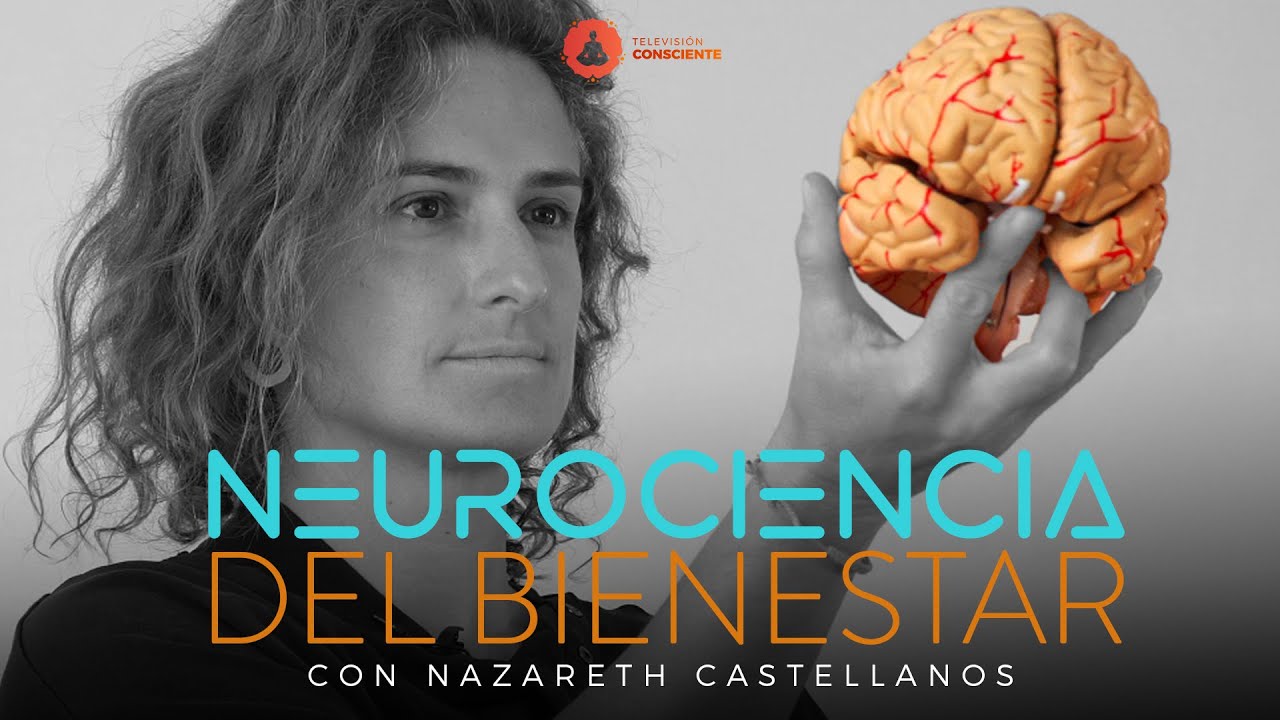
The documentary you are about to watch is part of a comprehensive course on the neuroscience of well-being. can be found at conscious-tv. com The course consists of 14 chapters.
Where Dr Nazareth Castellano She will make scientific proposals to achieve lasting and solid well-being. Improve your well-being through neuroscience by visiting conscious-tv. com It is possible that our body is able to know long before our brain does.
What we eat can affect our emotions Can body posture affect memory or our decision making process It's true that at the neurological level we have at least 7 senses To what extent does our heart or our blinking affect our perceptions? We can know where consciousness resides Because we are unhappy when we feel lonely The progress of neuroscience in the last few years is such that In some cases it touches on concepts belonging to fields such as theoretical physics or philosophy. Curiously, many of the new discoveries corroborate the ancestral approaches of spiritual philosophical currents Or medical disciplines like yoga or Ayurveda.
Sufi medicine or traditional Chinese medicine Let's get closer to the world of neuroscience by the hand of Nazareth Castellanos Graduate in theoretical physics and doctor in neurosciences from the Faculty of Medicine of the Autonomous University Of Madrid Who has guided much of his professional life To understand the brain And their interrelationships The dream of perception Each one of us Lives in a dream The dream of our own perception This perception It was believed to be very conditioned by a supposedly static memory. By feelings that we believed to be objective And above all Because we thought it only depended on our brains. But things are much more complex than they appear to be and as science is advancing Our fiction of knowing is fading away.
Every act of our life such as eating, thinking, or sleeping is a consequence of thousands of interactions of the whole body. Both inside and outside We don't know how all these interactions take place But we do know that there are profound relationships between the brain, the gut, the heart. Breathing Bacteria the muscles And even the body position A different perception When we think about the information processed by the brain, we usually think that we only have five senses.
What, then, are exteroceptive senses, that is, those that come from sight and smell? It is said that we actually have seven senses: touch, hearing, sight, taste, smell, and touch. And in exteroceptives, that is, those that come from the senses, the receptors are not the priority.
The primary sense of our brain is interoception, that is, the information that the brain receives signals from the intestine inside the body The stomach, the heart, breathing—all of that is information. What our brain constantly processes, and that is the primary meaning. The second sense our brain has is proprioception.
Some people consider it part of interoception, but there are researchers who think that proprioception It is a separate sense, and proprioception is the sense that accounts for how this Our body That is, if I am crouching, if I am standing straight, how are my shoulders, how are my arms? How is my structure, my skeleton, how is our body architecture? And that information that has often been thought to be the brain knows How our body is doing, but that's it, it's passive information; the brain needs to know what posture we are in.
But today, what we are seeing is that information about posture It is key for our brain to say That our brain interprets How it is in our body and the information it carries The interpreter uses it to make different decisions, meaning that it is binding information. For example, proprioception is so important. What is said has recently been discovered to be one of the senses that people with the disease never lose.
Alzheimer's In other words, your brain still knows. How is your body doing? This has led to the consideration of many techniques based on In physical movement to try to reduce the associated cognitive deficits to neurodegenerative diseases When we go a little deeper We soon realise that the reality has not much to do with what we think it is.
What is The Jewish mystic said That we see things not as they are but as we are. What happens is that the brain generates an internal representation of the external world To adjust it to our needs And above all to adjust it to our idea of the world The brain always compares our model Our hypothesis with what it perceives And he's afraid that they don't match In simpler words The physical world as we know it is a vast phantom whole Collected and organised by the senses The sense of sight gives us the dimensions Shapes, colours, the sense of hearing gives us the ability to communicate and interact. With the world, but if instead of these senses we had other senses that allow us to perceive Other qualities of matter such as electromagnetic waves or temperature.
Our brain would give us a fiction of a totally different reality. than the one we currently believe exists In short What we perceive It speaks above all about ourselves For a clearer understanding of this phenomenon We must understand the effect of change blindness A concept used by magicians and illusionists. Why the brain doesn't notice certain changes When there are other sensory stimuli that predominate The brain Only professes to where the attention is placed Let's pay attention to counting the number of passes that are made with the basketball in the following scene How many countries have you counted Most of the people Do not visualise the gorilla entering the scene.
There is in the cognitive process what is called a fraud of perception. On the one hand there is the reality On the other side is the processed reality Or what reality appears to be The knowledge of the brain Neuroimaging techniques have advanced to such an extent that it has been possible to decipher a large part of the brain's brain language We know that neurons have their own language In fact they communicate in up to 5 languages We also know Much of the content that drives our brains is unconscious. That is to say Most of the brain deals with non-conscious information.
And conscious information is processed by a very thin neural layer. Called cerebral cortex Let's imagine we are paying attention to the We are not paying attention to what we are doing. Listening, for example, to sensations of our breathing We will have a lot of activity in this part here, which is the prefrontal cortex.
It is one of the most important parts of our Brain We are going to talk a lot about it in the neuroscience of well-being. The prefrontal cortex Almost the crown jewel So when we are paying attention to something, all these neurons here They're Boom, Boom Boom Boom emitting electric shocks at the same time They are singing in a choir. But it's a choir that's very peculiar.
Because there is a part of the choir that is speaking in a different language. Another party who is speaking in another another party who is speaking not Our brain speaks up to 5 languages It is said These five languages allow the brain to communicate with each other. Then When we perform any task Producing all these electrical discharges for the brain involves an enormous amount of hemodynamic resources.
The brain produces very little energy But it consumes up to 20% of the energy produced by our body, which compared to its small volume is the organ that consumes the most energy To do any task, no matter how simple, is a huge hemodynamic effort for our body. That we have the frontal cortex What as I say it is very Involved in processes with the maintenance of attention the regulation of our behavior Inhibition of our behavior Designing a strategy this is tremendously important frontal cortex. Silence of the mind and stress We are also When we are not aware When we think we're doing nothing our brain is doing lots and lots of things The state of letting the mind drift is a very energy consuming state for our brain.
The more time we spend in this wandering, the worse our sense of life satisfaction becomes. We spend half the day in a state of mind of daydreaming or autopilot. Half the day we are not where we are we flee from the present moment And that makes us suffer, as neuroscience corroborates And The greater the spontaneous activity of the brain Also known as default network The more likely we are to develop Alzheimer's disease That's why it's critical to look for neuronal silence Mental calm Various techniques such as yoga of the four elements or yoga nidra They try to bring sustained attention to those stages as well.
To which we normally tend to give very little importance. In such a way as to bring about a greater consciousness And a more rapid personal transformation scientifically it has been shown that people who practice meditation on a regular basis have a better quality of life than those who do not practice meditation. Brains have what we know as that neuronal calm.
What this means is that when we are not involved in, for example, reading in which Making our daily life our neurons are More or less silent We do not say that zero exists, but that it has some activity, but that activity is How could it be A calm sea This is how he expects us to have A brain of a person who is calm and therefore has an adequate level of well-being. But what would the brain of a person who has a high dose of mental wandering look like? what is also called vagrancy Mental, because it means that the activity Of the neurons would be a very rough sea with a lot of swell this swell is amount of Biochemical and biophysical activity of our brain is related to a feeling of dissatisfaction.
With a feeling of unhappiness There is a great deal of scientific literature and many, many articles that have demonstrated that What is the practice of meditation strengthens the prefrontal cortex But what is interesting here, or the studies that have always seemed most interesting to me, are the ones that that it is not necessary to be a great meditator or to live in a monastery and dedicate oneself to Dedicate your life to meditation spending 5 hours a day sitting down Meditating Studies show that as early as 8 weeks From the moment we start practicing there are already changes in our brain. Specifically in the prefrontal cortex At 8 weeks of age, our prefrontal cortex is already Start to be trained to maintain Attention to this Obviously, if we do not continue to practice this reorganization, then this reorganization Anatomically and functionally we have made of the prefrontal cortex as it becomes diluted. Because our brain has a great capacity for learning, it learns from everything.
What is happening learn with habit More than discipline and I like this approach that says that more than discipline, it is the habit. Habituation makes neuroplasticity Procure a reorganization in the brain that makes it possible for me to maintain Attention to But if after 8 weeks I stop practicing meditation The brain returns to its original state, i. e.
To a prefrontal cortex that is unable to Keeping your attention on something specific is not just a matter of A bit like a weather vane wandering between different stimuli One of the great concerns that has been with us historically Is to know the nature of the mind Neuroscience now invites us to get to know ourselves And what effects it has on us Certain states of mind For example, it is now proving scientifically what many of us had intuited The more stressed we are More unhappy we are Chronic stress has a very negative effect on health, generating intestinal alterations. Ulcers Cardiovascular problems Neuroinflammation and cognitive impairment Sadly nowadays in the West 75% of the population Consider having chronic stress We are what some call tired societies We have to bear in mind that the brain works by habit. So if we generate a habit of stress for years, we have a habit of stress.
The brain It will ask for more stress In Selye's words The prestigious researcher It's not stress that kills us It's how we deal with it. Other thought-provoking studies How stress affects children's development Well, it's been shown that they can absorb the stress that parents experience. This is the stress that a neurodeveloping child is used to living with.
Increases the size of your amygdala May have long-term consequences Such as psychotic episodes or alterations that affect their health and above all vital dissatisfaction We always think or resort to the synonyms that a stress is negative, but nevertheless, stress is a negative factor. It has one aspect that is very positive It is important to distinguish between stress, which is deustres and eustres. Eustress is positive eustress we need it for example imagine the case of an accident An explosion of something What scares us are the mechanisms that are activated instantaneously.
In our body so that we can cope with the situation. and it is important to say that they are almost automatic and instantaneous. Because if our brain did not have that capacity If we were to take control of our consciousness, we would often not be able to reach deciphering the solution to a problem But there is another factor that is negative, and that is stress.
and one of the most negative aspects of stress nowadays is not so much The stress has become chronic. According to the last study that was published just a few months ago, the statistics of How we perceive our life What percentage of stress We have in our life, so approximately 75 % of the Of the population in developed countries They consider themselves to be chronically stressed And perhaps the most used phrase is to do everything in a hurry, not to have time, not to stop. This makes societies feel tired for the most part, but above all, it makes us feel the need to We must accustom our body to a certain level of stress.
As Jackson Briwer himself says, and it is one of the most recognized things in neuroscience, our brain and our body In general, it is a system of habits, our body gets used to The regime that we grant you will not be He is a creature of habit if we accustom him to that level of stress. This is what you will end up asking for As a society, it would be interesting to see what solutions we can put in place to mitigate this. an important and very topical problem For example Practising certain breathing techniques Or slow and conscious movements They are fundamental to regulate stress In other cultures Breath control technique It's called pranayama And it allows you to be aware of the breath And so calms the mind and regulate the body The importance of posture One of the experiments The most important work that has been done on decision making and the role of the corps In decision making is what is called the Iowa task.
Which is so named because at the time the principal investigator the leader of this project Antonio Damasio was working at the University of Iowa This experiment led to what is known as the somatic marker theory. What is the theory that has been defended by Antonio Damasio for more than 30 years? What has been defending Somatic marker theory The experiment was very simple Imagine the people who volunteered for the experiment were given four blocks of cards.
and they were blocks in which you could make a lot of money blocks in which you could win or lose blocks in which you neither won nor lost At the end you had to choose which block of cards was the one you were going to Choose with which block of cards You are obviously going to stay with the one that is going to make you the most money. well, what is done then is that people are raising cards To try to get the rule out the algorithm of each block is making me lose a lot of money. This one made me win, this one was so-so.
So I'll keep this one here What the researchers saw was That we need to mentally and consciously We needed to raise up to 80 cards To find out which was the good block After 80 letters you could say This is the good block because it is the one that makes me the most money. But what happens That these researchers then put a bunch of electrodes on people's bodies. and what they realized is that from letter number 10 onwards That raised The body already knew which was the good block And why did he know because every time the hand came towards the bad block the heart rate increased the body posture shrank skin conductance increased When the hand approached the good block without the person being consciously aware that the block was Which block was the one that had chosen which block was the good one his body I was already reacting in a favorable way His body posture changed Increased cardiac variability All this Without the person being aware of it for the time being Of which block was the one that was suitable This led Antonio Damasio to say that the body knows what the mind has not yet realized.
But among other implications, this is where a whole movement has arisen, not because of the practical side. What he wore was to say If we knew how to listen to our body We wouldn't need 80 cards to know which was the good block at the tenth card we could already intuit I think it is this one but I don't know why And this also led us to think about the amount of weight that we put on the thought and the reasoning To the arguments Only then do we decide and we are not conscious of deciding on the good block when we have An argument But we were no any weight to that intuition that tells us I think it's this although not yet I know why And this gives us food for thought as to the importance of The sensations of our body increase our proprioception increase it body awareness We know that there are indicators in the body that determine our decision making. And also our emotions Emotion is totally linked to the body And also to decision making That's why Being aware of those previous indicators that our body shows us It helps our emotional regulation And decision making there are certain techniques such as yoga or Chi kung Who give a special importance to this body awareness or body listening the stillness of the body developed through asanas It allows us to put maximum attention on the body So that we can then escape from it and from the senses.
Thus entering more easily into the silence of the brain with meditation Also Working these areas of the brain Makes them deteriorate more slowly Maybe from now on we should consider listening more to our body and learn to interpret it. For example Through posture our brain interprets our mental or emotional state In which we find ourselves The same thing happens when we see a person whose body posture Is submissive or cowering Even if his words are positive We will give more credence to what your body is telling us The body posture Our memory capacity also plays a role And on the bias with which we perceive the world As Antonio Damasio says The body whispers to us and we have to know how to listen to it. The documentary you are about to watch is part of a comprehensive course on the neuroscience of well-being.
can be found at conscious-tv. com The course consists of 14 chapters. Where Dr Nazareth Castellano She will make scientific proposals to achieve lasting and solid well-being.
Improve your well-being through neuroscience by visiting conscious-tv.