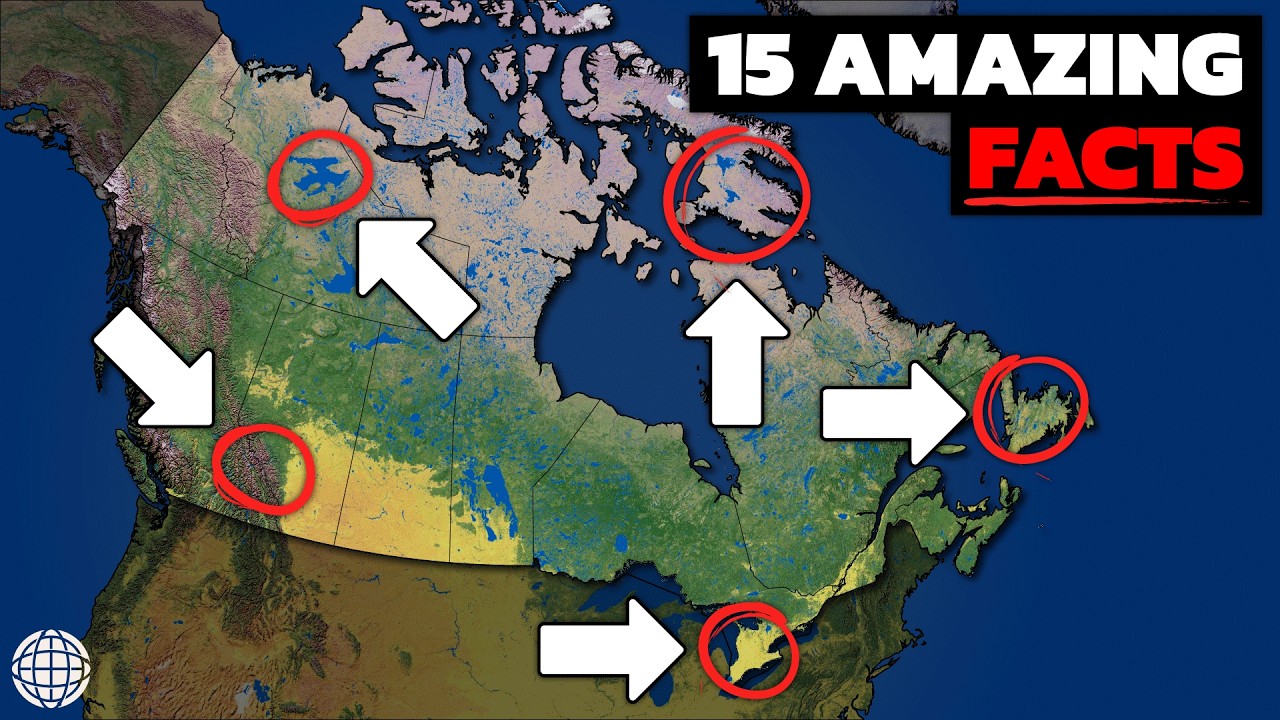
Canada is an amazing country that makes up about onethird of all of North America and because it's so vast and spans such a large area it's bound to have some of the most awe inspiring geography attached to it so here are 15 of my favorite geography facts about the great white North and to kick us off do you know how many islands Canada [Music] has Canada has more Islands than any other country in the world with an estimated 52,000 named islands and countless smaller unnamed ones the Arctic archipelago alone contains over 36,000 Islands including Baffin Island the world's fifth largest and elisir Island the 10th largest combined these islands account for about 15% of Canada's land mass and they're not all Arctic Baron Tundras Canada's Islands offer incredible diversity in the East Prince Edward Island is known for its rolling farmland and beaches while in the West Vancouver Island and Haida guay feature Lush rainforest and towering mountains but unlike island nations such as Indonesia or the Philippines which are densely populated Canada's islands are often remote and sparsely inhabited this isolation makes them vital for scientific research tourism and Environmental Conservation and because it has so many islands it also [Music] has Canada's coastline is the longest in the world stretching over 202,000 km it borders three oceans the Atlantic the Pacific and the Arctic to put it in perspective the second longest coastline belongs to Indonesia a country of over 177,000 Islands yet its Coastline measures just 54,000 km Canada's coastline is nearly four times longer this immense length contributes significantly to Canada's economy and biodiversity the coastlines are home to vital Fisheries particularly for lobster and crab on the Atlantic side and salmon on the Pacific side the Arctic Coastline though less accessible is becoming increasingly important with climate change as melting ice opens potential shipping routes like the Northwest Passage Canada's extensive Coastline also includes famous natural wonders like the Bay of fundi known for having the world's highest Tides with some areas rising over 16 m in a single day with a coastline this long it's probably not surprising that Canada is really really large Canada covers a vast 9. 98 million square kilm making it the second largest country on Earth after Russia it's so large that you could fit the entire European Union into Canada with room to spare despite its massive size Canada's population is only about 40 million people meaning it has one of the lowest population densities globally with only about four people per square kilm an extremely low amount when you compare it to the United states which has on average 35 people per square kilm this vast expanse of Canada includes towering mountains expansive prairies frozen tundra and dense forests the country's size creates extreme Regional diversity from British Columbia's temperate rainforests To None of its icy Arctic and from the flat prairies of Saskatchewan all the way to the rocky coast of New Finland Canada size and overall northernness contributes to harsh winners which can make living difficult however this space Also allows Canada to preserve its incredible Natural Beauty with over 38 national parks protecting these Landscapes now despite having so much space Canada's people haven't really spread out to occupy it [Music] all despite Canada's immense size about 75% of its population lives within 100 Mi of the US border this narrow strip of land accounts for less than 5% of Canada's total area But it includes cities like Toronto Vancouver Montreal and and Ottawa this concentration is largely due to geography and climate the southern parts of Canada have a milder climate more fertile land and better access to trade with the United States meanwhile the northern regions are dominated by harsh Arctic and subarctic conditions making large-scale settlement difficult in comparison Russia another vast country with a cold climate has a similar pattern with most of its population concentrated in the more temperate West which means Canada's largest bay is mostly uninhabited ladies and gentlemen it's time to take your nutrition to the next level meet hu the sponsor of today's video huel is spelled h l and is the global complete nutritional drink that's trusted by over 400 million people globally their black addition ready to drink is a complete meal in a bottle high in protein low in sugar and packed with all of the nutrients your body needs to feel its best and right Now new customers get 15% off and a free gift using my exclusive code at hu. com Jeff I'm actually recording this video from the southern tip of Taiwan and while I love the food here I still brought this big bag of hu with me as I travel around the world why because hu is a balanced meal designed by experts provide my body with all of the nutrients it needs basically hu takes the guesswork out of Health the eating which is especially important now because I'm eating out a whole lot more so get 15% off and a free gift for new customers using my exclusive code at hu.
com sjf unlock a healthier easier way to eat with hu nutritionally complete meals in seconds so you can focus on what really [Music] matters the Hudson Bay is the world's second largest bay after the Bay of Bengal covering 1. 23 million square km situated in northeastern Canada it's surrounded by Manitoba Ontario Quebec and none of it now despite its size the Hudson Bay is relatively shallow with an average depth of just 100 m this shallowness means it freezes over completely during the winter and even in summer the water remains extremely cold the bay is a remnant of a prehistoric sea left behind by melting glaciers after the last ice age the Hudson Bay plays an important role in Canada's history and economy it was the site of early fur trading posts established by the Hudson's Bay Company which helped shape Canada's development today its Shores are sparsely populated with small communities relying on fishing hunting and shipping the Hudson Bay of course is not Inland but Canada does have plenty of really large [Music] lakes Canada is home to more Lakes than any other country boasting over 2 million with 31,725 of the country's total area a staggering contrast to countries like Australia which is famous for its Aid Landscapes and limited freshwater resources among Canada's most famous lakes are Lake Superior which is shared with the US and known as the world's largest freshwater lake by surface area and Great Bear Lake located entirely within Canada and recognized as the country's largest by volume these Lakes are essential for hydr power providing clean energy to millions of Canadians as well as for recreation and wildlife habitats altogether Canada's Great Lake system which also includes Lake Ontario Erie and hiron contains 20% of the world's freshwater Supply so it makes sense that some of those Lakes would also have their own Islands Canada is home to manit tulan Island the world's largest freshwater Island located in Lake hiron covering 2766 km it's larger than some countries such as Luxembourg which is only 2586 Square km but unlike most islands surrounded by saltwater manat tulan is unique for its freshwater setting but that's not the only thing that sets this island apart from the others manat Tulin itself contains over 100 Inland Lakes some even have their own Islands this extremely rare phenomenon means that there are islands within Lakes on an island within a larger Lake Treasure Island is a great example of this because it's the world's largest natural Island in a lake on an island in a lake manat tulan island has a rich indigenous history and remains home to several anishinabi communities its Landscapes feature Rolling Hills beaches and forests making it a popular destination for outdoor enthusiasts boating fishing and Hiking are common activities while visitors can also explore cultural sites and learn about the Island's First Nation Heritage but this is perhaps not even Canada's most famous freshwater [Music] Island Canada's southernmost point Middle Island is farther south than parts of Northern California located within Lake Erie at 41. 4 De North it lies on the same latitude As Cities like Rome and Chicago however its location surprises many because Canada is often associated with Northern cold climates and snow covered Landscapes now all that said there are no permanent settlements on Middle Island as the entire island is a conservation area so technically Canada's southernmost point with people would be P Island just a little north of Middle Island all in all not that different and still well south of much of the United States we've now covered Canada's far north and far south but what's in the [Music] middle Canada's boreal forest is one of the largest intact forests in the entire world spanning over 2.
7 million square kilm and stretching from New Finland to the Yukon this biome covers nearly 35% of Canada's land area making it a critical component of the country's geography and environmental health the Boreal forest is home to iconic species such as moose lyns and wolves as well as billions of migratory birds that Nest here in the summer its trees mainly spruces Pines and Furs also play a vital role in sequestering carbon helping to mitigate climate change Canada's boreal forest is larger than those in Russia or Scandinavia and it plays a crucial role in regulating global weather patterns its vastness and importance have earned it recognition as one of the world's most significant ecosystems unlike tropical rainforests which are shrinking due to deforestation much of Canada's boreal forest remains pristine however wildfires are a growing concern for the region as every summer lightning storms set off large unmanageable fires now underneath all of those trees is some seriously old [Music] rock Canada is home to some of the oldest rocks on Earth dating back nearly 4 billion years these ancient formations are found in the Canadian Shield a massive geologic feature that stretches across Northern and Eastern Canada including parts of Quebec Ontario Manitoba and the Northwest Territories the Canadian Shield is a treasure Trove for geologists in 2008 researchers discovered rocks in Northern Quebec's greenstone belt that are believed to be 4.
What are the key takeaways?
Based on the transcript, here are the key points...