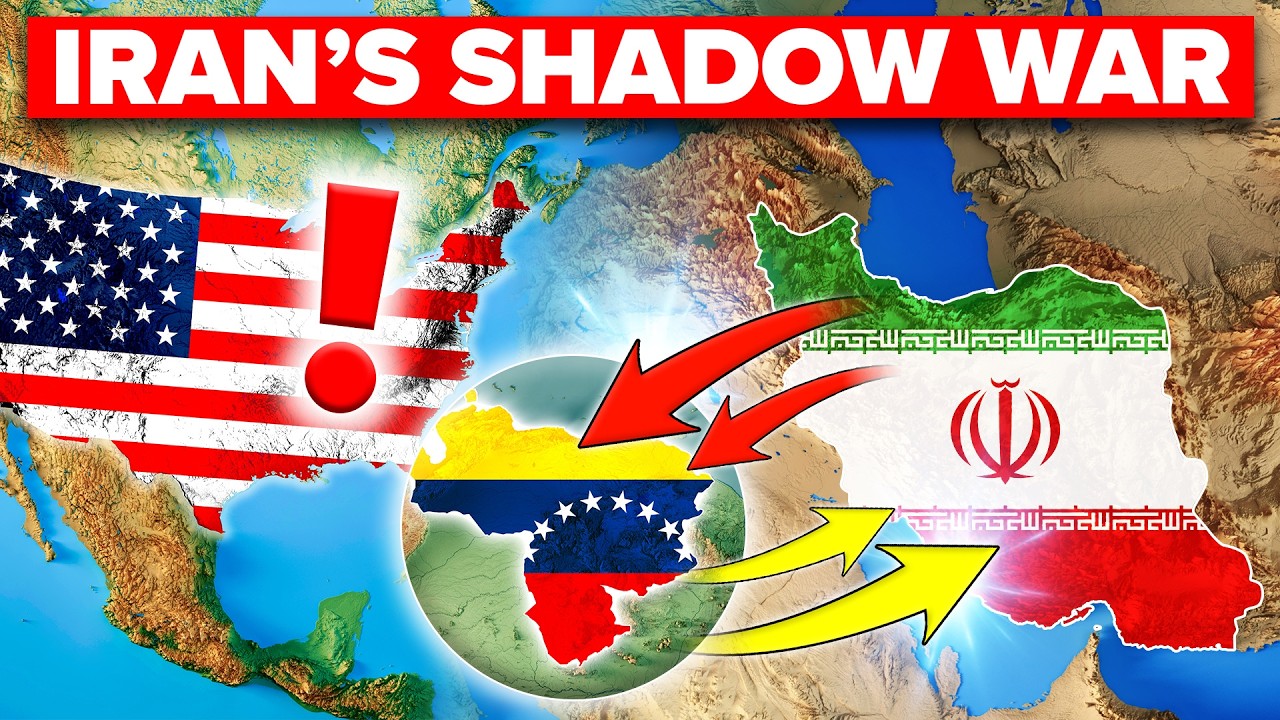
While the world remains fixed on Iran’s nuclear ambitions and proxy wars in the Middle East, the country has actually been quietly preparing a far more dangerous threat across the Atlantic. Venezuela has become Iran’s gateway to the Americas. Global analysts have uncovered what could represent one of the most sophisticated sanctions-evasion networks and military buildups ever documented outside the Middle East.
Let’s break down what’s really happening, why it matters more than ever in 2025, and how this could spiral into a nightmare scenario that makes current Middle Eastern tensions look manageable by comparison. The relationship between Iran and Venezuela began pragmatically in 1960 when both nations were founding members of OPEC (Organization of Petroleum Exporting Countries), which also included Iraq, Saudi Arabia, and Kuwait. You’ll notice that of the five founding members, only Venezuela was in South America, making it a vital exclave that can compete with other American nations.
But the real transformation occurred in the early 2000s under Iranian President Mahmoud Ahmadinejad and Venezuelan President Hugo Chávez. These two leaders shared an anti-American rhetoric, believing they could create an alternative power structure that could challenge Western dominance, particularly that of the U. S.
as the head of NATO. Between 2005 and 2013, this vision crystallized into approximately 270 bilateral agreements worth $16 billion, covering everything from oil infrastructure to military cooperation. But here’s where it gets concerning for U.
S. national security. During Venezuela’s 2020 fuel crisis, when the country’s mismanaged refineries were collapsing, Iran didn’t just send emergency fuel shipments.
It sent Mahan Air, a sanctioned airline with known ties to the Islamic Revolutionary Guard Corps. These flights routinely transported IRGC technicians and tech and industry components, establishing what would become a permanent air corridor between Tehran and Caracas. The payment to Iran came as nine tons of Venezuelan gold bullion, worth approximately $500 million, which completely bypassed the global market and the U.
S. dollar system that practically directs Venezuela’s currency exchange. Fast forward to 2025, and the situation has evolved far beyond economic cooperation.
Let’s talk about what Iran has actually built on Venezuelan soil. At Venezuela’s El Libertador Air Base in Maracay, Iranian firms, including Qods Aviation, a known IRGC front company, have established a fully operational drone assembly line. And we’re not talking about hobbyist FPV drones that are being retrofitted as killer frontline units in Ukraine.
These facilities are producing Shahed-131 UAVs, the same models Russia has been deploying with devastating effect in Ukraine. Venezuela is essentially getting direct training and experience for producing these drones en masse, while being controlled and molded by Iran’s anti-American agenda. The facility in question is located just over 1,350 miles away from Miami across the Gulf of Mexico.
And according to additional intelligence assessments, Iran is likely trying to influence countries across Central America to become the next staging ground for these drones. Those 1,350 miles might currently be too far under the current operational capabilities of the Shahed drones. All it would take is another generation or two of improvement, coupled with a favorable defense treaty with a Latin American country, to bring that distance down by a few hundred miles.
Then, you might have Iranian drones within operational distance from the American mainland. And this isn’t unfeasible. The Shahed-136, which is already being produced by both Iran and Russia, is estimated to have an operational range of over 1,600 miles.
If Iran transfers this technology to Venezuela and keeps its iron grip on the country’s underground, it can create a direct threat to the U. S. Of course, the military implications for drone production are just part of the story.
Venezuela still needed to prop up its economy enough to be able to build these drones. And this was done through one of the largest sanction evasion operations in the world, possibly outmaneuvering what Russia is doing. Traders rebranded over $1.
2 billion worth of Venezuelan Merey crude as Brazilian “bitumen blend” and shipped it directly to China. Here’s how they did it. Tankers like the Liberia-flagged Karina spoof their AIS location signals while loading in Venezuela, then sail with forged certificates of origin claiming Brazilian ports.
The cargo arrives at China’s Yangpu port labeled as non-sanctioned Brazilian crude, even though Brazil’s state oil company Petrobras doesn’t even export bitumen blends. China simply pays for the purchase at discounted prices, owing to the fact that Venezuelan crude doesn’t have import quotas. And this was just one of the many operations.
In the end, Venezuelan oil exports to China jumped from 351,000 barrels per day in 2024 to 463,000 in early 2025. These revenues fund not just the Maduro regime’s domestic repression, but also international disinformation campaigns targeting the U. S.
and Africa. And while the maritime shadow fleet moves commodities, the aforementioned Tehran-Caracas air corridor continues to move people and dual-use technology. Since 2020, Mahan Air and Venezuela’s sanctioned national carrier Conviasa have institutionalized what appears to be a civilian passenger route.
But eyewitnesses have repeatedly observed Conviasa aircraft parking at cargo ramps rather than passenger terminals at Tehran’s airport. Unmanifested pallets are discreetly offloaded, which is characteristic of operations involving sensitive or undeclared cargo. Then in 2021, Mahan Air transferred a Boeing 747-300M directly to Conviasa’s cargo subsidiary Emtrasur.
When Argentine authorities detained this aircraft in 2022, they discovered the captain was a former IRGC Aerospace Force commander. It turned out the aircraft was being used for training missions and fleet integration. This mirrors Iran’s well-documented aviation strategy in the Middle East, where civilian airlines have been used to transport military equipment, dual-use goods, and IRGC personnel to Syria and Lebanon.
It would take nearly two years before the aircraft was transferred to the U. S. as an attempt to start dismantling this air corridor.
But beyond direct economic ties, perhaps the most alarming aspect of Iran’s Venezuelan operations is the integration of Hezbollah into the country’s infrastructure. In 2008, U. S.
Treasury officials reported that the Venezuelan government was “employing and providing safe harbor” to Hezbollah operatives. Individuals like Ghazi Nasr al-Din, who was a Lebanese-Venezuelan diplomat, used their official positions to raise funds for Hezbollah and facilitate the movement of operatives into Venezuela. Nasr al-Din also arranged meetings between Venezuelan officials and Hezbollah leadership, coordinated fundraising with direct bank transfers, and organized travel between Venezuela, Lebanon, and Iran.
Coincidentally, this led to Hezbollah training being conducted on Iranian soil, with the proxy being partially responsible for the current Middle Eastern conflict and requiring Israel to invade Lebanon and assassinate Hezbollah leadership to force a ceasefire. One possible scenario that stems from Venezuela’s complicity is issuing fraudulent passports and official documentation to Hezbollah-linked operatives. This would allow covert Iranian proxies to embed within Latin America and potentially access U.
S. territory under false identities. Unfortunately, this scenario isn’t purely theoretical.
Between 2008 and 2012, fraudulent passports were issued from the Venezuelan Embassy in Baghdad to 173 individuals from Iran, Syria, Iraq, Lebanon, and Jordan, many with suspected ties to terrorist organizations. Venezuelan Vice President Tareck El Aissami, himself of Syrian-Lebanese descent, reportedly facilitated hundreds of Venezuelan passports to suspected Hezbollah members. Now let’s connect the dots to what’s happening globally in 2025, starting with Iran itself and its weapons capabilities beyond drones.
By July 2025, Iran had accumulated over 880 pounds of uranium enriched to 60% purity, whereas weapons-grade material requires 90% enrichment. Here’s the critical detail you need to understand: nuclear enrichment follows an inverse difficulty curve. The more enriched uranium already is, the easier and faster it becomes to enrich it further.
Iran’s trial deployment of advanced IR-9 centrifuges, which can theoretically reach enrichment speeds 50 times faster than older models, could shorten its “breakout time” to produce weapons-grade material to mere weeks. For reference, the bomb dropped on Hiroshima used only about 140 pounds of enriched uranium. Satellite imagery analyzed in November 2024 revealed new tunneling activities at the Natanz facility, suggesting preparations for even more hardened enrichment capabilities shielded up to 90 meters underground.
Only the United States’ GBU-57 Massive Ordnance Penetrator might be capable of reaching these depths, and even that remains uncertain. As both a pre-emptive and retaliatory action, the U. S.
conducted multiple strikes on Iran in June 2025 to neuter Natanz and the Isfahan Nuclear Research Center on the ground. But satellite imagery from late September showed new and repaired buildings that would suggest increased activity in “Pickaxe Mountain,” a facility only one mile south of Natanz. Iran has also successfully tested the Fattah-1 hypersonic ballistic missile, claiming speeds of over Mach 13 with advanced maneuvering capabilities designed specifically to defeat missile defense systems.
With the distance between Iran and Israel minimal, Israel’s Iron Dome would have mere minutes to detect and react. Coupled with the missile’s course-correction abilities, this represents a severe existential threat. The ballistic missile would be theoretically able to carry a nuclear warhead that Iran could feasibly produce by 2026 if its enrichment capabilities continue.
This is further complicated by Russia and Iran signing a comprehensive strategic partnership treaty in January 2025, deepening military cooperation and coordinating on regional security issues. This formalized what had been an operational alliance into a strategic framework. And while you might think Russia is not a large factor in this shadow war, the military alliance allows Iran to directly siphon off Russia’s experiences in Ukraine.
The Shahed drones that are being manufactured at El Libertador are combat-proven in Ukrainian skies. The maritime deception tactics, such as AIS spoofing, forged documentation, and ship-to-ship transfer, all mirror the sanctions-evasion playbooks refined through years of Russian and Iranian cooperation. Throughout all this, China remains a huge factor.
While China is arguably helping Russia avoid sanctions, it has also supported Iran for decades. For one, China has directly contributed to both Iran’s ballistic missile and nuclear research and enrichment programs. It has also been one of the first countries to recognize the post-1980 revolutionary regime that led to Iran being sanctioned in the first place.
China accounts for over 90% of Iran’s crude and processed oil exports, helping the latter avoid sanctions placed on its energy industry by the U. S. and its Western allies.
With China essentially allowing Iran to remain a regional player by funding and contributing to its weapons programs, it’s indirectly making things more complicated for the U. S. With Venezuela now acting as another of Iran’s proxies, China and Russia have yet another angle through which they can conduct asymmetric warfare.
Let’s game out how this could unfold and the implications for each major player. Scenario 1: Coordinated Multi-Theater Crisis Iran could leverage Venezuela as a distraction platform while escalating in the Middle East. If China moves on Taiwan simultaneously, potentially between 2026-2027, based on Xi Jinping’s stated timeline, the United States faces simultaneous crises in three theaters: the Middle East, Indo-Pacific, and its own backyard.
The Pacific Fleet would need to concentrate near Taiwan. The Mediterranean Fleet would maintain pressure on Iran and support Israel. That leaves few forces to monitor an emboldened Venezuela with operational Shahed drones and Hezbollah networks.
NATO would also face a critical decision point. It would likely need to honor mutual defense commitments if the U. S.
mainland faces direct threats from Venezuelan-based operations. However, Russia remains a threat in Eastern Europe, and NATO has arguably set a bad precedent there by allowing the war in Ukraine to go on for practically four years. In the middle of all this is Israel.
If it senses that Iran could pull the trigger on creating and testing a nuclear bomb, it might launch even more pre-emptive strikes on Iranian facilities, triggering a broader regional war that would demand immediate U. S. involvement.
Scenario 2: Venezuela as Iran’s Sacrificial Proxy Iran could use Venezuela as a staging ground for long-range drone strikes into the Gulf of Mexico, targeting U. S. maritime chokepoints.
The Shahed-131 has an operational range estimated at around 550 miles, which isn’t enough to reach the mainland. However, the U. S.
maintains several naval sites at Guantanamo Bay and across Puerto Rico, both of which are within striking distance. And remember, Venezuela might just be the starting point. If Iran develops another proxy, perhaps somewhere in Central America, its effective range increases drastically.
Simultaneously, Iran escalates offensives against Israel, backed directly by Russian military support and advanced weapons systems. Russia benefits by diverting U. S.
attention; Iran achieves its strategic objective of destabilizing Israel; and Venezuela serves as the expendable triggerman that gives both plausible deniability. If U. S.
forces respond with strikes on Venezuelan facilities, which they would almost certainly have to, Iran positions this as American aggression against a sovereign Latin American nation. This plays perfectly into their decades-long narrative of U. S.
imperialism, which directly plays into China’s ambitions, which can now swoop in to repair the damaged infrastructure and put the affected countries under mountains of debt while simultaneously proclaiming its famed goal toward neutrality. Given enough pressure, Venezuela might fold and allow China to start exploring its domestic oil reserves, which are considered to be the largest in the world and are only hampered by Venezuela not having the economic and industrial capacity to use them. If China takes hold of this resource and manages to transport enough of it, it could theoretically bypass its need for the Malacca Strait as the primary oil tanker bottleneck.
Scenario 3: The Nuclear Threshold If Iran crosses the threshold to weaponized nuclear capability, which can range from anywhere between weeks or months to years, considering how few international safeguards and monitoring are in place, the world could burn due to cascading effects. Saudi Arabia has explicitly stated it will pursue nuclear weapons if Iran obtains them. Crown Prince Mohammed bin Salman declared in 2018: “If Iran develops a nuclear bomb, we will follow suit as soon as possible.
” Saudi officials reaffirmed this position as recently as September 2023. The UAE also has an infrastructure that could be repurposed if regional security dynamics deteriorate further. The country also has access to ballistic missiles and is running one of the largest nuclear power programs on the Arabian Peninsula.
While its commitment to nuclear nonproliferation started in 2009, this stance could change if it senses enough pressure from both Iran and Saudi Arabia. Israel, widely believed to possess undeclared nuclear weapons, has also adjusted its military doctrine in response to Iran’s progress to something more akin to “shoot first, ask questions later. ” The deployment of F-35I “Adir” stealth fighters for long-range missions and the commissioning of Dolphin-class submarines capable of carrying nuclear missiles suggest that it could be preparing for deterrence by annihilation.
With so much nuclear storage within a relatively small region and historical proclivity for conflict, it would take only one miscommunication or overreaction to start a chain of nuclear missile launches that devastates the Middle East. And even if those warheads are relatively small, they could have a profound impact on the world’s economy or spur other countries like Russia into a nuclear war of their own. Scenario 4: U.
S. Decides to Intervene in Venezuela If Iran has already developed its nuclear weapons program to the point where it would take weeks to finish a bomb, Israel’s current military capabilities can’t penetrate the hardened underground bunkers at Natanz. Only the U.
S. has bunker-buster missiles capable of reaching those depths. But a U.
S. attack on Iran would directly prove to the Axis of Resistance that the West sees them as a legitimate threat, which would only escalate the conflict regionally. Any attack by the U.
S. or Israel needs to essentially be an open declaration of war, one that would remove Iran’s ability to prioritize research instead of defending itself. That same attack would not only degrade America’s geopolitical standing globally but would go directly against the administration’s ongoing efforts to bolster internal and regional security.
A wide-scale attack on Iran would require a coordinated effort and incredible amounts of dedicated resources, putting strain on an economy already affected by trade tensions with longstanding partners. At the same time, Iran could inflict severe economic damage by cutting off access to the Strait of Hormuz, which is vital for international oil trade and used by Saudi Arabia as one of the largest crude oil exporters. And if the U.
S. commits forces to a Middle Eastern theater, Venezuela becomes even more dangerous as an uncontested Iranian staging ground. That means the U.
S. would also have to interfere directly in Venezuela, creating yet another crisis in the country. President Donald Trump has already authorized CIA operations in Venezuela, and the U.
S. has deployed multiple missile systems, two warships, and a surveillance aircraft to directly exert presence near Venezuelan waters. Trump also implied that President Maduro’s days were numbered, suggesting he is actively taking a more aggressive stance against the country.
Of course, none of these scenarios is certain. Everything can change from one month to the next as the major players gain or lose on the geopolitical stage. Russia is being pressured directly by Ukraine and Europe.
If it loses enough, it could back out of supporting Iran. China could then lose confidence in being the sole backer, which could either entirely aggravate Iran or pacify it completely. But while the world is trying to adjust, Venezuela is still in one of its biggest crises in history.
It has the highest inflation rate in the world and faces currency collapse. Venezuela’s ALBA bloc has been weakening. Several member states, including Ecuador in 2018 under President Lenín Moreno, have distanced themselves from the alliance, citing Maduro’s regime.
Accelerating this trend through economic incentives and security partnerships could further isolate Venezuela. The regime would need Iranian support even more to maintain even basic government functions. This dependency means Maduro has every incentive to continue facilitating Iranian operations, even risky ones, in exchange for continued economic lifelines.
In turn, Iran’s international support comes primarily from the axis of Russia-China-North Korea. Actively disrupting these networks, particularly the technological and financial flows that enable them, can degrade Iran’s capability to sustain Venezuelan operations. However, the U.
S. has become increasingly unable to manage with both domestic and foreign challenges, especially ones that can’t be met with military presence and direct sanctions. Iran and Venezuela have successfully created a shadow network over the past 15 years, building infrastructure and relationships while American attention cycles between domestic priorities and visible threats closer to home or those directly infringing on its economic interests in the Indo-Pacific or Europe.
It’s now up to Trump’s administration to discern whether Venezuela is a symptom or an effect of Iran’s meddling and how best to cut it out at the root. And regardless of what option gets chosen, chances are we might see thousands die in the aftermath. Thanks for watching.
To learn more about how the U. S. had previously tried to pacify Iran, check out this video.
And if you want to stay informed about the evolving threats to global stability and American security, subscribe to The Military Show for daily video analyses.