Do you struggle with any of the following problems? Not knowing what to talk about on a first date, clueless on how to socialize at a party, or perhaps nervous about an upcoming networking event? Well, if any of this applies, then this video might be for you.
And if not, then still stick around cuz I'm about to enlighten you on a bunch of random obscure dinosaur facts that might just come in handy one day or might not. But hey, at least they're interesting. And let's start with one that likely won't even remain true by this time next year or even next month.
And that is the most recently described dinosaur, which was the Enigma cursor Molly Borth. Both a mouthful and a neoniththeician herbivore from the late Jurassic period. Well, at least this would have been the newest a week ago when I started researching this.
But as fate would have it, there's been a new find since with a new newest dinosaur being the Chinese sarapod Tong Nan Long Ziming. Again, another one of those species with a tricky name. But it still doesn't come close to micropachyphilosaurus Honguensis, meaning small thick-headed lizard of Hong Tuan, who holds the crown for the longest name of any dinosaur species.
Meanwhile, the shortest winner goes to Yi Chi, which possesses the absolute least amount of letters allowed by the group that makes the rules on naming dinosaurs. And yes, that's a real group. And ironically, both the longest and shortest named dinosaurs lived in Mesazoic China.
And speaking of China, it is one of the top three countries where the most dinosaurs have been unearthed with the other two being US and Argentina. And actually, it's just the top 10 countries that account for 3/4s of all known dinosaur species. But then on the opposite side of the spectrum, the largest country in the world where no dinosaurs have ever been found is the Democratic Republic of Congo, which in case you didn't know this, is the 11th largest country on Earth.
Funnily enough though, it is the supposed home to a mythological apparently still living dinosaur named the Mole Mbe which may or may not exist. Emphasis on the knot. However, Mole Mbe or not, dinosaurs are indeed still all around us seeing that birds are well literally therapods and therapods are well literally dinosaurs.
And the largest bird we know of that actually lived amongst his non-avian relatives was the garganavis, an ostrich-sized bird from the late Cretaceous Hatsig Island, meaning it was really Europe that had the first big bird, not the US. And so obviously this was pretty meaty for a bird back in those times. But still pitifully small compared to its other cousins that it shared the planet with, as just the averagesized dinosaur across the board was about 4,282 kg or 9,440 lb.
So, just a little heavier than this EV Hummer right here. However, the median, which is better at showing the most common weight, was closer to 630 kg or 1,389 lb. So, about the size of an adult bison.
And so, considering the average, you can bet there's quite a range in dinosaur size with the largest known genus based off of uncontroversial and substantial evidence being the sarapod Argentinosaurus, which weighed some 80 tons and measured 36 m or 118 ft long. while the smallest dinosaur is actually a living one if we include birds. With that title going to the bee hummingbird, which is about the size of your thumb.
Pretty cool, right? So cool that maybe at this very moment you've been inspired to buy the legacy of these titans. And I'm not talking about a chicken, but rather a fossil.
But before you do, just make sure your finances are in order, cuz they can be downright expensive. With the most costly fossil ever being sold for $44. 6 6 million, which if you're the average human worldwide, would take you 4,597 years just to save up for it.
And who was this good-looking, expensive as h double hockey stick dinosaur, you may ask? Well, a remarkably wellpreserved stegosaurus named Apex, who lived approximately 150 million years ago. And that's a pretty cool name and all, but a bit misleading as this was no apex predator unlike some creatures which it shared the planet with, or should I say water with, such as the Liopluridon and Plyiosaurus.
And you can bet the waters back then were filled with sea monsters and making you wish there was a way you could enjoy fishing without any of the unwanted dangers. And actually, there is. Let me introduce you to today's sponsor, Fishing Clash.
just about the only way you can catch basilosaurus, megalodons, and so many more monstrosities while at the same time keeping your hands, arms, and feet. Not convinced yet? Well, if you're a nature lover, then listen to this.
It's got a vast amount of detailed ecosystems to explore, unique fish species specific to their real life habitats, and virtual events that promote sustainability and conservation, allowing you to both have a great time and make the world a better place. And if you worry that Fishing Clash may suffer from some of the normal pitfalls of regular apps, then take solace in some of these facts. First, despite a 7-year run, it is still updating on the regular.
Second, allows you to play the game both casually or competitively depending on what you're looking for. And third, everything is unlockable through Free Play, and clearly something is cooking here as 50 million people are already playing the game. If you're interested, download the game using my link in the description box or scan the QR code on the screen and use my special gift code to claim a $20 value reward including unique avatar for free.
And now back to the video. So obviously Stegosaurus being 150 million years old is uh quite well old. I mean the Stega was even ancient by dinosaur standards.
In fact, it is so old that we Homo sapiens are closer to the T-Rex in time than the T-Rex was to the Stegosaurus. And actually, its entire group, the Stegosauria, were already long gone by the time the asteroid arrived. And just as an additional fun fact, those spikes at the end of its tail are called a thagizer.
And the reason why is mainly because of a 1982 comic where a caveman teacher is teaching other cavemen about Stegosaurus and well decided to call it a thagizer. And yes, I'm serious. But now going back to the whole time thing, another one for the road is that the time between the Spinosaurus and the T-Rex was approximately 93 times longer than the total existence of us modern humans.
So yeah, dinosaurs have been around for a hot minute. And paleontologists currently think that the first in the scene, i. e.
The oldest dinosaur was the Niasaurus, a smaller creature from Triacic Tanzania, who was around 243 million years old, making dinosaurs older than bees, pine trees, ants, flies, and turtles to name a few. On the other hand, the youngest known non-avian dinosaur is regarded by some to be the Triceratops, or rather a triceratops. as 13 cm or 5 in below the pollen calibrated KT boundary.
A lone triceratops horn was found, the youngest bone yet. Its discovery back in the early 2010s was also very big news as it got rid of the gap hypothesis which essentially claimed that dinosaurs had died before the asteroid as there was a geological zone of about 3 m or 10 ft in which no dinosaur fossils had yet been found. And Triceratops actually holds another distinct distinction as under phoggenetic nomenclature dinosaurs are actually defined as of all the descendants of the most recent common ancestor of Triceratops and modern birds.
And this might seem pretty specific but it actually covers a lot i. e. all dinosaurs and dinosaurs ultimately came in just about every shape and size which is why it's a bit surprising that as far as we know there was never a fully marine dinosaur.
Now, there is evidence that semi-aquatic dinosaurs were a thing, but nothing 100% aquatic. And this actually extends to birds as well, seeing that even penguins don't spend their entire lives in the water. And no, the mosasaur doesn't count, as it is obviously not a dinosaur, and neither a terasaurus or the dimetradon, which is often considered to be the animal most often mistaken for one.
Now, on the flip side, the ovaraptor was definitely a dinosaur. And if you've seen the movie Call Dinosaur or perhaps certain documentaries, you might think of it as an egg thief with its name meaning exactly that. But as it so turns out, this famous egg snatcher was innocent all along.
You see, the holotype had been found on top of multiple eggs, leading to the idea that it had died mids snack. But now, it is believed that those eggs were actually its own, meaning that in reality, it was just a good mom that died trying to protect his children. A tragedy is those little unhatched guys had their entire lives in front of them.
And some dinosaurs actually had rather long ones. The longest lived believed to be sarapods who possibly could live to a maximum of 100 years or older. While smaller dinosaurs typically lived shorter lifespans.
And a bit like trees, dinosaur bones also have growth lines which allow paleontologists to sometimes take a stab at estimating the age at which a specimen died. And across the main dinosaur groups, those being the Ornithysian, Therapods, and Sarapotamorphs, the oldest confirmed age from each group has been a 31-year-old Drconics, a 53-year-old Maraxis, and a 60-year-old Dloaticus, respectively. Of course, though, older individuals are probably still out there.
After all, it's thought that less than 1% of all dinosaurs that ever lived are actually represented in the fossil record, and there is no chance that we'll ever find all the ones that did live. But that being said, can you guess which dinosaur was the most common overall? And the answer is of course subject to change.
But for now, many think it was the Edmontosaurus, a large North American hydrosaur which is known through over 10,000, possibly 25,000 individuals. And this is actually a minimum as this number pertains just to a single square kilometer from one of the formations it lived in, the last formation, which dates the Cretaceous. And the Cretaceous is of course one of the three periods the dinosaurs lived through.
The other two being the Triacic and Jurassic that altogether formed the Mesazoic, an era commonly nicknamed the Age of Dinosaurs. And did you know that throughout this entire period, the Earth was so much warmer than the present that no dinosaur lived in a time of permanent ice sheets or glaciers? And this partially explains the fact that dinosaurs managed to live in every single continent, including Antarctica.
And actually, because Antarctica was closer to Australia and South America, it's believed that certain groups like sarapods would use the continent as a stepping stone to get to the other side. Thus explaining why certain South American dinosaurs and Australian ones are so similar. Now, migrating through Antarctica is pretty rad and all, but it's ultimately just one of the countless dinosaur facts out there.
So, to increase the ratio of dinosaur facts per minute, I'm going to go on a bit of a tangent, jumping from one fact to the next. So, in other words, brace yourself. Dinosaurs despite being known as the terrible lizards are not lizards.
They are in fact part of the clay arosauramorpha which also contain terasaurs, crocodilians etc. While lizards fall into the clay lepidosauramorpha which also contains groups such as snakes. Furthermore, all dinosaurs can technically be divided into just two groups.
One being the dinosaurs with birdlike hips while others are those who possessed lizard-like hips. And dinosaurs lived so long ago that grass only evolved towards the end of their reign. roughly first appearing during the albian stage of the Cretaceous.
They're also so ancient that at the time of their existence, Earth was on the complete other side of the galaxy than it is today. So that line from Star Wars really ain't too inaccurate when applied to Jurassic Park. We often think of crocodiles as being somewhat dinosaur-like.
And this is actually kind of correct, seeing that crocodiles are the closest thing we have to dinosaurs that are not dinosaurs, genetically speaking. And despite many thinking crocodiles are equally ancient, they didn't even actually coexist with the terrible lizards. At least not the true crocs, with those only evolving some 46 million years ago.
And one other fact that people often get wrong is the fact that fossils are not actually dinosaur bones, but rather what were their bones, which over a very long time have been surrounded by a sediment that hardened to rock, encasing the bones, after which minerals very gradually replaced the bone's original material. And there is a pretty interesting technique to tell if something you found is a rock or a dinosaur bone, and that's to lick it, as fossils are more porous, meaning that your tongue will stick to them. But I wouldn't try this trick on any live specimens if you ever find yourself in Jurassic Park.
Which speaking of, the majority of the animals featured in Jurassic Park are actually from the Cretaceous, not the Jurassic. But the creator decided on Jurassic because um well, he thought it sounded cooler. And to be honest, I kind of agree.
What I also agree on being pretty cool though is the fact that records indicate that dinosaur bones have very many times confused ancient civilizations with the Chinese confusing them for dragon bones while Europeans attributed them to biblical creatures and giants. And even in the early days of paleontology, dinosaurs were viewed as biblical creatures at least for a bit. With one idea painting them to be animals designed to end the suffering of the old and how?
Well, of course, by killing them. But I'm about to end your suffering by speeding up the regurgitation of facts a little bit more. So, let's go.
While birds are the last dinosaur standing, they did almost join them in extinction. As despite the common belief, the KT asteroid did indeed kill off the vast majority of them. The fossilized poop of a dinosaur is referred to as a copperite.
And the largest one ever discovered is a specimen that's been named, specifically Barnum, which weighs about 9. 3 kilos or 20 lb and is thought to have come from a T-Rex where it is currently held within a museum in the US. is finally named the puzzium.
And granted, calling something dinosaur poop is rather specific. So, how do we know it's really that? Well, through various signs.
In the case of Barnum, it was verified as a T-Rex droppings as it was discovered next to a T-Rex skeleton and had the typical shape of fossilized dung, as well as containing crushed and digested fragments of bones with a high level of phosphorus and calcium, which is typical among fossilized dung. And thanks to their often huge sizes, number two ain't the only thing they've hit records on. with this group also representing the largest carnivores and herbivores to have ever lived.
Not surprisingly though, this also translates into the largest other things as well, including the largest claws, arms, legs, tails, and footprints of any known animal, which funny enough though does not include teeth size. But T-Rex teeth are oddly similar in size and shape to bananas, so still plenty big. And despite looking comically small, each of its arms were able to lift things up to 199 kilos or 439 lb.
Furthermore, it's thought that at any given moment, approximately 20,000 T-Rex roam North America during the Cretaceous, with the same study that supplied this number estimating that 2. 5 billion T-Rex lived and died during the entire existence of the species. And one of its favorite prey, Hadrasaurs, would occasionally deliberately munch on rotten wood, likely to access fungi, decomposed wood material, and possibly the many insecttovores trapped within.
Let's get a little faster. Dilophosaurus is the only dinosaur from the original Jurassic Park movie that it was significantly larger in real life than it was portrayed. Paleontologists can sometimes tell the identity of a dinosaur off of a single bone or tooth, as certain ones possess autopomorphies, meaning traits only seen in certain taxonomic groups like species, genus, or families.
An example of this is Spinosaur teeth, which have very unique features. The Carnotaurus is one of the more famous dinosaurs out there. Yet, despite its celebrity status, it is only known from a single skeleton.
albeit a miraculously wellpreserved and completed one. The non-avian dinosaur survived approximately six extinction events until the seventh, i. e.
that giant pesky asteroid successfully took them out. The US states where no dinosaur fossils have ever been found include Florida, Hawaii, Illinois, Indiana, Kentucky, Maine, Michigan, New Hampshire, Ohio, Oregon, Rhode Island, Vermont, West Virginia, and Wisconsin. while Washington was the most recent one to find a dino.
Some dinosaurs had asymmetrical ears like an owl in order to help them hunt. At the same time, some dinosaurs laid perfectly spherical eggs and opposed to the oval shapes you often associate with both dinosaurs and birds. Fossil fuel does not come from dinosaurs.
Dinosaurs were also called pachipods and the Rex came awfully close to being named the manospondilus gigas. Even though sarapods are much bigger, it is the Rex who had the largest eyes of any known dinosaur and also that of any known terrestrial animal. So maybe it's not shocking to hear then that unlike what you may have learned in Jurassic Park, the king had great eyesight.
The original Spinosaurus skeleton was destroyed during World War II after an Allied bombing run because the museum director, a diehard Nazi, was salty that the owner of the bones was not a Nazi supporter and thus he refused to evacuate the fossils. As of now, the largest dinosaur with confirmed feathers was the predatory therapod Utyrannis, who lived in Cretaceous China and measured up to 9 m or 30 ft long. It is also the largest two-legged thing ever found with confirmed evidence of feathers.
And speaking of two-legged things, scientists will often use bipeedal dinosaurs as a reference when building bipeedal robots, as their leg structures are sometimes considered more efficient than our own. There's almost a 100% chance that you've drank the very same water that a thirsty dinosaur gobbled down millions of years ago. Despite all the jokes that Tyrannosaurs get about having short arms, the Ablasaur, not the Tyrannosaurs, had the shortest forms proportionally, of any known dinosaur group, with the carnotaurus in particular having the shortest amongst that specific group.
As a whole, the non-avian dinosaurs ruled Earth for about 165 million years, give or take, which is almost three times the duration of so-called mamalian rule. The first dinosaurs to be named by a paleontologist, and you should know this by now if you watch our videos, hint hint, was the Megalosaurus, a Jurassic dated therapod that hails from England. A good chunk of dinosaur eggs and fossilized embryos shows signs of precosiality, meaning many kinds of dinosaurs were born almost fully self-sufficient.
No waiting around like us apes to become useful. T-Rex is more closely related to a hummingbird than many dinosaurs lived alongside, including the triceratops. Dinosaurs experience shorter days and longer years than we do due to the moon's differential position during the messoic period with days of the time lasting approximately 23.
5 hours while years went on for about 372 days. While sarapods as I mentioned could be massive not all were ginormous with the smallest like magurosaurus, pollutitan and europosaurus all being closer to a bowl in size than an adult elephant. There was no carnivorous dinosaur that had four legs like a lion or komodo dragon.
While sarapods have always been pretty much depicted as gentle giants, we weren't actually 100% sure that they ate green stuff because despite them being shaped and designed like vegetarians, no concrete proof was known until recently. Recently meaning just this year after a fossilized gut content containing a bunch of leaves were found in a certain specimen. Meaning that for nearly 150 years, we were only really guessing.
Smartly guessing, though. There is only one dinosaur that researchers are confident in that we know what it sounded like whilst alive and that is the parasaurolophus. As in one study, researchers were able to reconstruct a complete 3D model of its iconic horn and blue air through the passages producing a sound that sounded like this.
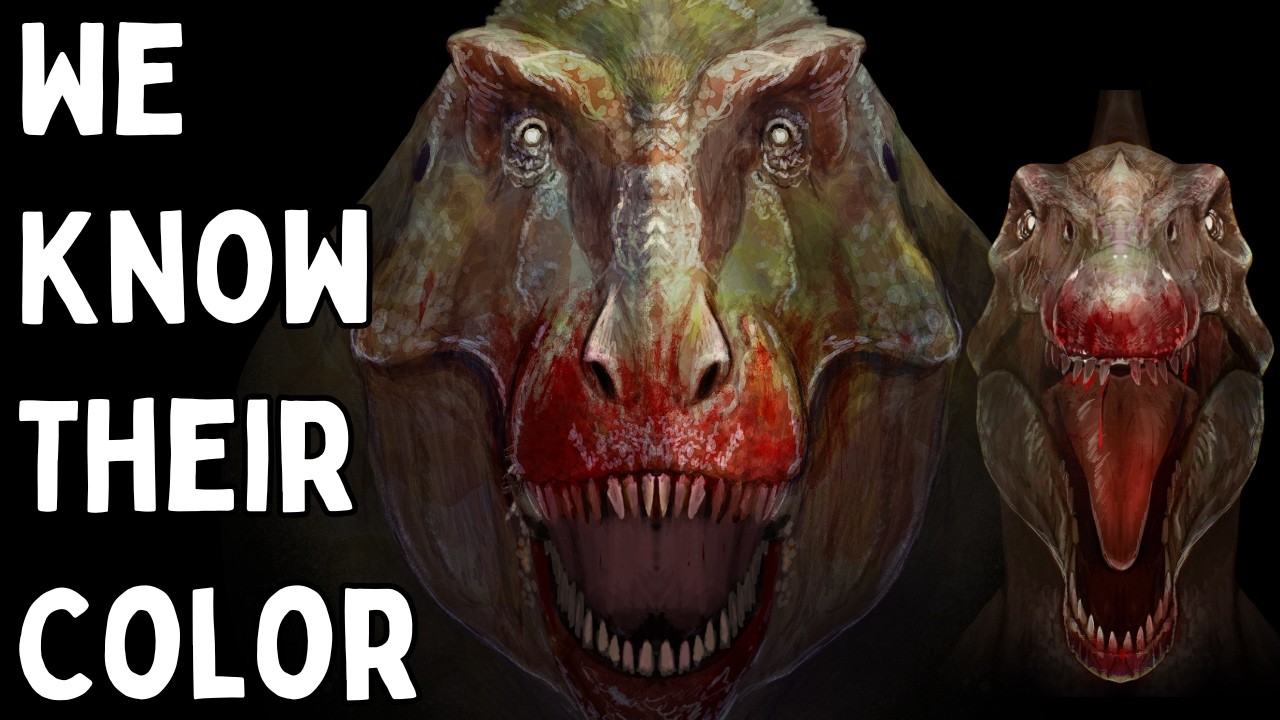
And obviously, it's quite amazing that we have an idea of how at least one dinosaur sounded like as this area of their life was once considered impossible to ever unlock. And a similar situation is seen in dinosaur coloration. A field that for a long time was unknown.
However, recently certain paleontologists have realized that within exceptionally preserved specimens, melanosomes can still be found. An organel that's the site for synthesis, storage, and transport to melanin within an animal, thus allowing us to analyze what color they might have been in life. And naturally finding melanosomes in a dinosaur is rather rare, but we have still found them.
And here they are along with their corresponding coloration. Borealo pelta had a reddish brown color to it. An unidentified hydrosaurus probably gray in life.
A 2016 Satacosaurus shows signs of being counter-shaded with stripes and spots. The Yuan Chuavis was black and gray. Protoerix was also black and Eioon Fukiosaurus who had a secondary color as well, gray.
Meanwhile, Cruel Espenia was of unknown color, but likely was in part darker shades of browns. Confucioris was primarily gray with secondary areas of white. Chenguioris was black and unnamed Bohyronith was weakly iridescent.
Wuong was iridescent and gray. Sinosuropterix was counter-shaded with shades of white and reddish brown. Soronithsaurus was a mix of red and black.
Microaptor iridescent black. Guadanosaurus was a blend of red and brown. Kottterix was dark gray and black.
Kihong was iridescent and black. Then Bayosaurus was light and dark brown. Archopterics was primarily black.
And then finally, Ankoris was a mix of white, gray, and dark red. And another interesting thing about this last dinosaur is that another specimen found later on with melanosomes as well seemed to have been a different color, leading paleontologists believe that the two specimens were possibly of different ages. And who knew that the color of dinosaurs would go from unknown to quite an extensive list?
And it's really just one of the many advancements that we made in paleontology over the last few years. And we now understand dinosaurs better than ever before. And obviously, I can't tell you everything about dinosaurs in one video, but these facts so far should be more than enough info to bewilder a few people.
Thanks for watching, and don't forget to check out Fishing Clash if you want to try some prehistoric fishing from the safety of your own home. Link in code in the description. And until next time, Onyxing Zoo.