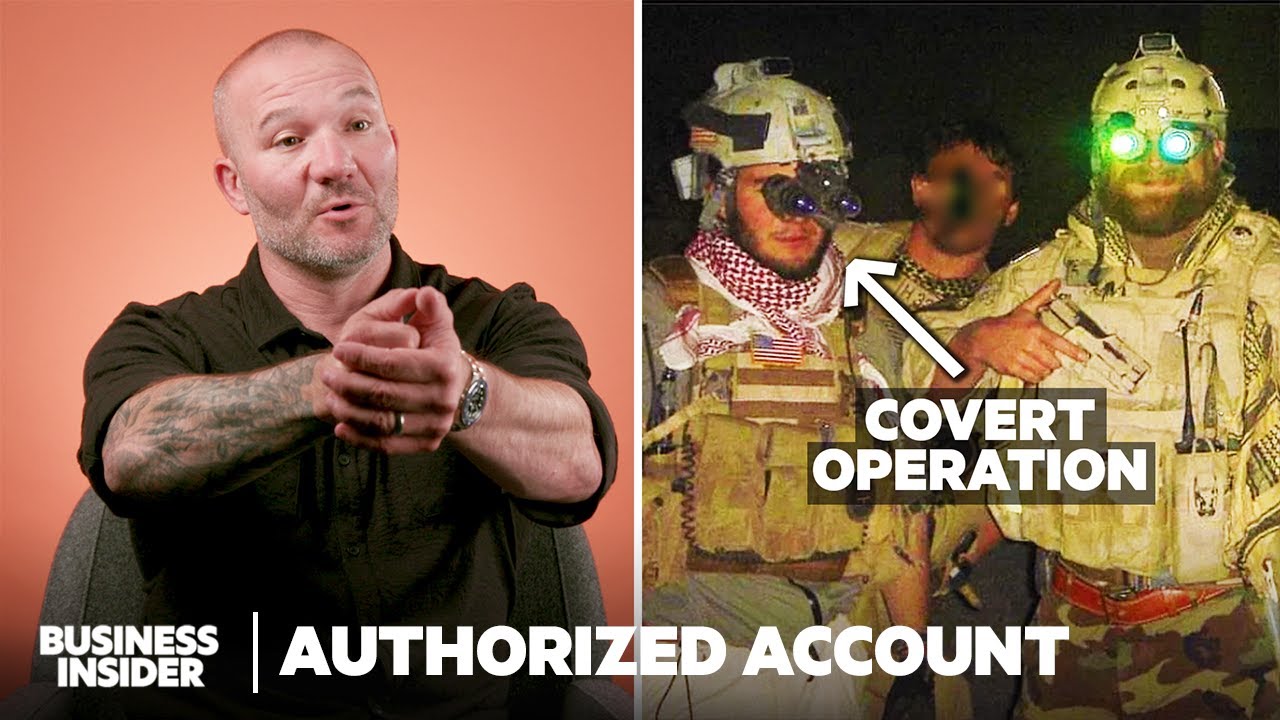
My name's Shawn Ryan. I was a Navy SEAL for 5 ½ years. This is everything I'm authorized to tell you.
You know you're going to be cold, you know you're going to get hypothermia, but at the end of the day, going to BUD/S is basically like getting kicked in the nuts. And so how do you get prepared for getting kicked in the nuts? You don't.
You just take it. How do we keep each other in line? A lot of hazing.
You have a tremendous responsibility being a member of a SEAL team, whether you're the communications guy or you're the lead sniper. You might be the guy planning the mission. You might be the point man.
And so there is no room for jackassery. And if you're not doing your job to the best of your ability and you're clowning around, then you're going to get tuned up and maybe kicked off the team. And so, it is a very, it's very much a work hard, play hard environment.
But if you can't play hard and work hard the next morning, you're not going to make it. When you're in the SEAL team, you are closer with your immediate teammates, your platoon mates, than you are with your own family. And so you eat with them, you sleep with them, you hang out with them, you party with them, you grieve with them.
I mean, that is your family. And so you become inseparable. Home on my off time as a SEAL was a lot of happy hours and a lot of ladies' nights and chasing women and drinking booze and probably a bar fight or two.
On deployment, an off day looks like a really good workout in the gym and a lot of Xbox. A lot of people pose as a SEAL. I've seen it happen a lot.
This is, you know, this is 20 years ago. We would have the support guys going out in town and bragging to everybody that they are a SEAL, a SEAL teammate, or SEAL Team Two. And they would go to those specific bars where SEALs hang out when those bars were empty.
That way, none of us were in there catching them doing it. But unfortunately, we know the bar staff, we know people that work there. And so that word will get around, and a lot of times they would wind up taped to the flagpole naked when everybody shows up to work the next morning.
The No. 1 unspoken rule for the SEAL teams was work hard, play hard. As long as you could show up to work ready to go, pristine condition, and be able to perform, they did not care how hard you played.
Some of the jobs I had as a SEAL was, one, I was a point man. Basically, a point man is the point guy when you're doing an infill, entering into a target, you're the navigator, navigating your route in, how you're going to get in, how you're going to get out, how you're going to lead your entire team in. My first mission as a SEAL was to go to Haiti in 2004.
There was a lot of civil unrest going on all over Haiti. We staged out of Guantanamo Bay, and basically what we would do is we would fly over on a helicopter every morning and do reconnaissance in all these different towns and villages to report back about the civil unrest. We had prisoners breaking out of prison.
It was just complete chaos all over Haiti. Bodies all over were on the beach. But it was just a reconnaissance mission.
I felt good. Wasn't enough action for me. It made me really hungry for more.
I wanted to go to the Middle East. The hairiest mission I've been on was when we went to Baghdad, and this was a SEAL Team Two. There was an election going on, and we had a badass lieutenant who started farming us out to conventional units who were having problems.
We would find units that were getting blown up by IEDs or being ambushed on roads. Terrorists would set up roadside bombs, set up ambushes, and they would just blow these vehicles, kill our guys, time and time again. We would go with these conventional units for a couple of weeks, training them up, and then we would actually take them on a real-world mission with us.
And every time we went out, we would kill the guys that were killing them within a 24-hour time frame. I wasn't actually a schoolhouse-trained sniper. I was just really good at it.
And so when we did all these sniper missions, I was basically aiding the lead sniper and teaching the conventional guys how we do business. It was one of the biggest responsibilities I've held. There was a very small village outside of Taji that was considered "black.
" And so what black means is no US troops or personnel are allowed to drive through, walk through, fly over. You'd basically just stay completely out of the town because it's so dangerous. This one was out in basically farm fields.
And so we took four teams, and four teams of two to three guys each, and we'd set them up along this road. So, town's here, black town. My OP was the first one right outside of the black town.
So it was the most dangerous spot to be in. And then we had our command-and-control-type observation point kind of hidden back in the rear where they could do comms. And about halfway through the day, we got compromised.
We were in weeds that were probably about chest-high. And so I'd patted down this little hallway, and I was laying in the grass looking at the town, like I should have been. Probably about 30 meters off the road, and I saw a man walk right by me out of my peripheral.
And I noticed when he walked by me, he noticed me. I could see him looking off the side of his eyes through his peripheral. I thought, maybe I'm supposed to kill this individual.
He's going into a black town. I wanted to pull us out. I wanted to do an emergency extract because I had compromised the team.
Rest of the sniper OPs decided they wanted to stay. They wanted to see how things went. Ten minutes later, we got mortared, probably four to five different impacts right on top of us.
I wanted to emergency extract again because I knew the next thing that was probably going to come was the fighting-age males in the village would have walked online through the field and just killed all of us. The next thing, that search party did come, but it came with vehicles. We were so well hidden that goats were actually eating vegetation out of our ghillie suits, with goat herders seeing this.
And so everybody was scared to move when that was happening because you didn't want to alarm one of the goats. And one goat goes crazy, then the whole herd goes crazy, then the goat herder knows something's going on. So we didn't move.
A couple of goat herders had passed. What we noticed was five guys coming out of the village, the black village, carrying AK-47s, carrying 105 rounds, carrying wire, shovels, everything you need to basically make an IED explosive. So they walked right past me, and we radioed to the rest of the team that these guys were coming their way, but nobody answered our radio.
They started digging. They planted the bomb. All I heard was just shots over and over and over and over.
It sounded like a gunfight. It sounded like the bad guys were, the terrorists were killing my guys because all of us were suppressed, meaning quieter shots, no muzzle flash. It seemed like forever, but it was probably less than a minute.
And we kept calling our guys. "Hey, what's going on? Hey, what happened?
What happened out there? Is anybody out? You guys alive?
Give me a head count. " Nothing. In my head, I knew everybody was dead.
And so it was me and two other guys, and we just got back to back, and we said, "All right, this is it. We're just going to take as many of these people out as we can before they get us. " First thing we hear come over the radio, maybe five, 10 minutes later, is, "Holy s---, we just killed the f--- out of those guys!
" They let the Army guys take the shots. They were not suppressed. So I thought their gunshots were the enemy's gunshots, but it was the Army guys, unsuppressed, shooting alongside with our snipers, who were suppressed.
You know, hearing my guy come out saying that they had just killed those guys was one of the best-sounding voices I've ever heard in my life, knowing that my guys were still alive and that we had defeated the enemy. SEALs use a lot of weapons. We use .
300 Win Mag sniper rifle. We use a . 50 caliber sniper rifle.
We use a 7. 62 sniper rifle. We use a 5.
56 sniper rifle. We have M60 machine guns. We have Mark 48 machine guns.
We have Mark 46 machine guns. We have Mark 19 grenade launchers. We have M203 grenade launchers.
We have . 50 cal machine guns. We have mini guns.
We have pretty much anything you can think of that fires a bullet. Main weapon I used was a M4 10-inch barrel with a Nightforce suppressor, and secondary was a P226. A suppressor is not a silencer.
A lot of people think it's a silencer. It does dub the noise down a lot. You don't need to wear ear protection when you're shooting with a suppressor, but it's not like what you see on the movies where it sounds like a sewing machine.
The main point of a suppressor is to suppress the flash that comes out of the end of the muzzle, whether it be a pistol or a rifle, because if you're shooting at night and you're in a combat scenario, every time you fire that weapon unsuppressed, it's going to leave a signature. The enemy combatants will wait for that flash, and then they'll aim at where the flash came from. So if you have a suppressor and you're on night vision, then they can't tell where the shots came from, so they don't have anything to actually shoot at.
Most fun to fire was definitely the Carl Gustaf rocket launcher. I can't remember the exact millimeter of the rocket, but it is about this long, packed full of high explosives, and they will take just about anything out that you point it at. So one thing that we would use them a lot for are terrorists hiding in caves.
It's good to be familiar with as many weapons systems as you possibly can be. Two, we were in the Middle East, and that's the type of weapons that the terrorists were using, and so we trained on all the Soviet-style weapons as well, which are what the enemy combatant, the terrorists, were using at the time. You might be dressed up like a local or somebody from Afghanistan, Iraq, Yemen, Pakistan, wherever you're operating, Syria.
You might be dressed up in the local garments, and what does everybody have there? An AK-47. So you could be undercover, and that's the reason you need to be familiar with it.
You might run out of ammo on a direct action or some type of a raid where you have to pick up an enemy combatant's weapon and be very familiar with that to continue on with the mission. When you see SEALs in the back of a old Toyota Hilux truck, a lot of times what that is, is those are, many times, up-armored, but they blend in with the local vehicles as well. So you can't get Hiluxes here in the United States, but everywhere else in the world is running around with diesel Toyota Hiluxes, especially in the Middle East.
A lot of times we're attached to some type of a partner force, whether that be a force of Afghan commandos or Iraqi commandos or wherever you're at. A lot of times in special operations you're going to be attached to a partner force, and those partner forces use Toyota Hiluxes. If you're in a 100-vehicle convoy with a partner force and there's only four vehicles that actually have SEALs in them and the rest of them is a partner force, you don't want to be the guys that are standing out, because if you do get ambushed, it's going to be a dead giveaway.
You don't want to make yourself a higher-profile target than anybody else on the battlefield. We did a course that was actually put on by the British MI6. We were actually going to go into Eastern Europe, Eastern Bloc countries in Europe, and hunt down warlords and people that have committed war crimes.
They put us through a course that taught us how to break into cars, how to hotwire cars, how to blend in, how to surveil somebody on foot, how to surveil somebody in a vehicle, how to surveil somebody in a boat, how to follow them into 50-story buildings, and blend in in every type of environment that you can think of and be actually comfortable doing it. I would say the most important piece of equipment that you need in combat is a radio, because radio gets you out of there, it gets you in there, it's your communications, and it is actually the biggest gun on the team because you're calling in the biggest guns. You're calling in A-10s, you're calling in fast movers, you're calling in Apaches, you're calling in Spectre gunship, so I would say that the radio is by far the most critical piece of equipment for a mission.
I grew up in a small town in Missouri, about 6,000 people. I was a s--- disturber, troublemaker. I liked to party, I liked to raise hell, but it was a good childhood.
I had a really good childhood. Very close with my family, my brother and sister. I tried to go into the Marine Corps first, but they wouldn't let me in to go force reconnaissance at the time.
They told me I had to go infantry. Then I went to the Army, told them I wanted to be a Green Beret. They kind of laughed me out of the office.
I didn't even know what a Navy SEAL was at the time, and the Navy recruiter stuck his head out and basically said, "Hey, have you ever thought about the SEAL teams? " And gave me a pamphlet. So I went home and went to the library, checked out every book I could possibly find on special operations and Navy SEALs, watched all the documentaries on National Geographic and Discovery, and decided that's what I was going to do.
I wrestled in high school. I wanted to do the most grueling thing I could possibly do in the small town that I grew up in, which was wrestling, so I cut a lot of weight. Did a lot of running.
Really had to work on my swimming. That was the biggest challenge for me, was the swimming. And so I did a lot of laps in the pool.
You can't prepare for it mentally. A lot of people never believed that I could make it. I wasn't a superstar athlete.
I really wasn't much of an athlete at all. I didn't make good grades. I wasn't the most popular kid in school by any means.
And so I think a lot of people thought that I would just go and fail. The only reason I didn't quit is because I didn't want to disappoint my old man, and that's because I felt like I disappointed him a lot as a child, and I wanted to prove to him that there was more than what he saw for the previous 18 years. BUD/S is the very, very beginning of the pipeline to becoming a Navy SEAL.
BUD/S stands for Basic Underwater Demolition/SEAL training. They want to know how tough you are. They want to know what you can take.
They want to know that you are a team player. They want to know what your physical endurance is like, what your mental toughness is like. And I knew it was going to be tough.
I didn't know it was going to be that tough. First phase is very structured. Usually you'll wake up, you will have some sort of a PT event, meaning you're either going to do a 4-mile timed run or a 2-nautical-mile swim, or you're going to do an O course, or you may go to the pool and do a pool workout, but you always start off with some type of a physical exercise.
Then you'll be getting your ass kicked on the grinder by the instructors with calisthenics, push-ups, pull-ups, sit-ups, flutter kicks, getting sprayed with the hose, getting sand kicked on you. Nice little wake-up in the morning. And then that will filter into more beatings until lunch.
At lunch, you probably get about 30 minutes. You run back from lunch. It's about a mile and a half to and from lunch.
You run everywhere. And then beatings commence after lunch well into the evening. Usually, you're done by about 9 o'clock at night.
You'll probably do some type of rock portage. Those are the little boats that you see out there, those rubber boats with the guys with the paddles and the life jackets, and they have to land those boats on the rocks with the surf. Sometimes the surf can get up to 12-, 15-foot swells, and so it makes for a very challenging experience.
Hell week is famously known as the most grueling week of SEAL training. It's five days, five nights, no sleep. Maybe you might get a little nap here and there, but you are constantly moving.
You are constantly in the water. You're freezing your ass off, fighting hypothermia. I believe the water there is a brisk 58 degrees.
I was so miserable when I was in hell week that I almost quit. My buddy slapped me in the face and told me, "There's no way you're leaving us here. " What you don't see on TV and in the documentaries and everything is, like I said, you are constantly wet.
You're constantly sandy because 90% of the course takes place on the beach, and so the instructor staff, they know that sand gets into every crevice of your body. And they take advantage of that. So they might have you do a 5-mile run after you go get wet and sandy, and that rubs all the skin off your crotch, off your armpits.
Any skin that's rubbing together, it's going to be raw. Then when that dries, they have you hit the surf, meaning get back in the salt water, which is like dumping hydrochloric acid on your skin, and it's just a constant vicious cycle of doing that over and over and over and over. Everybody that quits has to ring the bell.
It's a very humiliating experience. You have to ring the bell in front of your entire class. Most classes, at least when I went through, were right around 200 to 250 people.
And then place your helmet in a line right under the bell. So after hell week, you will just see a line of 100-plus helmets all under that bell. The first time I heard that bell, I was thinking, I hope to God that's not me one day.
I did not want to disappoint my father and call him letting him know that I had quit and didn't have what it took. And once I got that in my head, it never crossed my mind again. They just want to see that you can overcome just about anything, but it's not near as grueling as getting shot in combat or having a limb blown off or something like that, and they want to know that you're going to fight through and still be with the team and not give up.
When hell week's finished, it's one of the best feelings in the world. They bring the American flag out. It's a big ceremony.
You haven't slept in five days, and they basically just give you a big congratulations for completing the toughest military training in the world, and then they offer you a pizza. Then there's phase two, which is dive phase, and that is learning how to do scuba. That's learning closed-circuit breathing, apparatuses known as a Drger.
The first thing you do is you go through dive physics and dive medical so that you actually understand dive medicine and how deep you can go for how long, things like that. Then, once you pass that, then you move into open circuit, which would be what most people consider or call scuba diving. It's called pool comp.
It's the last big, big obstacle that gets people kicked out that they can't pass. It starts with very, very minimal tasks. It might be just, hey, put your tanks on underwater, and then it's, all right, your tanks are malfunctioning.
You need to take them off, figure out what's going on, all the way up to, you'll be fully jocked up with all your dive equipment minus fins, and you'll just be crawling on the bottom of the pool, and then a group of instructors will come down. They'll give you what they call a "surf hit," which is basically beating the s--- out of you underwater. They'll punch your gut, make sure your air is gone, tie your hoses up so you can't breathe out of your breathing apparatus.
They'll tie that in knots. They will make your tanks malfunction, turn your air off. Basically, what they do is create mass confusion and take all of your air away, and what they want to see is that you can remain calm, you're not going to jet to the surface for air.
Get your dive rig back to a functioning way and continue on that track. There's no secret to staying calm down there. You have no air.
You just got the s--- knocked out of you. You can't figure out what's wrong. You have water in your eyes.
I mean, you can't really see. But, you know, it's not supposed to be easy. Open water is a whole new ballgame.
Nine times out of 10, if we're diving, we're diving under a ship to plant a bomb, and then we're kicking back out. Sometimes these can be eight-hour excursions, and so they want to see that you're comfortable underwater and that you can handle yourself, and not only yourself, your buddy. You're not diving the coral reef down in Key West.
You are diving San Diego Bay, ships, sharks, seals, dolphins that are trained to kill you. So, in the early 2000s, the Navy developed the Mammal Program, and what they were doing were they were training dolphins and seals, the animal, not the special ops. They were training seals and dolphins on anti-swimmers and I believe it was explosive detection, and so they would train these animals, and then they would send them out, and the dolphins would obviously use their sonar to find enemy combatants that were trying to plant bombs on ships.
So, as a BUD/S student, guess who the test dummies are? Fortunately, I did not have that experience, but I did wind up in the mammal cages by accident. The only way you know where you're going is you memorize your bearing.
You look at your compass, you hit your bearing, and you count your kicks. So, my kick count was 66 kicks was 100 yards. It was about a six-hour dive, I believe, and my kick count was a little off because of the current.
I had the wrong bearing. Next to the pier that you're diving off of for BUD/S just so happens to be the Mammal Program. And so if you look at the top of the water, it is chain-link fence, so you'd think that goes all the way down to the bottom.
Well, it doesn't. It's more like a cargo net under the water. And they kept saying, "Dive Bear 23, you are entering the mammal cages.
" And I remember looking at my buddy like, f---ing idiots, they're going to go in the mammal cages. And they kept saying it. I was the lead navigator, and we were completely what appeared to be inside the mammal cages.
I looked up. I saw the cargo net. It was going over my wetsuit hood — that's why I didn't feel it — all the way behind us.
So, when we came, when we looked up, we thought we were inside the mammal cages and kicked like hell to get the hell out of there. Turned out that the net was just draped over top of us. And we were Dive Bear 23.
So. Everybody hits a low point. And so when you have a good guy, a good teammate that puts out, that cares about the rest of the team, when he hits that low point, the rest of the team will help encourage him to get his spirits back up, not to quit, and let him know that the rest of the team's depending on him.
My favorite part was the land-warfare phase, which is demolition, firearms, land navigation, basically your land-warfare phase. They start to treat you like an actual human being again, and the beatings become less and less. You're learning land navigation.
You're learning pistols. You're learning how to shoot rifles. You're learning how to shoot submachine guns.
And the best part, the best part of all is learning demolition. You're learning how to use C-4, TNT, Bangalore torpedoes, detasheet. You name the explosive, we use it.
You're blowing up cars. You're blowing up buildings. Learning precision demolition.
You're blowing things up in the water, like obstacles that they'll put out into the ocean. You'll dive down, plant a haversack on them, and blow it right there in place. I love to blow s--- up.
The first weapon I trained on was a SIG Sauer P226 9-millimeter handgun. I think they start with the handgun because the handgun is the most challenging weapon to master in firearms. And once you have the fundamentals of handgun shooting down, then all the other kind of shooting, just with all the other platforms, just kind of falls into place.
SEALs are such good shots because we train, train, train, train. It gets ingrained in you. And so even in BUD/S, you're going to spend a week to two weeks of dry firing.
And what I mean by dry firing is no bullets, no nothing. Just your weapon. And so you come out just like you're shooting a real, just like you're shooting for real with real bullets, but you get your form down.
They just want all the motions, all the grips, everything, side alignment, grip, the way you hold it, the way you present your pistol, everything has to be perfect. And then by the time that you put a real bullet in that weapon, it goes right where it needs to go. And then you'll do the same thing with rifle.
You'll take your M4, you'll start shooting, dry firing for a week, maybe two weeks. Before a live round ever leaves that barrel, you'll know exactly what you're doing. I left the SEALs for a multitude of reasons.
I didn't get enough action. I was very, very gung ho about going to war. We did the Haiti thing.
Then we went to Germany. Then we went to Afghanistan. Did a little bit in Afghanistan, did a lot in Iraq, but I didn't want to do another six years for a very small portion of it to be in combat.
I saw what 20-plus years will do to somebody, to their body, to their home life. Pretty much everybody I know was divorced or has been divorced or was getting a divorce. A lot of them didn't know their kids very good.
Your platoon, your teammates, are your primary family, and the families are the secondary. And I knew that if I stayed in at the rate I was going, that I was going to be a very lonely person come retirement. I wanted to try business.
I became a real-estate agent and failed miserably at it and got into a fire academy. I found out that I wasn't going to have a guaranteed job and that it would likely take about 2 ½ years before I did get a full-time job as a firefighter. I didn't have time.
I don't have two years, 2 ½ years to wait around. A friend of mine gave me a call and told me that he wanted me to try out for this contracting program. He said, "This is a black program.
I can't tell you who we're actually working for, but I can assure you that everybody who's in this program or even gets a chance to try out for this program has to have had a special-ops background. " And about six months later, I got a call to show up at a specific location, what kind of gear I needed, and that I was going to be a tryout. And so I went.
I did the tryout. It took about a month. When we finished the tryout, they had told us that the client that we were going to be working for was the Central Intelligence Agency.
Pay was astronomically higher. It was probably four to five times higher than I was making as a SEAL. The deployment cycle as a contractor is kind of on you.
I liked to do 60 days on, 60 days off. At the end, I was doing 45 days on, 45 days off. Some guys like to do 90, 120 days out, one week back.
It's kind of all up to you and how much you want to give them and how much you want to give your family. When I left the agency, I started a tactical training company. It grew very fast.
Got to train Keanu Reeves for "John Wick 3. " That was pretty much the height of it. Then I got really tired of it after doing the job for real for 14 years, give or take a little bit.
I had grown a pretty successful YouTube channel from the tactics training videos that I would put out. And so I decided that I wanted to document history from the people who were there, the way it actually happened. So I started the Shawn Ryan Show for a couple of reasons.
I really got tired of watching the mainstream media talk about all the events that I was a part of or that my colleagues were a part of. It was always somebody that had never been there. And veterans didn't have a voice.
And I wanted to bring that out and talk to guys like myself who had been through that and how they got out of it. So, everybody that I brought on at the beginning had found some type of success through entrepreneurship and had been through the low points, the addictions to adrenaline, to substance abuse, to broken families, to suicide attempts. You have been in a fight-or-flight state for as long as your career was, basically.
More adrenaline dumps than anybody else you could possibly imagine. Multiple adrenaline dumps a day. That's a lot of chemicals being released into your brain.
It becomes an addiction, an addiction for adrenaline. My coping mechanisms were finding new ways to get an adrenaline release. Lots and lots of sleep meds.
Everything from Ambien, Valium, Xanax, Lorazepam, anything I could get my hands on. Opiates, hydrocodone, tramadol. You name it, I'll take it.
I moved out of the country to Colombia, South America. I lived in Medellín for quite a while, and I got really into cocaine and started going into the worst neighborhoods I could find in Colombia to find where to buy cocaine from. And when that got boring, then I would go to another country, and I would start doing it there.
At the worst point in my life, I was drinking two fifths of vodka in a day. I would wake up and have about a fifth of vodka in mini bottles that would be everywhere, all over my house, in my car, in my bedroom, everywhere. And then at night after dinner, I would just crack open a fifth out of the freezer and start going to town on that.
Wash down my pills to go to sleep, which, by the end of it they didn't even really put me to sleep. And then I would wake up with a nice pick-me-up of Adderall or some other type of stimulant to keep me going. And it just became this vicious cycle for years and years and years.
When you are a SEAL, there's not much support. It's not something that they like to address. They don't want to bring any light to that.
It makes the units look bad. And so a lot of them pretend like it's never happening. Nobody wanted to go to medical because everybody wanted to go on the mission.
And so if you went to medical, everybody was scared that it might be some type of chronic illness or injury that would take them off the mission. So a lot of guys would hide it. I had a hernia that I got in basic training, and I refused to tell them all the way through because I was scared that they were going to pull my SEAL contract out from under me.
So I went all the way through basic training with a bulging hernia in my groin and finally told them when I was done. I've had multiple concussions from explosions from being blown up, blowing cars up, shooting huge rocket launchers like Carl Gustafs, falling out of helicopters. I don't even know how high we were because it was dark and I missed the rope and fell out of the helo.
But it was 50 feet or less. A lot of wear and tear from humping the mountains of Afghanistan. A lot of wear and tear from BUD/S.
Major back issues, those kind of things. I've never been shot. A lot of us have the same injuries and the same symptoms and deal with PTSD and deal with traumatic brain injury and stuff like that.
And when you get out, though, there are a lot of resources. Not very many government resources. The government doesn't do a very good job at treating these things.
It's a dark time for a lot of guys, especially when they get out. We're not used to slow-paced environments. We're not used to not having adrenaline dumps.
We're not used to integrating into a civilian environment. And we're not used to having to deal with feelings. You have a mission to do.
That's the only reason you're there. And so when you get out and you have to — you have to learn patience. I guess I'll say that.
And a lot of guys don't have very good patience when they get out. But what there are is a lot of veterans out there who have started nonprofits, and the focus of the nonprofit is what worked for them, whether that's group therapy or psychedelic therapy or going to hyperbaric chambers to try to repair your brain health. I did two different psychedelics.
The first one was ibogaine, which is about a 12-hour experience. It's like watching your entire life through a different perspective. And then you do what they call 5-MeO-DMT.
It's basically an ego death. And it is a death experience. That was the most intuitive experience that I've ever had.
And when I came out of the death experience and experienced the bliss, I could feel and see a flow of energy coming from the ocean onto the shore, into the grass, up the trees. And you, for the first time in my life, I have realized that everything is connected and everything is one. It was really intense.
I came back. I didn't need any of my meds anymore. I quit drinking.
I'm sober for 2 ½ years. I quit smoking cannabis. I quit a lot of things.
And I was present with my family. It brings hope to all the guys that are getting out that hear this. They hear the low points that these guys, including myself, went through.
And they realize it's not impossible. It gives them hope. I'm a producer on "Authorized Account.
" If you enjoyed this, please subscribe and comment below with more topics you'd like to see us cover.