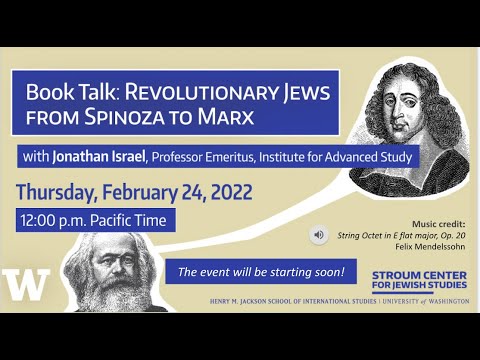
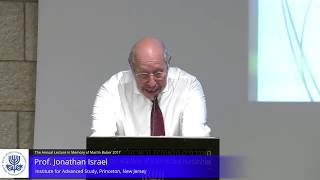
hello and welcome my name is noam pianko i'm the director of the strum center for jewish studies and the present professor of jewish studies at the university of washington and i'm excited to welcome you today unfortunately i'm having some technical issues so i'm just here uh through audio and not through video but i'm so glad to be with you nonetheless for this exciting event um today we have the uh wonderful opportunity to celebrate and learn about the newest contributions of the samuel and althea strum endowed lecture series in jewish studies jonathan israel's book revolutionary jews
from spinoza to marx this book will join an incredibly robust august group of dozens of books essays and thought pieces in jewish studies including really classic texts um in in the field of jewish studies um uh texts such as uh yosef hiroshami's book sahor jewish history and jewish memory and we are so proud to have this volume in our collection as well this event is made possible by a collaboration with uw press and the generous support of the community donors of the strum center and many of you are in the audience today and on behalf
of all of us i'd just like to thank you for your generosity i also want to thank our tremendous staff the group of professionals at the strum center who work so hard every day to bring quality thought provoking and academic programming to new audiences these professionals include sarah zadie's rosen cara skoon maker grace elizabeth d and daniel wang for today i also really want to thank and welcome professor michael rosenthal for agreeing to moderate today's conversation with jonathan israel uh michael is a friend and former colleague here at the university of washington and michael really
was instrumental in organizing the conference in 2017 that brought jonathan israel and many other scholars to the university of washington to discuss spinoza and modern philosophy and it is uh thanks to that conference that we had this strum lecture and now this book and i'm very grateful michael that you have agreed to join us today so thank you um for that uh professor uh rosenthal just to introduce uh michael to everybody holds the grass team chair and jewish philosophy with appointments in both department um and the and tannenbaum center for jewish studies and the event
today is going to include a brief overview of the book from jonathan israel and then michael and jonathan will have a bit of a conversation and there will be time at the end for questions and answers as well and in order to keep the focus on the presentation attendees in the zoom webinar do not have video and microphone enabled but we welcome you to submit questions via the question and answer function at the bottom of your screen at any point during the event so without further ado i want to um ask michael to introduce jonathan
and to start our event thank you all for being here yeah thank you very much noam and it's really a pleasure for me to be back at the university of washington where i miss many of my colleagues and especially the center for jewish studies the strom center and professor bianco and thanks to all the staff for making this event possible let me turn now to the main speaker and introduce briefly so we have plenty of time for conversation and discussion the main speaker of our event and that's professor jonathan israel who's professor emeritus in the
school of historical studies at the institute for advanced study in princeton um jonathan as you may know is an incredibly um well-known and recognized historian for his many works his books include the european jewry in the age of mercantilism 1550 to 1750 radical enlightenment philosophy in the making of modernity as noah mentioned he delivered the 2017 strong lectures in jewish studies which focused on spinoza as a revolutionary thinker and the idea of the radical enlightenment and then the jewish emancipation and i'm just so pleased that he was able to complete this book to deepen and
widen his reflections back in 2017 and that we have a chance to hear from him today to talk about it so let me turn things over to professor israel who'll give a brief overview of the book and then we'll have a chance to engage in a conversation with him for a while before we turn to questions and answers thank you jonathan oh thank you uh michael i'd like to uh begin by um just thanking noah and michael really for arranging the event in 2017 that's the only time i've ever been to seattle i would get
to say to get back there at some stage but it was a wonderful conference which michael organized and uh the discussion was really uh very stimulating and if it were not for noah and michael i'm sure this book would not exist because the idea of writing it is so closely linked to the the stone lectures and to that occasion so i look back on it very fondly well the point of the book is to uh trace the early stages of the development of what you might call the modern jewish revolutionary consciousness after a certain point
let's say about 50 years before the russian revolution from around 1870 the tendency of some jews to adopt a revolutionary attitude both towards government and towards churches towards religion and established forms of education and law uh became so conspicuous so obvious that it was very much disapproved of of course in many quarters but uh was a very well-known phenomenon on both sides of the atlantic of course culminating in people like leon trotsky in the period just before and during the the russian revolution so there were many jewish revolutionaries in the half century or so before
the russian revolution but what this book tries to do is to look at how uh this modern jewish revolutionary consciousness uh emerged in the first place and what its relationship is to the wider uh jewish uh society jewish culture jewish tradition because there must be deep philosophical and deep uh i should say deep historical cultural reasons why uh such a phenomenon should arise and why it should become so embedded in jewish social history now uh so uh i want to say that down to what i've really focused on is the period from the beginning of
the enlightenment down to the early stages of karl marx's life because marx has a very interesting development as a radical and as a revolutionary he was certainly revolutionary and radical from a very early stage but the early marx uh the revolutionary it wasn't at all a marxist in the way we would think of marxist today was nothing like being a marxist because he wasn't interested whatsoever in socialism until 1845 or so until he was about 27. uh he took no interest whatsoever in economics believe it or not it's because we we think of him as
an economic theorist almost more than anything else as as an ideologist but the early stages marx belonged to a quite different kind of revolutionary tradition and perhaps we'll say more about that further on what i want to say is that the kind of oppression that the the jewish people um encountered in the uh russian empire in the later 18th century uh of course it caused a lot of gloom it was deeply resented and that oppression was a very terrible thing there's no question about that and it affected the entire jewish people in eastern europe in
a very profound way so how do you deal with that uh i think there were basically let's say by the 1870s and 1880s there were three different ways of dealing with oppression this kind of oppression you could uh the the the you could adopt a rather passive submissive attitude which some people did you could get your family and up and uh decide that immigration was for you the solution and go to the new world go to america or go to argentina brazil or go to south africa or australia but this remember is only an option
for significant numbers of jews from around 1880 or the pogroms of the early 1880s before that it was not really it was not a possibility for more than a very very tiny number uh the other thing you could do is to if you're energetic and optimistic and forward-looking is to join one of these secrets of course they were very severely repressed so they had to operate secretly these secret revolutionary organizations in the revolut in the russian empire or in neighboring countries now um if you go by by that time by the 1870s and 80s the
last of the restrictions in other parts of europe were disappearing uh even in hungary uh even in uh and certainly in countries like switzerland germany and sweden the old disabilities and restrictions on jewish life were finally got rid of in the 1860s and 70s the last of them were gone by about 1880 so you could say that central western and central europe had adjusted to the idea that jews should be integrated into society and should be equal before the law and should be equal citizens with equal access to educational institutions but so the number one
thing to remember i think in in in looking at this story which i'm trying to tell is that that's a totally different picture from how things looked from the uh through the early modern period down to the early 19th century let's say down to the time that marx was a young man so throughout that period um quite serious restrictions down to the early 19th century there were still really rather serious restrictions on jewish life applied right across central and parts of western europe as well and even parts of the new world remember until the 1830s
even in the united states which was the freest of all the western countries since uh the american revolution since the 1770s and 80s but even in the united states down to the 1830s some people sometimes forget this that many states i know pennsylvania is a good example but actually a particularly good example but most because there was a protest from the uh the jewish community of philadelphia about this which was rejected in i think 1783 the last year before uh the end of the revolutionary war that uh many state constitutions did not allow uh any
person to uh take out public office or become a representative in the state assembly unless they were willing to swear on the divine status of the new testament as well as the old which jews of course couldn't do and it was designed uh to uh was supposed to be designed to exclude atheists and base but it of course also uh was designed to exclude the jews too so even in the united states there were certain restrictions and the blasphemy laws were quite tough so if you criticize the churches in a way that some people didn't
like it could get you into a lot of trouble uh before the early 19th century it was much worse than that so in the 17th and 18th centuries you had a lot of restrictions and european life was quite oppressive even in the freest continental european country which was holland the netherlands the netherlands had a great reputation because you could you had more freedom of expression you could publish books more easily uh you could criticize the government to some ex to some extent you could even criticize the uh the dominant church to some extent as long
as you didn't one thing that was against the law was to deny the divinity of christ so as long as you didn't say that uh that the doctrine of the trinity is nonsense which quite a lot of christians in the netherlands did believe there were a lot of sicilians and unitarians who didn't think that that christ was divine they thought christ was a man they thought christianity was the right religion and christianity has a very precious moral core and role to perform in the world but they did not think christ was divine but you and
that you were not allowed to say or publish that could get you into prison you had to be uh depends where you said it in amsterdam you'd get away with it as long as you didn't uh do it too flagrantly it had to be in sort of semi-clandestine okay but there were much worse restrictions than that yeah in the netherlands for example um even in holland uh a very good instance would be the guild system uh down to the 19th century or the early 19th century the guilds um more or less excluded the jurors from
nearly all crafts and nearly all economic activities apart from trade overseas trade financial things the things that they you know traditional restrictions had squeezed them into and there were many parts of europe until the middle of the 19th century papal rome would be a good example jewish life was very severely restricted and oppressed in rome uh and in in other parts of italy as well and until the 1830s you still had the inquisition operating in spanish-speaking countries and in the spanish new world so there was plenty of oppression on all sides and it was greatly
resented and it greatly restricted jewish life so and since immigration was not really a major option uh well it was a major option especially if you needed to escape the inquisition you could get away from portugal or spain and you could get to holland or england or um or hamburg which was a relatively free city um but even that actually was an option only for relatively small numbers of people and you wouldn't be able to escape without leaving a lot of your possessions behind and suffering in many cases at least suffering quite severe losses um
so the the restrictions on jewish life um everywhere really were very even in england even even down to the the 1870s oxford and cambridge still excluded jurors from higher education so that was quite a big restriction which was much resented um if it were not for the uh beginnings of the university of london in the late 1820s which was set up by one of these uh radical enlightenment figures uh jeremy bentham who uh was privately anti-christian you you were not allowed of course if you without destroying your own uh career reputation you couldn't come out
and say that publicly but they were of course a lot of influential anti-christians around and bentham is a good example of one who were determined to change all this and there were many many changes one of which was the beginnings of the university of london which deliberately didn't have a theology department and from the beginning was always open we want no theology here and the catholics who were another discriminated against group in britain in the 19th century catholics and jews can be students at the the new university of london on an equal basis with everyone
else that's something that doesn't get going until around 1830 this is quite late after all and that that means that until 1830 higher education uh not in england is for jews is shut you don't have access you can't study you can't get degrees there okay so the restrictions are very great immigration is not really a solution what do you do so this i think i set the scene in a way which shows why a certain kind of enlightenment particularly the more radical forms of enlightenment that wanted to change the whole political uh not just make
society more tolerant but changed the whole legal structure the whole educational structure drastically reduced the power of the churches so that they couldn't form couldn't perform such an obstructive role as they had in the past as far as most jews were concerned and it really changed the framework of society as well as the legal status of the jews so jewish emancipation depended on enlightenment you cannot separate jewish emancipation in the modern world from enlightenment but the more moderate kinds of enlightenment that wanted to um wanted to compromise let's say with the existing legal structures the
existing political structures and with the churches and say okay you know we want to leave church influence over education for example over the law pretty strong we need a few changes but let's leave church influence pretty strong over the over education and uh we're not that interested in the jewels anyway which would be very much the attitude of voltaire or montesquieu or david hume that they weren't so only certain kinds of uh enlighteners who were prepared to go much further like john tollen for example who was the first in 1714 to publish a pamphlet in
england saying the jews are the same as everybody else let's integrate them into society on the same basis as everybody else it's quite an important thing in 1740 but that's connected with his opposition his sweeping comprehensive opposition to the entire um institutional educational and religious structure in britain so you can see from what i've said or at least i hope so that this is at least reasonably persuasive that um for jews especially after the disappointments of the great there was one other possibility which i didn't mention of release from oppression let's getting out of the
prison there was one other thing that greatly appealed to vast numbers of people in the late 17th century and down to the middle of the 18th century the messianic movement of sabotage 3 which many listeners will know something about 1665 1666 the messiah has come divine intervention is here the redemption of the jews is at hand everything is going to change and everything is going to be much better and the uh the the prison the prison gates are going to be thrown open and the day of liberation is here well that's wonderful and people were
enormously excited in 1660. the trouble with that solution is they didn't work and nothing happened there was another bout of messianism in the 1750s in in especially in poland the movement of jacob frank which may come up in the discussion later um but that didn't work either so um this the messianic possibility uh by arousing a lot of excitement actually was counterproductive in a way for those that believed in miracles and in divine intervention because there weren't any miracles and there wasn't any divine intervention so in the long run the messianic movement was deeply disappointing
and i think it only added to the pressure the tendency to make a deeply rationalizing philosophical and radical kind of enlightenment appealing to um to large numbers of the the more educated element or those that were able to get access to uh books in in french and german in particular i think those are the two languages that mattered most among the modern languages um for this purpose um and uh uh opened up this whole new um process and this whole new phase in in jewish history now how that worked out in more detail in terms
of the intellectual and philosophical uh consequences of this process which i've tried to set the scene for uh i hope will emerge from the discussion so perhaps uh without more or do uh i can um end the setting the scene part of the um of the discussion uh this afternoon there and hand over to michael to steer the um the more specific discussion of different uh thinkers and writers and different elements in the book great thank you jonathan um that's a great introduction um let me just start with i have a bunch of questions and
hopefully we'll hit on some of the themes and also give you a chance to raise some of your own issues if i missed something that you you want to emphasize about the book um let me start with something kind of personal and i noticed in the preface you dedicate the book to a friend of yours another historian and but you mentioned you both had a teacher in high school walter isaacson that inspired you in some ways so i found it very interesting in this long in this point in your long and very distinguished career as
an historian that you came back to someone who inspired you in some ways at the very beginning of it so maybe could you just say a little bit about your motivation behind writing this book yeah i think that uh like many other people uh i feel that my life was very very strongly uh redirected uh as a teenager by one particular teacher i think one particular teacher can change one's life quite fundamentally and i i uh early as an early teenager i think i was a bit of a slow coach not doing very well in
school uh wasn't all that excited by school work either uh i was doing a bit better by the time i got to 16 or 17 but i was still only vaguely in the middle of the class at best i think um but then meeting valter isaacson uh he he was a refugee from nazi germany he'd been a young lecturer at marburg i believe uh when the jews were all jewish teachers and civil servants of course were forced to leave their positions uh and eventually um quite late i think it's not until 1938 that he actually
left um germany and moved to london and became a latin teacher at kilburn grammar school with a secondary school which is where i attended in the 1960s and um he was always i think more interested in in history of philosophy than history as such so he turned his general history lessons often into discussions of uh canton and hegel and i got quite intoxicated with this even if i couldn't make much sense of it at first i remember my father was a businessman i was talking excitedly about this teacher one evening putting his he's tired from
work and he put his newspaper down very impatiently and said okay we'll explain hegel's philosophy to me then and i was completely stumped for a moment but that didn't dampen my excitement not at all and uh so he had a very inspiring effect uh walter isaacson and um he uh i think he had he was he he had a sense that certain pupils were able to respond to the kind of thing he could teach them and he enjoyed very much coaching a small group um for the oxford and cambridge admission exams i i don't think
there's any chance that i i would have i was i won an open scholarship at cambridge uh as an 18 year old and took up that scholarship in 1964 and i'm absolutely certain that if it was not for this teacher i would never have been in a position to have that opportunity so from that point on i felt that i had uh that i even had an advantage over others because of him so it certainly had a tremendous impact yes great let's get into the substance of the book um you begin maybe not so surprisingly
with spinoza so why isn't isn't he someone who was a heretic and banned from the jewish community uh in one sense do you begin a book on jewish revolutionary thinkers with spinoza um and and in some ways also i think which also interests the audience i think a lot would be what way does his sephardic background matter to the development of this thought and the theme of the book maybe a supplementary question as well yeah well two very very pertinent questions uh well the first thing to remember i think is that uh the scethadic the
portuguese jewish community in amsterdam in the middle of the 17th century were not only faced by the problem of spinoza and of course after a certain point they got fed up with his defiant attitude and expelled him in in july uh put him under the permanent ban of the kirim in in july 1656 but they were having trouble with a number of other uh scethadics the others were mostly people who recently arrived from the peninsula and were not necessarily um that they were convinced that they were absolutely fed up with the catholic church and the
inquisition but that didn't necessarily mean uh that they were won over to orthodox judaism so we do know that in the uh middle and late 1650s spinoza was not just an individual but part of a group and that is really the beginning of the story because we know quite a lot about particularly juan de prado who was another one of these groups so we also we we know less so far but research is being done we will know more about a man called daniel ribera and one or two others so they were facing the um
let's say an anti-rabbinic anti-orthodox revolt uh which was followed along the lines a little bit of urel de costa who many of those listening to this discussion will know the name or el de costa in the early 17th century who was another refugee from the inquisition in portugal he went to hamburg first before he came to holland but um now oral decosta didn't have any doubts that the catholic church and the inquisition were very oppressive and very evil and felt deeply resentful about that um but he wasn't so convinced by the rabbis either and uh
in fact he couldn't quite work out since his idea of judaism he started piecing things together uh mainly from reading latin books uh or latin versions uh of of the old testament and and and latin versions of accounts of of judaism in ancient times and he couldn't quite see what uh modern orthodox jury how that followed on in many cases from what he thought judaism ought to be about from his deductions from uh reading uh ancient texts in latin so there was a an intellectual problem you might say actually one or two other sephardic writers
mentioned this that newcomers from the iberian peninsula in most cases recognizing that they were new to normative judaism were respectful and submissive unfortunately there were certain arrogant types often and i think this is true he says it's often connected with there being physicians or um or or for some other reason having uh uh as new christians of course there was no a barrier so they're going to university so there's one way in which um these refugees from the inquisition in spain and portugal had uh an advantage in a debate about religion or about politics or
society with christians that other jews didn't have and that is they had western university degrees and were highly literate in latin as well as their vernacular language which in their case would be spanish or portuguese but was often french as well many of them had spent periods in france so uh these uh so there was a the the rabbis in holland in the middle of the 17th century recognized that there was a social cultural problem that these refugees uh normally were very receptive and let's say uh passive learners in the hands of the rabbis but
there was a core hardcore of real exceptions to this uh nearly always people who had university degrees and they were a lot more latin than the rabbis did read a lot of books and um robio de castro for example who's one of the physicians who went to holland says these people were often intellectually very um confident not to say arrogant and they didn't necessarily accept uh what the rabbis told them and so you had a real intellectual uh cultural problem which showed itself in hamburg in holland and i think uh you can see this very
clearly from the history of the sephardics in in london in bevis mark's community as well so it's a much wider problem than just spinoza um and i think uh it's not surprising when you think of this background uh that to to answer your second question why the sephardics begin this process more than ashkenazic jews because the ashkenazic jews had much less access to western higher education and latin than the civilics uh the sephardics had at this hardcore of university trained latin reading intellectuals often physicians um like juan de prado who was uh spinoza's closest ally
in in amsterdam in the 1650s uh and that these people um were and there's another important psychological factor i think uh and intellectual factor and that is that um most rabbis in germany poland russia uh the czech lands and so on in the ashkenazic world uh felt that the uh as as did the community elders the the the elders governing the jewish communities that the the best defensive mechanism the best way to ensure jewish survival and stability under the conditions they had to live was to be very submissive to authority and never to challenge they
might sometimes be forced into disputations which they were very reluctant to join to participate in but never to challenge christian arguments and belief you don't do that if you in any any regard for your own safety um but these people uh are coming from they they're fleeing the inquisition with the university degrees and they they they hate christianity they detest it in an intellectual way which is very different from the attitude of rabbis in ashkenazic europe is very different i mean oreo de costa i believe spinoza in his own way juan de prado certainly and
a lot of other sephardic jews in the late 17th century elijah montalto who spent a lot of time in france would be an excellent example of this are so fierce and so vehement in their anti-christianity admittedly they can't publish any of their texts but they write manuscripts which are carefully kept secret especially in amsterdam there was a whole collection of them in the it's heim library in amsterdam uh that eventually when european uh non-jewish free thinkers discovered the existence of these manuscripts uh anthony collins uh and john tolland are very good examples here especially collins
who was particularly interested in these manuscripts um and arranged for uh and several french free thinkers in the early 18th century also arranged the um translation usually into french actually the translation from they were written normally in spanish or portuguese these clandestine anti-christian texts that were kept secret uh they were then uh these free thinkers who are not jewish then arrange for their translation into french and then through the 18th century they begin to diffuse and you can see how they have quite a big uh significant input for example into the work of the baron
dolby would be a good instance of somebody who is interested in this kind of thing and absorbed quite a lot so these uh these extremely uh dismissive arguments against christianity which absolutely don't come from an ashkenazic background but sephardic background play a large part in the in the beginnings and in the evolution of this type of uh radical enlightenment both in its uh non-jewish aspects and in its jewish aspects great um one thing that i i was really amazed by in your strom lectures back in 2017 was the discussion about these revolutionary jews living in
the new world in various ways both in kind of south in suriname and also in in the american colonies you point out um i think in the book that there were only about 2 000 jews out of a population of 2.5 million um uh in in the in the americas uh how in the united states in the united states just in the united states in the colonial department well i have another follow-up question in a minute after this about the the kind of david nasi and the caribbean enlightenment but how were jews in north america
involved even though they were tiny why were they involved and how were they involved in the kind of revolutionary movement that you were describing uh well they were um certainly uh very small groups and you might think that their role couldn't have been very significant but i think it does have a certain significance and the reason for that is that they uh especially in charleston uh and uh in savannah in in the southern states where they were very important often sephardic uh jewish community not only they were mixed methodical uh communities but also in uh
newport uh rhode island uh and in new york uh had pretty strong links with the caribbean area and the caribbean played quite a big role in the american revolution because um there wasn't much um under under british rule until 1775 um certain things weren't produced to any great degree in north america there wasn't much in the way of um producing things like artillery for example or or artillery uh shells uh and uh certain kinds of guns and uh certain uh naval munitions would be another example where were you going to get naval supplies from they
weren't uh so used to that uh there are certain other things that were very important in american life interestingly in particular bibles because you couldn't get them from england once the war started and you needed lots of bibles uh so they they tended to come from holland as well now many of these things that were suddenly in short supply it could be provided from holland which was still a very major trade depot and the dutch had colonies in the caribbean and several of these coli colonies curacao and but particularly the island of statious until it
got attacked by admiral rodney and the british who got so fed up with this and and we're so aware of the role because the the british say this a number of times that the the dutch and dutch jews the jews in particular they blame for this uh were one of the main providers of the munitions and supplies and other things that the americans lacked and that they were considered a tremendous nuisance the british navy launched a full-scale attack on synthestatious took over the island i think that was in 1781 if i remember the date correctly
they um and expelled the entire jewish community with two or three hundred people they were told they had 48 hours to leave and they lost all their stuff and it was um the the questions questions about this were raised in parliament by edmund burke later but it was a long remembered um episode and uh the in fact it's also mentioned by the um by the philadelphia community when they in 1783 when they complain to the uh state legislature of pennsylvania you're not letting us uh you know uh we're not um we're not eligible to be
members of the state legislature we're not eligible to take up public office because of this restriction that bars us and yet we've contributed in a very significant way to the success of the revolution look what's in eustacious did the british completely uh so infuriated that they launched a full-scale attack on the island and uh and they uh the reply was well that's just too bad we're not changing the rules but uh so i think it was quite widely know it became quite widely known that uh the the the caribbean had played this role no so
let me let me ask a question about david nasi and so you talk about the role of what you called the caribbean enlightenment which is a very interesting idea can you tell us something about the that and about the life and role of david nasi who lived mostly in suriname i mean i you you write about how he proposed that one of the caribbean islands or at least he follows a suggestion of someone else in france i think that a caribbean island be made into a homeland of the jews where they could find no it's
actually that theodore who suggests this in in the uh philosophy that that's an island can be found yeah they could rule themselves in this kind of enlightened state uh kind of maybe a vision of zionism among the letter or something something like that i'm just curious like maybe say a little bit about that that that was an incredible thing well i think there was um voltaire discusses in one place uh the eastward philosophy because diderot and his friends uh discuss it certainly in 1770. it attracted a certain amount of interest that um in suriname going
back to the late 17th century ever since the middle of the 17th century in fact since the 1650s the jews enjoyed a more or less um complete local autonomy they had their own little town called yodan savannah and uh they were just left to run their own affairs more or less and although they uh as like in the united states they they uh after the revolution they were not allowed to um take up public office and they couldn't be part of the governor's council because if you wouldn't swear by the new testament you couldn't uh
nevertheless they had a level of autonomy and freedom in suriname which went beyond anything seen in europe and uh the um enlighteners like beethoven and adolbach and voltaire to some extent were very interested in this phenomenon and um so it sort of crops up in a number of curious contexts in 18th century enlightenment literature um and uh it kind of was a reminder that the extremely cramped and restricted conditions um forced into a very narrow set of economic roles which characterized jewish life in europe was something imposed on the jews it was not something i
think most people would have before the enlightenment would have just thought well jewels they're people who live in these crowd corners and have a very restricted uh range of economic roles in society uh and the it's only with the enlightenment to i think tolland is actually the first writer to say that there's absolutely no reason why the jews shouldn't be farmers and doing just about everything doing everything that everyone else does it's just that they prevent it from doing so by the oppressive conditions under which they live that's a very important argument in tolen's pamphlet
of 1714 which i mentioned before and i think that this this phenomenon of the jews being uh agriculturalists of uh of being free more or less to do whatever they want and to run their own town uh was rather fascinating for four enlighteners in the 18th century so that although the uh uh it was not a large community by by the standards of jewish population uh elsewhere was not much more in the 18th century was it was not not a great deal more than sort of 1500 or something like that uh maybe it was 2
000 at times but it i don't think it ever got beyond around 2000 so it was quite a small number of people in a way but it was a very large proportion of the white population in suriname at that time in fact it was probably about half because i think the rest the the protestant uh and catholic population was probably not significantly larger i think in suriname than the jewish population so this this is the other thing the idea that the jews are not they're sort of some small minority who squeezed into a corner but
you know have a large role in society which included in military functions by the way there was a lot of interest in that especially in holland uh later um and through the enlightenment period that there was there was no reason why jews shouldn't be soldiers and shouldn't help guard the faults and so on and um when uh the netherlands found itself again at war with england in the 1780s in the the fourth anglo-dutch war um the the in curacao in suriname in other um caribbean colonies this is really the first time in modern history that
the the the jews in significant numbers are performing military roles alongside christians that have never happened before right so let me kind of step back from a particular case and ask you a kind of broader question that kind of comes up from the book and you talk about the what you call the jewish impulse to self-emancipate um and but you also talk you just were describing the various ways in which many jews at least did accept a kind of uh submissive role in regard to society didn't imagine that their world could be otherwise so is
this idea of self-emancipation which becomes increasingly important with the enlightenment is there something new do you think thanks to spinosa and the enlightenment or is it something that has roots in in jewish history and thought more that go farther back that or kind of is it so to what extent is this itself a revolutionary change or is this part of a continuity that relates the jewish tradition in some way do you think well there certainly is an ancient jewish tradition of course of of military valor and defending the uh ancient israelite republic and so on
which uh was in a certain sense familiar to all jews because they're reading the torah and they're reading the other books of the old testament so they know about the everybody knows about the maccabean revolt to give a very obvious example um so it's there lodged in their consciousness undoubtedly and indeed skinosa mentions this he said i think in that famous passage there's a famous passage in the um tractatus theological politicos where spinoza says if the jews ever recover their courage he wouldn't exclude the possibility that someday they might be able to to establish their
own state again uh and i think although that's arguably a slightly sarcastic remark because he doesn't think i i think it is partly a sarcastic remark he's commenting on the fact that the jews have lost the prowess that they once had but he's also reminding people that if they had that prowess once before it's not inconceivable they might get it back again somehow at some future point um and i think that's he's making a double point really that the jews are not in a position to achieve this as things stand but you can't entirely exclude
that possibility in the future so i think that that's a very interesting thing but i i i when we talk about spinoza's influence i i let me say at this point because i think it's a very important aspect of the book uh i do think uh there are two different senses in which the old idea that spinoza was completely ignored uh in his own time and afterwards and had very little influence which you can still see in some books even down to the 1970s and 80s some scholars are still saying this that until the uh
1780s till the uh big uh controversy that arose around lessing and mendelssohn the the so-called pantheism strike in the 1780s um that the very little attention was paid to spinoza and so on uh this is of course total nonsense uh as i've been arguing for many years now and it's completely unhistorical that's totally untrue but it's um totally untrue in two different ways firstly there is spinoza the philosopher and writer of texts who was definitely not ignored and there was a very strong reaction to the to spinoza the philosopher in his text but in addition
to that there's also the myth of spinoza who uh becomes the kind of uh well there are two mr spinoza one is this sort of noble-minded um figure who uh who who lives very modestly who doesn't doesn't seek position or or money and sets a moral example to others but uh i think during the enlightenment just and this gets much less attention but historically it's arguably more important i think it's less attention because it's not so uh closely linked to the spinoza the person and spinoza the thinker perhaps than the other myth uh and it's
more of a creation by early especially early 18th century french free thinkers um the most famous of whom was the marquis de jean who became very important later at the court of frederick the great but during the 1730s um having um having had terrible rows with his family and with the catholic priests in southern france where he came from was living in holland writing books in french and in these books he he was uh he was right he was very anti-christian he was very sympathetic towards the jews and especially to jewish arguments against christians and
uh he wrote very extensively and although he's not there's not much interest in the marquis da jar today his books were widely read in the 1730s and 40s and in two of them this is i think a good example of what i'm trying to the point i'm trying to make here um in the letters and in the letters which is that's the more surprising instance in the letter sheen was chinese visitors do a tour of europe and being extremely sensible and extremely rational these chinese visitors have a very long list of criticisms to make of
european society european education just about everything they see seems irrational silly badly structured unjust and defective in just about every way you can think of and uh on almost every page darshan is telling you uh the the the the and these these chinese visitors are sending letters back supposedly to their relatives in china and constantly mentioned but there is one sensible philosopher whose name is spinoza and we're told again and again how spinoza's ideas cancel out all this nonsense and would replace it with a much more rational system so uh country now some historians don't
accept this argument so there's a bit of a controversy going on about this but i don't think their arguments are very good ones i may say so uh spinozism as a um [Music] don't let's call it darjon spinozism so we've got something very specific in mind although there are many other uh french free thinkers in the early 18th century uh who are repeating this kind of stuff but spinoziest and spinozism is mentioned again and again and again and again it's the central theme of this of the period from about 1710 to 1750 uh when voltaire
and montesquieu were young and it is a central strand of the enlightenment and i think nobody reading french growing up in the second or third quarter of the 18th century could possibly not have an idea of stenosis as the great alternative to the way things are because that's just you know this is hammered into french libertine culture uh during that period if you if you look at darjon's books you will very quickly see what i'm getting at how spinozism is seen as a kind of solution to a world of misery most people are living unhappy
lives the chains of oppression are on all sides how do we escape from tyranny and prejudice and priest craft and uh general oppression well the answer is spinoza's so i think this is not a very difficult theme or for anyone to latch on to who's around at that particular time in history i want to ask you a little bit again another kind of historiographical question but i think one that is at the heart of of your argument in the book and that's maybe you can say something about the relationship between what you call the kind
of general enlightenment the jewish enlightenment or the husker law and then what you distinguish that as the kind of the spinosistically inspired radical jewish enlightenment and maybe i know it's a very broad theme but maybe to kind of focus this question maybe on particular figures maybe you could say something about the project i'm so this is right after the period you were just discussing this is like the 17th second half of the of the 18th century what was the project of jewish reformers like moses mendelssohn and krakmal what was wrong with it from the point
of view of the radicals yeah uh well uh haskallah um what you might call the mainstream haskallah the the haskallah that the jewish enlightenment of moses mendelssohn or krochmael is uh an attempt to uh and i think the beginnings of it go back to um an earlier stage i mean you can see already for example in uh the early 17th century in elijah uh del medico of crete a very interesting jewish writer of the early 17th century that there's a whole tradition of and and del medico's status with orthodox rabbis was already a little bit
tense or dodgy in fact he had to leave holland in 1629 somewhat under a cloud um because he was complaining um i think particularly about toothy and well let's say there's three good uh elements in his critique of jewish orthodoxy as let's say uh of the early or middle seventeenth century and this would apply very much i think to uh the the haskallara of mendelssohn firstly um the jewish rabbinical grip on jewish education was um having the effect of closing off jewish youth from science and the latest developments he uh donetico was particularly interested in
the example of galileo and astronomy uh you know if we don't keep up with the latest science if we are stuck in medieval notions of science that is a tremendous disadvantage culturally to uh to young people and it and it it's it's a barrier to the pursuit of of truth and wisdom so there's a complaint about that that we're being cut off from the sciences that uh the the rabbis exercises censorship which is too strict that they're not allowing enough scope for people to express their views and to express criticism uh and that they they
should be more leeway for debate and delmetico was very interested in discussion with the carrots the medieval jewish heresy uh which most orthodox rabbis uh in early modern times and still in the 18th century reacted to the cairoites in a purely negative way simply rejecting their um their opposition to talmudic uh additions to the um the rules and laws and observances that judaism has set out in in the torah and um or not so much in the talmud that the carrots are complaining about rabbinic interpretations and additions since let's say the 9th of the 10th
century and um whereas del medico felt well you know i mean they've got a few points which are worth listening to we should have constructive discussions with carrots so so in in these respects there was already quite a lot of tension between what you might call an incipient jewish enlightenment and uh strict rabbinic orthodoxy so mendelssohn wanted uh he wanted to reform jewish education above all as did his colleagues and and allies they wanted to modernize the teaching of uh hebrew make it more grammatical look at other languages also they wanted uh jewish youth to
learn other languages besides um yiddish and hebrews so that they could read books in other languages they wanted to broaden horizons to learn more science and they wanted more debate and discussion and less censorship and the um this kind this modernizing broadening tendency that mainstream jewish enlightenment very quickly uh provoked the opposition especially in poland and in prague of um orthodox rabbis who who simply um opposed what they were doing so there's an opposition between jewish orthodoxy and haskell are really from uh i think which is incipiently there already in the 17th century and can
be indeed connected with the episode i was talking about before spinoza and the prado so i i i don't think it's something totally new but um mendelssohn also and his closest allies like uh vessely and and and others uh were very anxious um not to be too divisive or to create very deep rifts within the jewish people uh and so they they went out of their way i think to um not very successfully it has to be said in the long run but they went out of their way to maintain uh a harmony compromise and
at least a working relationship with with jewish orthodoxy so it's not to create a complete break but as always happens in these situations there are few people who who go off in the more extreme way uh and don't accept this need to uh for compromise and for harmonization and uh so in around uh mendelssohn of course broke with uh solomon maimon for example who is one of the people i discuss in the book because maimon uh who uh actually uh grew up in a lithuanian stettle and went to a fader where he found which he
describes in his famous autobiography um solomon maimon's laban's autobiography is one of the great jewish books of the late 18th century but it gives you an extremely negative picture of what standard jewish education in eastern europe was like in the late 18th century not very attractive very narrow and very sensorious so and you know it for him uh yes the jews are suffering impression they live in a kind of gigantic prison but there are also many prisons which are run by the elders and the rabbis of the jewish communities themselves who created uh another kind
of an oppression within a an oppression and this is how mayman saw it which also has to be um which we also need liberation and emancipation from i have to say actually one point of connection between maimon and those uh followers of sabotage fee and jacob the jacob frank that i mentioned before is that it's quite clear when you look at the history of the sabatian movement and the francis movement that they wanted liberation not only from the oppression around them but liberation author also from orthodox rabbis and from too restrictive and constricting a jewish
lifestyle and observance i mean one of the first things they do is to throw orthodox jewish observance out of the window which is why uh they were regarded with such abhorrence by orthodox rabbis i i want to talk the next two questions a couple questions i want to get to marx hopefully by the end of our time here but i i want to ask two questions about two revolutions one is the french revolution and then the revolution of the failed revolutions of 1848 um so let me there the revolutionary period at the end of the
18th century obviously a lot was at stake for jews i mean you know you're talking about the kind of intellectual background then something really changes the french revolution emancipates the jews in france and then it's napoleon who extends this model in through the wars of conquest at least to parts of germany and elsewhere um so we get the beginning of kind of real political emancipation of jews in europe and at the beginning of your discussion of this period in the book you mentioned arthur hertzberg's thesis um that modern anti-semitism was not really directed at the
french revolution but to some extent as a reaction to it but in fact in fact to some extent was a product of the revolution and that's a thesis with where modern anti-semitism in some ways begins with the french revolution which seems like kind of very paradoxical kind of claim and you said to some extent you agree with it can you say a little bit about that i mean about the maybe the the tensions within the project of political jewish emancipation um the sense in which it really did open up opportunities for jews and maybe at
the same time made things more difficult for them in new ways yeah well uh remember let's go back to the enlightenment for a moment if you are i said that the moderate mainstream enlightenment partly because it's uh voltaire would be a good example here he said we cannot succeed if we alienate all the established authorities we want to weaken the position of the churches we want a more tolerant society but then we have to be allied with the courts with the princes and kings with the aristocracy so these uh radical enlighteners uh like the baron
doba for example who he thought were completely on the wrong track or condor say during the french revolution who was young when a young man but already doing his stuff when voltaire died and many others by attacking not only the churches but all the kings the aristocrats the whole educational system the whole legal system they're going much too far and um voltaire thought an enlightenment like that could never succeed and that was the the enlightenment that the the french revolutionaries were after but not all of them there were deep divisions within the french revolution remember
some uh revolutionaries adopted a much more moderate line from the point of view of kings or the the the churches and then others were much more russoistic that there are really three uh different ideologies i've argued in the french revolution um so one would be uh the let's say the revolutionary version of the moderate mainstream enlightenment one would be the revolutionary version of the radical enlightenment but in addition to that you have uh and they use russo as their cult figure and there's their icon but the robespierre's or the followers of naga um like sort
of stirring up the the less let's say that the less literate uh and the less well-informed part of the population with very simplistic notions or actually quite often with outright lies they acquire a lot of power by manipulating uh mobs in the streets uh and they you and they're very keen on russo's idea that the general will should not be understood as as a set of things which are good for the population as a whole as defined by philosophers which is which is or condorcet or or and other revolutionary leaders who uh following this radical
enlightenment tradition would understand the general will the general will is what is best for the largest number uh in terms of uh in terms as defined by reason what they much preferred to that was russo's idea that the general will should be defined as what most of the population want as a collective and even if it's a majority bullying the minority well it's still a good thing if most people want it so of course rob spiel was quite happy to go along with that and uh a lot of the more despotic and tyrannical aspects of
the french revolution are connected with this and it is that uh aspect i think which is why one or two of the jewish revolutionaries that i've discussed in the book uh who are not very well known uh in some cases deserve to be better known precisely because of their very interesting ideological role in this context a good example would be um junius frye for instance for instance who most people listening to this discussion perhaps haven't never even heard of a fry he's not very well known a lot of books on the french revolution don't even
have him in the index but uh he he was quite a prominent figure uh for a while in uh paris although he came from uh from austria uh from moravia more specifically uh and he came from a frankist family which is interesting and uh he uh apart from his political activities which i won't go into now anybody was a very active revolutionary in 1792 1993-94 until he was guillotined by roxbury in in 1794 um but in 1793 he produced a book of political theory which is hardly ever discussed anywhere which is entitled philosophy social social
philosophy and it has a number of very interesting aspects to it and one of them is it's very strong anti-russoism precisely on the point i just mentioned he's saying that this russo's conception of general will is not a true philosopher's conception of general will and it's a very dangerous one that can easily be used by despot so it was quite prescient in that way and the very next year he himself was was a victim of that despotism right let's turn a little bit now to the next revolution i mean in a way you you talk
about 1848 as an important marker and you talk about in the 19th century and before then there were revolution revolutionaries that wanted a kind of broader emancipation in the sense that they wanted restrictions on jewish life to be finally eliminated um but then after the revolution of 1848 you get i mean my sense is a different kind of marxist framework in which there's the jewish problem it becomes a symptom of oppression um and the revolution involves not the preservation or the reform or the reinvention of jewish life but really the dissolution of jewish life in
service of a new order um is that too simple this kind of pre and post 1848 thing i mean whether marxists either marx himself who didn't want to abolish judaism as a product as as part of the revolution uh i didn't quite follow the last part of your question what do you mean who didn't want to uh well so were there marxists who didn't want to abolish judaism who believed for example that it should be maintained in some form of a new order i see what you mean yeah no i think that uh one of
the interesting things about the revolutionaries that i've been describing in the period down to let's say the generation before marx is that mostly um they do see uh the the continuance or the reform of jewish life the continuance of of jewish collective life as an identity but now in a very different way from in the past and in a much more um open and liberal way than in in the past as something as a goal worth pursuing and as a valuable objective to to keep in mind so even somebody um another figure in the french
revolution that i talk about um quite a lot in the book uh sal kim hovitz or the most prominent ashkenazic jewish revolutionary in holland at the um in the 1790s a man called heart of the heart of limon um they are certainly not that they are very much at odds with the rabbis they are very much um critical of many aspects of jewish orthodoxy but they're not rejecting either judaism or the jewish people and they are very quite the country they are trying to reform and and reconfigure jewish life in a completely new context um
a bit like a later on uh say emma goldman would in the early stages of of the russian revolution that she's a thoroughgoing revolutionary in every way but you could but she's not rejecting the jewish people she's trying to resolve the difficulties of jewish life and and renew and reorganize jewish life at the same time so i think that the the kind of roots um i'm not saying that of course before the french revolution there were also jews who were quite willing to totally abandon and have nothing more to do with their jewish heritage just
as is the case with karl marx or with um leon trotsky later certainly there are but i that i see as uh as a a less uh certainly amongst those um revolutionaries who made a mark and who um who uh i i've described in the book um although there are one or two i couldn't discover very much about so it may be true of them but i think in the main uh not many of the figures had cut themselves off from jewish life in every way in a way that might say karl marx culturally and
psychologically in the way that marx and trotsky did so i think marxism greatly remember i see marks as two different people if you like or two different stages the early this doesn't apply to the early marks um although his attitude to judaism is probably already marked as an early man early on in his life and he's certainly rejecting um his his jewish heritage so i think that marxism by saying that uh you know uh by by re defining everything in terms of um economic class and in terms of the proletariat and the role of the
bourgeoisie um by redefining history itself and social development in terms of class warfare and the work the way that marx does i think he erases jewish identity and jewish culture as a significant factor and so so if you look at the proliferating number of east european jewish revolutionaries let's say in the 1880s and 90s some are marxists and the marxists tend to um be rejecting their jewish heritage completely but others are not marxists they're either i'm not quite sure what you'd call um emma goldman actually but she's an anarchist revolutionary of a of a non-marxist
type although she's in dialogue with marxist um and um or but there are a lot of examples of other jewish revolutionaries who who are in part also zionist they're very emphatic on the value this is actually a bit like spinoza himself who rejects rabbinic judaism but loves hebrew and several of these revolutionaries love not only love hebrew and and yiddish but they want to and they're not only trying to retain jewish identity but they want to improve uh understanding and knowledge of um and they want they want to reform and invigorate modern hebrew and they
want to following on from moses hess i think they're also very interested in the renewal of jewish society perhaps in the holy land so the beginnings of zionism can be clearly seen i think in the period between the late moses hesse and let's say the end of the 19th century even if there hadn't yet been very much in the way of immigration to palestine before 1900 that there had been of course a certain increase even in the 1880s and 90s um so i think that um this revolutionary tendency splits into two different streams uh one
stream simply cut themselves off completely from jewish identity jewish tradition and any feeling of responsibility or involvement with the future um the future life and and and fate of the jewish people but a lot of these revolutionaries are not doing that and i think that's a very uh there's a whole different stream who are more interested in jewish renewal than in escaping or erasing the jewish reality completely and i think that's a very interesting dichotomy yeah let me maybe one final question because we want to leave some time 15 minutes for audience q a but
my final question is kind of maybe somewhat philosophical i guess but also historical and it's this it's like many contemporary certainly thinkers academics many of whom i think would identify as the kind of jew that you talk about coming into being as a consequence of this radical enlightenment secular jews um in some ways i think they're more skeptical than you are about the value of the enlightenment and so following ardorno and horkheimer who wrote a famous book right kind of during world war ii about what they called the dialectic of the enlightenment um they point
out that not only the gap there's a gap between the ideals of the enlightenment some of the practices of various regimes that justify themselves in terms of this but also perhaps some of the forms of domination that we experience in the modern world are produced by this ideal of secular reason itself and so i'm sure you're familiar with this critique but i just thought maybe as a as a philosopher i wanted to ask you what do you as perhaps the most preeminent one of the most preeminent historians of the enlightenment and i think in some
sense as an advocate of it certainly of the radical form of it spinozistic version what do you have to say in response to that kind of critique uh well i must say it never really seemed to make a great deal of sense to me i am rather mystified i think by adorno and hawkheimer in a way i wonder just how cogent and logical their arguments are of course uh the development of modern science and technology gives all sorts of new uh aids that we're seeing today not least in the ukraine or all sorts of new
um apparatus making all kinds of new apparatus available to tyranny and despotism and all kinds of other bad things um but i can't quite see what that has to do with enlightenment which is which is enlightenment is is not about i mean it is very closely connected to the scientific revolution and to the modernization of technology and the promotion of modern technology but enlightenment strictly speaking whether you're and this is why i see it as one movement even though it's got two main streams of moderate and radical enlightenment but all enlightenment is is primarily devoted
to um the improvement to improvements that will bring about the greater happiness of mankind that's the point of it and if it's not concerned with improvements that either do or at least are argued to lead to a happier mankind i can't see what it has to do with it with the enlightenment so i think all enlightenment measures are meant to produce a more tolerant a more inclusive uh freer a less despotic and educationally broadened uh society that's the point of the enlightenment the enlightenment is about improvements and uh so this dark vision of adorno and
hawkheim i'm afraid just never never has made a great deal of sense to me okay um let's let's turn things over i want the audience to have a chance so if you have any questions uh maybe you can um type it into the um uh the chat here um so [Music] uh so here let's start with the last one maybe from an anonymous attendee in your opinion jonathan did marx interpret spinoza's conception of god correctly was his account of the world actually materialistic knows presumably furthermore how does this materialistic account of god in the world
transition into marxism that's more similar to how it exists in modernity and how when and how does the concept of social class become incorporated into spinoza's ideas now uh yeah so uh well that's a very good question in a number of ways um and i i should begin i think by saying that uh the spinoza is connected in all kinds of ways with um this radical enlightenment tendency i don't think it was inspired by spinoza individually or as a person i i should go back to the beginning and say um just as the rabbis were
dealing with a group i think that the radical enlightenment began with a group of people uh in a circle around spinoza uh though he wasn't necessarily the leader right at the beginning that were emerging in the 1650s 1660s and 1670s and these this group were very opposed to uh the existing setup legally religiously educationally and so on and some of them are much more overtly anti-christian actually than spinoza is i just bring in at this point the example of uh adrian corbach who was one of this circle and a friend of spencer who makes a
very interesting comment about the uh sabotage fee episode um spinoza scholars often say they're extremely disappointed that we never found if there was an answer and it's what spinoza's answer to a letter from henry oldenburg saying what do you think about the sabotage fee frenzy in eastern europe and the near east and uh we don't know what spinoza's answer it was but in but his friend kobach does answer this question and probably he i'm sure he asked the noser about it and they had a discussion about it so i i believe this is that can't
be proven but i believe this is actually answer in his suppressed book it was banned and destroyed and only only finally edited in the late 20th century kobach's book is is called the um industry um a light shining in dark places um he says he he's not unsympathetic to the the jews wanting everything to change and to have a better world but if they think this is going to be brought about by miracles and what he calls tricks the tricks of a messiah um then he's afraid that that's not going to work and it isn't
going to happen that way so if they want this liberation that the jews are talking about in eastern europe then they better look for for a more rational philosophical way of getting there so this is if you like it i mean that is a remark in 1668 which is amazingly um prescient i think of some of the things to come now of course spinoza's view is that uh nate god and nature are the same uh does that make his uh view of god the same as mark says well that immediately creates problems i think for
um historians of philosophy and for philosophers because the question of in what sense spinoza can be called a materialist and in what sense spinoza can be called an atheist is answered differently by different scholars and it's very is a complicated question but i would say to me it seems that uh that that the spinoza's moanism uh can be called a form of materialism uh and in that sense it is quite close to uh marx um i but i i i should make it very clear at this point that what i've argued in the book is
that some of the later jewish revolutionaries see a very clear lineage between spinoza's philosophy and their thinking that's particularly true i think of henry china and moses hess um but it is true also of a number of others um whereas others um that it's possible to see such a lineage to a limited extent even in the case of marx because the young marx before he when he wasn't interested in socialism when he wasn't interested in economics uh he was a democratic radical and revolutionary very critical of the setup in germany very critical of the german
legal system universities everything but not not economic issues he wasn't interested in that yet very critical of jewish life and uh jewish society too um and when he for example uh was uh preparing for his um his doctoral uh oral examination he filled this uh famous notebook with extracts from uh the tractator theological politics and from uh spinoza's correspondence so we know that marx had a certain acquaintance with spinoza's thought that he was familiar with it and that uh it's arguable that some of the comments that the young marx makes about um the need for
a democratic society for example are echoing points made by uh spinoza although that is debatable but i would say that they are but that in any case that's completely erased by the transformation of marx since in 1844 1845 when he's in his late 20s into a completely different kind of revolutionary a socialist revolutionary who then goes on to develop an economic theory of class warfare which i don't think has got anything actually to do with spinoza but neither does it have anything to do with the radical enlightenment or the story that i'm focusing on in
this book which only goes down to the young marx and the 1848 revolutions so i'm stopping in the middle of the 18th century well not not as regards setting the wider scene a bit but uh i i did i didn't i i deliberately wanted to focus on the early stages and not get into a discussion of marxism because so many others have written about that and so much has been said about that in the past i i want to ask the question that that i i in the next one by joella werlin asks did any
of the influential jewish thinkers in the caribbean or south america and suriname write about slavery or recommend action in regard to slavery and that occurred to me as well because i heard a wonderful talk last year where where the speaker wanted us to imagine you're sitting in one of these plantations in suriname and you're reciting the passover you know the story of liberation while your slaves are serving you at dinner how can you deal with that kind of performance what does it do and i think it's an important question to think about the the kind
of enlightenment the jews in that period or how how they were thinking about that problem did it just not occur to them or what was going on oh they certainly occurred to them and i i think it is a major issue in their thinking i've talked about this a bit in the book uh you mentioned before uh david nasi who um who is one of who's probably the most important of the caribbean uh jewish enlighteners and he uh he's very emphatic about uh the need for social equality of all groups uh and he's obviously aware
of the fact that uh there's a contradiction here between um the uh the the policies of the revolutionary dutch state that were set up in 1795 which was called the batavian republic which unlike you mentioned before michael that the the french revolution uh ended slavery and emancipated the slaves in the french uh caribbean so that's the point at which the slaves in haiti were were set free but this didn't happen in the dutch colonies and they didn't do anything along those lines and uh i think nasi is quite obviously embarrassed by this and talks about
slavery issues um he he wrote two or three significant texts one of which is a history of suriname and in that history um he criticizes um what he sees as particularly severe forms of slavery uh for example he the the the french colonial slave code the the code noir uh he says is a code noir in more senses than one and he attacks that quite vehemently but he doesn't really get onto the issue of the need to abolish slavery he seems to be embarrassed by it but there are other sephardic jews or other jews i
should say in the caribbean who uh and we know of at least one figure who was prepared to risk his his own life for this i success brought us i wish i was able to find out more about him not much is known about him except there's i've given him a few pages perhaps you remember those two pages michael he he um his family came from curacao but he was brought up in the north of haiti actually um he is very sympathetic he was a tremendous enthusiast for the french revolution his name was isaac sportaz
uh he was a descendant actually of the famous rabbi susportus who opposed the sabatian movement in the 1660s in holland he was a distant uh descendant and uh he uh he he was certainly brought up in a jewish milieu uh he had family members in charleston by the way so uh i i believe if i remember right he actually spent a period in in uh in south carolina uh anyway he he was very much supportive of the french revolution in the caribbean and and he devised a conspiracy which was supported by the the one of
the last french colonial governors in in in haiti who only controlled part of haiti because tucson louverture had taken over the interior of haiti by that time which was meant to um support the french revolution in the caribbean and which was promising the end of slavery for all the black slaves in the caribbean um by striking heavy blow at the british which this isaac has bought us proposed to do by um by renewing the revolt of the runaway slaves the maroons in the mountains of jamaica and he knew jamaica and he went to jamaica uh
to make contact with these maroons which he did and then he went back to haiti and then in curacao he was thrown out of curacao for his pro-french revolution plotting um and then the uh when the arrangements were made and there was actually a a a mostly black army prepared in haiti or military force which was going to be shipped over to jamaica the moment the maroons rose up in revolt again and at that point susporters went back to jamaica uh it was actually two saint louis vetera who gave him away to the british authorities
for his own reasons i won't go into that now but they the british knew he was coming and arrested him he was tried in kingston jamaica and then uh they wanted to make an exhibition of him to discourage others from supporting the french revolution in this way and isaac's supporters was hanged um for trying to uh emancipate the slaves and for supporting the french revolution um by the british and his last as they were stringing him up these last words were public well well i think on that note it's probably time to end that's a
fantastic way to end and i want to thank you jonathan for coming back to the university of washington and sharing with us this wonderful book um i think this is just to me just touching the surface of the riches historically but also intellectually philosophically that you can find in this text i would encourage everyone to go out and buy it of course uh the university and you know it's good for the university of washington press as well but thank you for writing it and thanks for coming and um i really enjoyed the chance to look
again at the text and to talk to you about it and i hope we have more opportunity to do that again soon me too thank you so much michael for arranging this uh discussion and for for leading a large part of it um i've really enjoyed it and i feel very appreciative thank you so much great thanks everyone at the university of washington thanks to all yes and thanks to all the audience and for the questions but just for listening thank you very much much appreciated