I've been a landscape contractor and landscape architect for 46 years now. Wow. And I've seen just about every mistake under the sun.
So, we have been called in to fix mistakes. We've also been called into court to testify as expert [music] witnesses about mistakes. And Brendan wants me to admit that I've made a mistake or two.
Today I'm sharing the 11 most common and most horrific landscaping mistakes that I've seen so that you can hopefully dodge the disasters. People think they're planting properly and providing a suitable home, but [music] they might be sentencing their plant to a slow death. This one I have experienced many times and the city of Fresno has responded to this problem by coming up with a whole policy that everyone has to abide by in order to avoid.
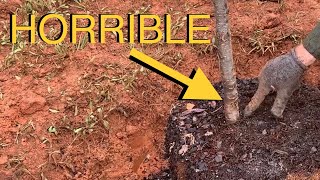
When we plant a tree for the city of Fresno, drilling or some large excavation is required and a waiting period of 20 days is required. Sounds a little severe to have to wait 20 days to plant the tree, but that reflects the seriousness of the problem. Settling is when the tree sinks below the grade, almost like dropping into a hole.
Then whenever it rains or even when you water, water collects around the base of the trunk. And there's nothing worse for a tree than water collecting around it. When you're planting your own trees and plants, here's how you avoid settling.
First of all, you don't necessarily need to dig it deep. You could just dig it the proper depth and not subject to settling on the bottom. If you're certain you don't have hard compacted soil, but think you have hard or compacted soil, then you need to dig down and get past that layer of compaction.
Then you have to settle it completely. Regardless of the depth, you want to dig the hole very very wide. So you want to go two to 2 and 1/2 times the width of the root ball.
The other important thing which is not well understood at all is the whole preparation or the back fill that you use. All soil scientists and arborists agree that it isn't beneficial to use a lot of bulk amendment in the back fill because we want trees to root out into their native soil. We usually recommend using the native soil so we don't have a difference in texture.
So you're not creating what is sometimes called the bathtub effect where you've got a hole that is a certain texture and a certain quality of soil and then you create an interface where that meets up with the native soil and the plants won't root out into that. The next one as I drive around [music] town I see all kinds of examples of this is very personal. In fact, frequently I clutch my heart and think I might not make it.
When you see the kinds of violations that are going on, I can see examples of this type of heading back inappropriately many, many times. That's improper pruning. If you have a big oak, beautiful oak tree, and you head it back, you really cause problems for the tree down the road because under the cuts sprouts all kinds of new growth.
And that new growth, if it's in the middle of a big branch, is very weakly attached. And so now it becomes a dangerous tree. The proper way to prune most of these trees is with thinning cuts, not with heading back cuts.
And with thinning cuts, you allow the tree to display its beauty. If you're doing heading back cuts, you're creating trees that all look alike. They just look like a big blob on top of a trunk.
they won't display their natural form and they'll we'll be weak. We're doing a disservice to the trees and a disservice to us. So, we think the best way to avoid making mistakes is to hit the like button and subscribe to our channel.
I can't count how many times I've seen broken pipes, damaged roofs, damaged foundations from poor tree choices. Typical lots here and around the country are small these days. And small lots don't have a lot of opportunity for planting that you might desire.
And if you plant a large tree with big roots and a big canopy, you limit your ability to have other plantings because that tree dominates to where it's pretty much the only thing you can grow. For small lots, we like to plant small trees, what we call patio scale trees, so that we can do other types of planting and create gardens that aren't onedimensional with one massive tree that's causing all kinds of problems. Chip.
Hey, Mr Chip. Hey, come on over. Chip arrived and just in time because this is one of the problems that he really is sensitive to.
You go to the nursery and [music] you see all kind of plants you like or you look online and you see all kinds of plants and you decide to use them all in your yard and the result is a headache. This is a mistake we see quite a bit where there is a lack of continuity in the planting and a lack of understanding that the white plants really look the most fantastic is when they are masked. Because if it has a beautiful flower and you see one of them, think of the impact if you see five of them altogether.
We would encourage you to try to heir on the side of simplicity rather than heir on the side of giving everyone a headache that drives by your house. Go ahead, Chip. He's annoyed by even the discussion of it.
People constantly complain about too many weeds, erosion, having to water too much. But there's one simple thing that you can do that solves all of these problems. Almost all gardens that have been in a while suffer from a lack of top dressing mulch.
It's really important. It's really good for soil. It's really good for plants, really good for weed control.
The constant replenishing of it, you can actually train your yard to not have weeds if you're generous with top dressing mulch. And yet, if you tour around your city and look at existing gardens, almost all of them no longer have top dressing mulch because it's blown away or washed away. But it's something that is really important for the ongoing health of the garden and the ongoing minimization of maintenance.
Another added bonus, if you pick the right one, it looks really nice. It looks better than your soil. So, it makes it look like you have a rich soil.
Having an irrigation [music] system to water your plants and lawn can be a huge timesaver. But it needs to be designed and installed properly because if you don't, your lawn could end up looking like this. Especially hot climates like ours.
I see I would say every day in the summer problems with the irrigation system. The coverage isn't sufficient. So we're after head-to-head coverage.
We don't have head-to-head coverage. So you have dry spots. It's usually the reason behind excessive weeds, disease, poor growth on the plants.
There's one other irrigation mistake I see a lot of. People don't realize what they're doing wrong because many plants are thriving and some are dying. It might be tempting to just throw water everywhere if you're trying to irrigate and because that is inexpensive and it's the simplest way.
But if you're growing different kinds of plants in different exposures, it really requires that you separate these areas. For instance, the east side should be watered differently than the south side and the north side should be different than the west side because these areas get different amounts of sun and require different amounts of water and different types of plants require different kinds of water and raised planters are different. A vegetable garden is different.
So all of this requires some separation. Separate the valves, have a controller that you can apply water on certain days for certain things. And that's really an area that many people aren't aware of when they start out with an irrigation system.
If [music] you fix this mistake, you can fundamentally transform your entire garden. This lesson I've learned from years of working in the industry and seeing this lesson over and over again. It's really predominant in new housing subdivisions because builders and developers hire landscape contractors to landscape yards and they get bids.
So they're usually interested in hiring the least expensive bid to do lots of landscapes for them. And so you see many many landscapes where they just drive a tractor and level everything, put saw right on top and put mulch right on top, but no consideration at all is given to soil preparation or putting life in the soil. And the soil is the most important part of that sod thriving and those plants thriving.
Lack of consideration for soil health affects all kinds of things including poor drainage and disease. Lots of weed growth, trees and plants not rooting out into the native soil, so they're subject to blowing over. And drainage can also be an issue.
Often times people think they're doing everything right. They get the right plants, they're planted in the ground properly, and they get the irrigation system operating, but they are overlooking one of the most important steps. Hearkening back to the last point, the way to avoid abuse of your soil is to prepare it properly.
Many existing landscapes that we go to, we can see no consideration at all was given to soil preparation. They almost always include fertilizer, but fertilizer is for plants. It's not for soil.
For soil, we need products that encourage life. The soil can be improved dramatically with products that increase complex life in the soil. So beneficial bacteria, fungi, prozzoa, good neatodes and that's really the essence of our product line.
So we would encourage you to use optimize and nourish bio and maximize and our penetrate liquid biotiller particularly good for heavy soil that doesn't drain well instead of our products. You could use really good quality compost or compost tea. [music] This style of planting has been around for a long time, and I see it discussed still to this day on the internet over and over again, but it causes problems for the house, and I think it's lent itself to kind of a tired and unattractive look.
Many, many landscapes that you see have plants that are usually too big for their spot right up next to the house, and that is called foundation planting. It started because foundations used to be ugly. Look at your house.
Is your house ugly? Do you need to cover it up? We don't need to cover the house.
We don't need to plant plants too close to the house that then invade on the windows, on the roof, make it hard to do common maintenance. Some small plantings might be okay, but we don't need to hide our foundations. Usually quite the opposite.
We want to show off the house. And the best way to show off the house, I think, is by creating useful spaces around it. bring the landscape out away from the house and make a lot of interesting things going on with plantings and uh and circulation and walkways.
Let's do away with foundation planting. Let's focus on creative spaces in our garden and plants farther out away from our house. There's no bigger problem than sites that suffer from this.
And I think it should be the first consideration when you look at your house and your site. you figure out what's the best way to drain this landscape away from the house. Drinage, in my opinion, is right up there.
One of the most important things. We don't want water sitting up near the house. I've seen lots of problems created by creative landscape designs a lot of times with with mounding or other changes in grade that doesn't adequately adequately address how the site drains between these changes in elevation between the mound and the house you trap water.
So these are areas that really need to be addressed right from the start. We want to grade this in a way that all the water runs off properly. It would be nice as part of our landscape plan to come up with a drainage plan that addresses that right from the start.
From there, we can be very creative with a landscape that we know uh drains effectively. By witnessing these mistakes over the years, I've learned the hard way. But hopefully by sharing them with you, your garden can thrive without these heartaches.
If you want to see one of the gardens we designed with all of these in mind, watch this video here.